



The car is equipped with three-point seat belts.
By adjusting the height of the front seat belt anchor points, you can achieve the best possible placement of the shoulder belt section.
Adjust the height of the front seat belts as follows.
Press the lock and slide the upper support of the belt up or down so that the shoulder branch passes through the middle of the shoulder and under no circumstances through the throat, then release the lock.
After adjustment, pull the belt to make sure the upper belt support is securely locked.
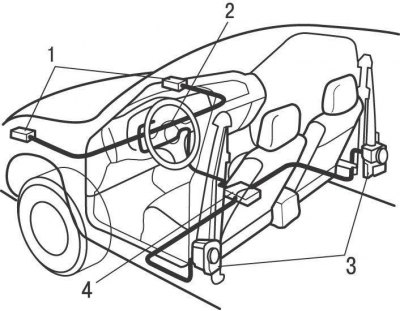
Figure 1.34. Elements of the passive safety system for front seat passengers: 1 – front impact sensor; 2 – Airbag system warning light; 3 – seat belt pretensioners; 4 – airbag sensor
The level of safety for the driver and passengers wearing seat belts is ensured by installing pretensioners 3 (figure 1.34) seat belts and pressure limiters.
In moderate to severe frontal collisions, pyrotechnic pretensioners instantly press the driver and passenger's bodies against the seatbacks.
The pyrotechnic seat belt pretensioner system is activated only when the ignition is on. Pressure limiters reduce the force of the seat belts on the driver and front passenger's bodies in the event of a collision.
The activation of the pretensioners is controlled by the 4 airbag sensor.
Warning! Do not remove or repair seat belt pretensioners, airbag sensors, or electrical wiring. Such actions may cause them to operate unexpectedly or cause the system to malfunction, which may result in serious injury.
The seat belt pretensioner system includes a control indicator that serves to inform the driver that the system is operating. This indicator comes on when the ignition key is turned to the "ACC" or "ON" position and goes out after 6 seconds. This means the front seat belt pretensioners are working properly. If any of the following conditions occur, please contact a Toyota service center as soon as possible.
1. The indicator does not light up when the ignition key is turned to the "ACC" or "ON" position and continues to light.
2. The indicator lights up or starts flashing while driving.
3. If any of the front seat belts does not retract into the inertia reel or cannot be pulled out due to a malfunction or deployment of the pretensioners.
4. Damage to the front seat belt pretensioners or areas near them.
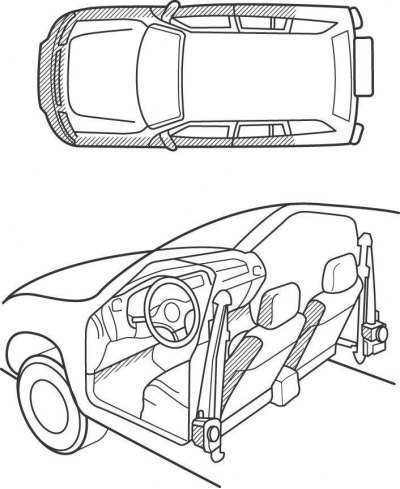
Figure 1.35. Body deformation zones that should trigger the seat belt pretensioner system
5. A traffic accident involving the front of the vehicle (shaded area shown in the figure1.35), but did not cause the pretensioners to activate.
6. Scratches, cracks or other damage to the seat belt pretensioners.
Safety belt with two attachment points
To check and adjust the belt, sit up straight and move back in the seat as far as possible. To fasten the belt, insert its plate into the buckle. When you lock the plate into the lock, you will hear a click.
If the belt is not long enough for you, pull the belt plate at a right angle to it.
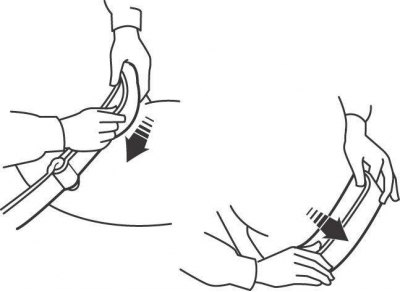
Figure 1.36. Using a two-point seat belt
Adjust the belt so that it fits snugly against your body (figure 1.36).
Place the belt as low as possible on your hips.
Select the excess length of the belt and adjust its position. Slide the waist belt as low as possible on your hips, then adjust its length.