Company Honda Company Ford Company Skoda Company Kia Company Mazda Company Mercedes Company Renault
English Русский
Български
Беларускі
Український
Српски
Hrvatski
Română
Polski
Slovenský
Magyar
Bookmark Articles Sitemap Contacts
ToyotaMan.ru


Camry Corolla Corona Carina Land Cruiser Highlander 4Runner RAV4 Others
Cruiser 100 (1998-2007) Cruiser 60/80 (1980-1997, petrol) Cruiser 70 (1985-1996, diesel)

Description of Toyota Land Cruiser and Toyota Prado cars

  • Main
  • Land Cruiser
Cruiser ↓ · Prado ↓

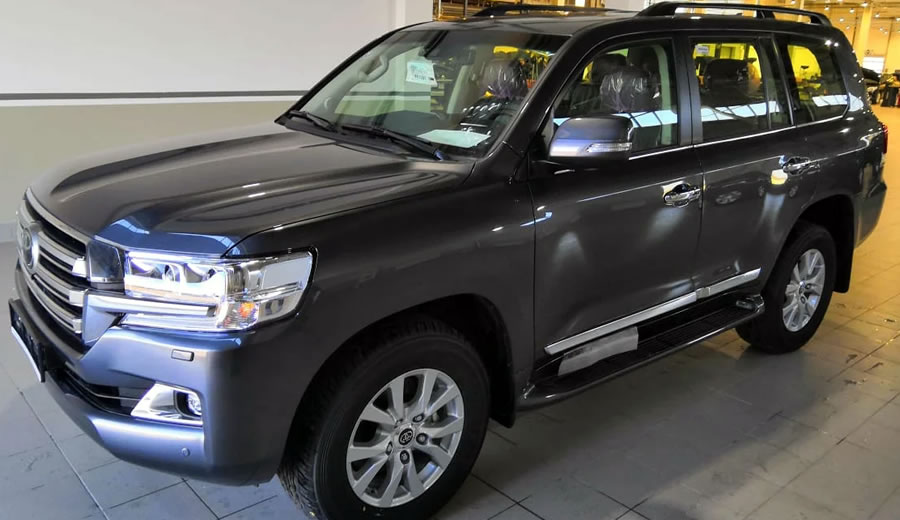
Land Cruiser 2018 year 
Land Cruiser 2018 year
Toyota Land Cruiser — a full-size all-wheel drive SUV from a Japanese corporation "Toyota Motor", the history of which dates back to 1951 and which are currently being produced. The body is mounted on a strong frame and was in the form of a station wagon, hardtop, convertible and chassis with a cabin. It has a more luxurious and expensive version called "Lexus LX". The word "land" is translated from English as "land, overland", and the word "cruiser" as "cruiser". The reliability of the Land Cruiser led to its enormous popularity and over 6.5 million cars were produced in total.

In 1941, during World War II, the Japanese captured an American Willys MB jeep on one of the islands, which served as a prototype for future Japanese SUVs. The military ordered Toyota engineers to start producing a similar one, but with a different appearance. The prototype "Model AK" was born. In 1942, the prototype "AK10" was developed, which was a half-ton truck used only by the army. Name "Land Cruiser" appeared in 1954.

The main competitors are considered to be cars Audi Q7, BMW X6, Chevrolet Tahoe, Infiniti QX80, Jeep Wrangler, Land Rover Discovery, Mercedes-Benz G-Class, Mitsubishi Pajero, Nissan Patrol, Porsche Cayenne, Range Rover and Volvo XC90.

Land Cruiser BJ and FJ (1951-1955)
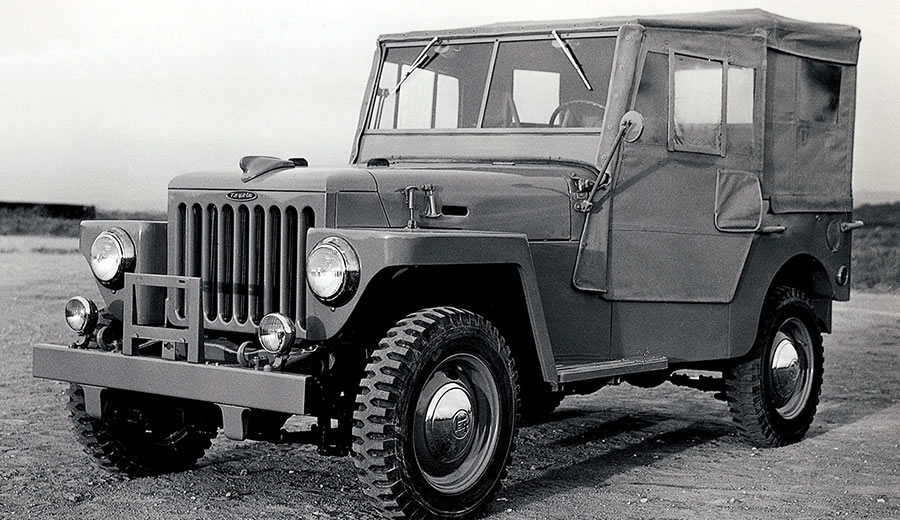


Land Cruiser BJ, 1951 year 
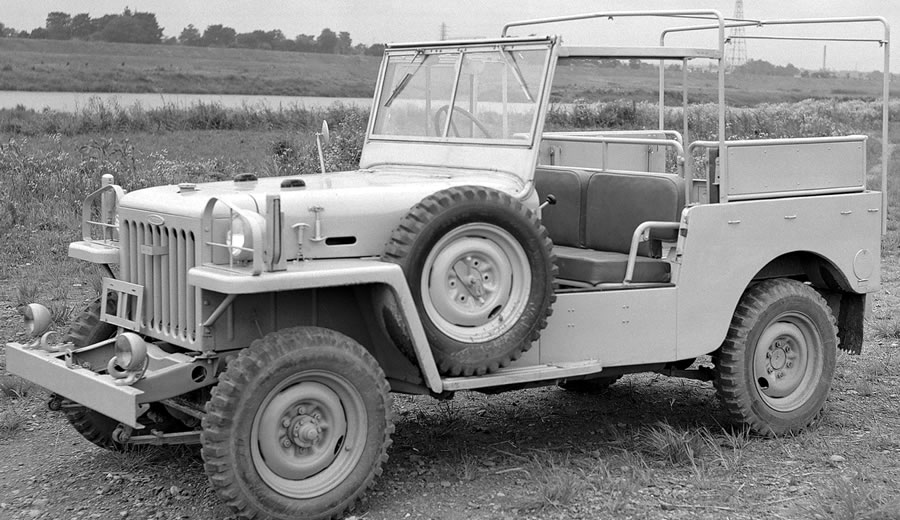
Land Cruiser BJ, 1951 year
A prototype was developed in January 1951 "Toyota "Jeep" BJ", which was completely different from the "AK10" prototype and had no common mechanical parts. The car had a two-door body with a soft roof, a front-mounted engine and rear-wheel drive with manually engaged all-wheel drive. The body length was 3793 mm, width 1575 mm, height 1900 mm, wheelbase 2400 mm and curb weight 1875 kg. Serial production began in 1953. In 1954, Toyota director Hanji Umehara came up with the name "Land Cruiser". At that time, there was an English competitor in the niche of these SUVs "Land Rover", so they came up with a name for the car that sounded no less dignified. The car was used mainly by the police, foresters and farmers.

Land Cruiser BJ, без крыши 
Land Cruiser BJ, без крыши
The engine was initially a petrol six-cylinder in-line 3.4-liter engine (3386 cm³, Type B, OHV) with a capacity of 84 hp, allowing a maximum speed of 80 km/h. In 1954, a six-cylinder in-line engine with a volume of 3.9 liters appeared (3878 cm³, Type F, OHV) with a capacity of 125 hp. Both engines were four-stroke carburetor with two valves per cylinder. The gearbox was a three-speed manual, there was no downshift for difficult road conditions.

Land Cruiser J20 and J30 (1955-1960)


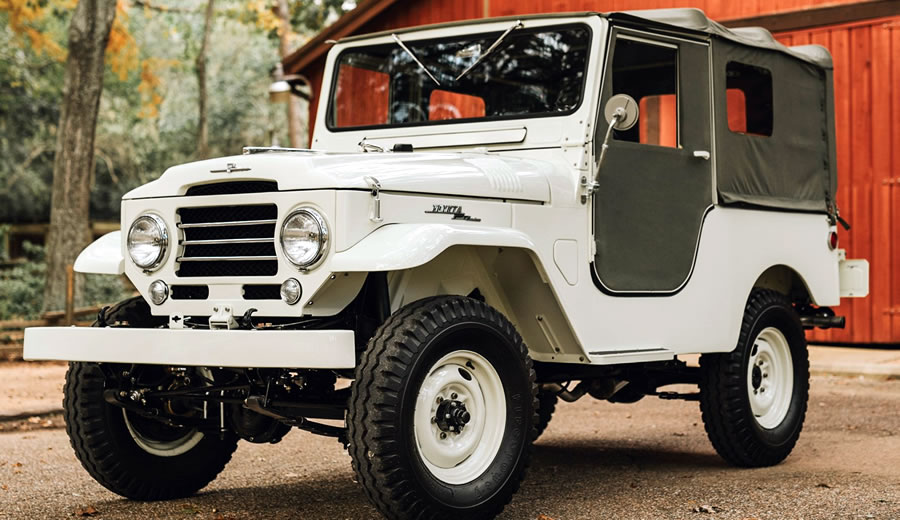
Land Cruiser J20, 1955 year 
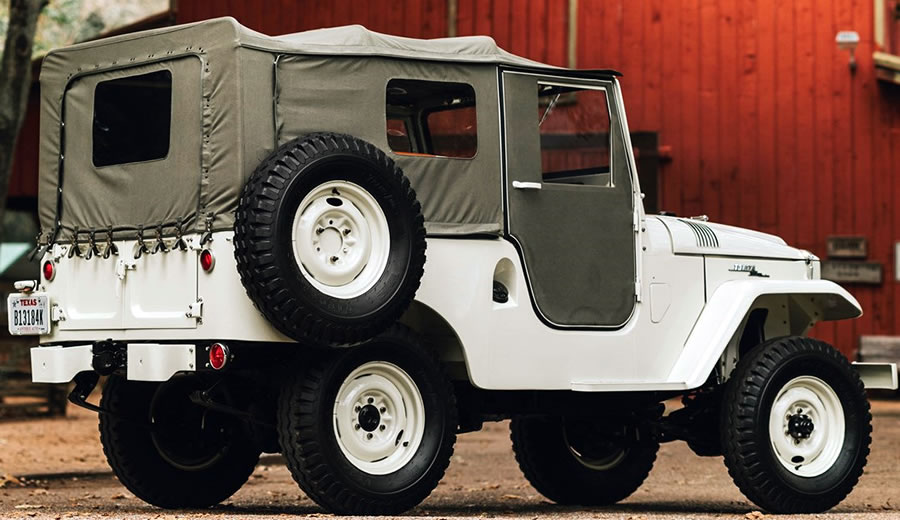
Land Cruiser J20, 1955 year
In 1955, an updated generation with the code "J20" appeared. The car was aimed at use by ordinary people and was exported to other countries for the first time. In Brazil, it was called "Toyota Bandeirante". The body design became more elegant, the improved suspension and interior increased the comfort of the ride. There were four body style options - a two-door soft-top, a two-door hard-top, a two-door pickup truck and a five-door station wagon. The length of the two-door car was 3838 mm, the width was 1665 mm, the height was 1900 mm, the wheelbase was 2285 and the curb weight was 1425 kg. Production was carried out in Japan, and since 1958 production began in Brazil.

Land Cruiser J20, view behind 
Land Cruiser J20, view behind
The engine was located in the front, was a six-cylinder in-line engine with a volume of 3.4 liters (3386 cm³, Type B, OHV) with a capacity of 84 hp and 3.9 liters (3878 cm³, Type F, OHV) with a capacity of 133 hp. The maximum speed was 100 hp. The gearbox is mechanical, four-speed, rear-wheel drive with manually connected all-wheel drive. There is also no downshift.

In 1957, a five-door station wagon with the code "FJ35V" appeared, based on an extended 2650 mm base.

Land Cruiser J40 (1960-1984)
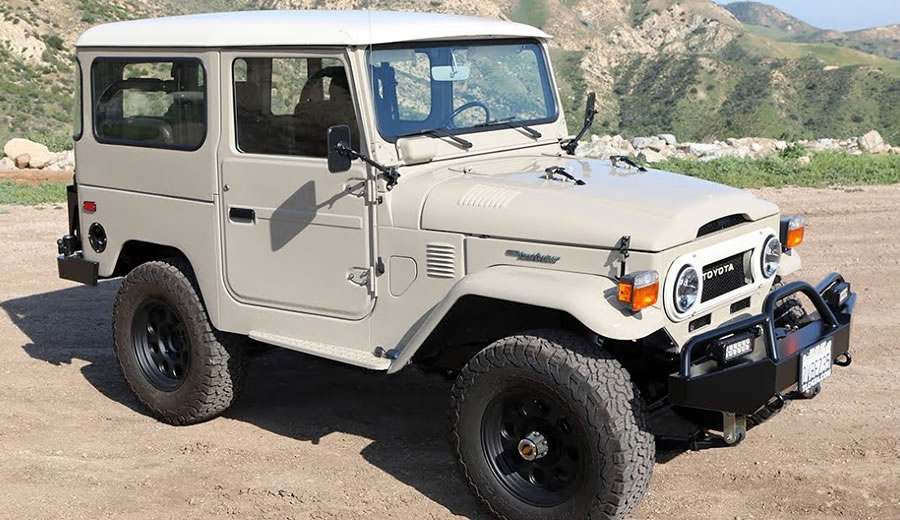


Land Cruiser J40, 1960 year 
Land Cruiser J40, 1960 year
The next generation of the frame SUV with the code "J40" appeared in 1960. The body was basically a two-door SUV with a length of 3840 mm, a width of 1665 mm, a height of 1950 mm and a curb weight of 1630 kg. There were also a two-door pickup and a four-door SUV. At first there were several wheelbase options - a short 2285 mm (J40/J41/J42), average 2430 mm (J43/J44/J46) and a long 2650 mm (J45/J47). In 1963, a longer 2950 mm wheelbase (FJ45-B) was added, used for the pickup and chassis cab. In 1967, the five-door SUV body with a 2650 mm wheelbase was replaced by a station wagon (FJ55). In Brazil, the car was called "Toyota Bandeirante" and was produced with engines from "Mercedes-Benz", and in Venezuela it was sold under the name "Toyota Macho".

The petrol engines were six-cylinder in-line units with a capacity of 3.9 litres (3878 cm³, F, I6, 115 hp) and 4.2 liters (4230 cm³, 2F, I6, 135 hp). Diesel engines appeared for the first time and during the 24-year production period the following models were installed:
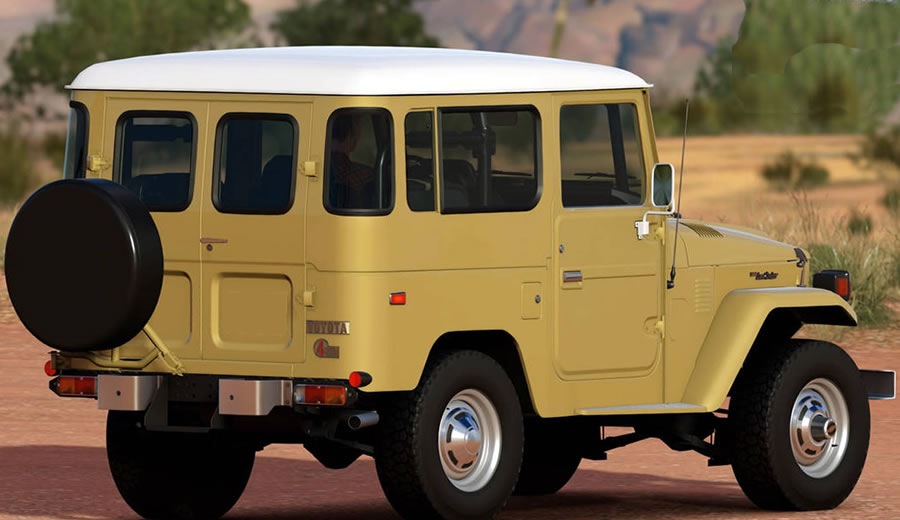
Land Cruiser J40, view behind 
Land Cruiser J40, view behind
  • 3.0 liters (2977 cm³, B, I4, 1974-1984) with a capacity of 85 hp.
  • 3.2 liters (3168 cm³, 2B, I4, 1979-1981) with a capacity of 93 hp.
  • 3.4 liters (OM324, I4, 1979-1984) with a capacity of 78 hp.
  • 3.4 liters (3432 cm³, 3B, I4, 1961-1973) with a capacity of 98 hp.
  • 3.6 liters (3576 cm³, H, I6, 1972-1980) with a capacity of 90 hp.
  • 3.7 liters (3661 cm³, 14B, I4, 1994-2001) with a capacity of 96 hp.
  • 3.8 liters (OM314, I4, 1973-1989) with a capacity of 85 hp.
  • 4.0 liters (OM364, I4, 1989-1994) with a capacity of 90 hp.
  • 4.0 liters (3980 cm³, 2H, I6, 1980–1984) with 105 hp.

A four-speed manual gearbox was installed.

Over the course of many years of production of this model, many improvements and modifications were introduced into the design.

Land Cruiser J50 (1967-1980)
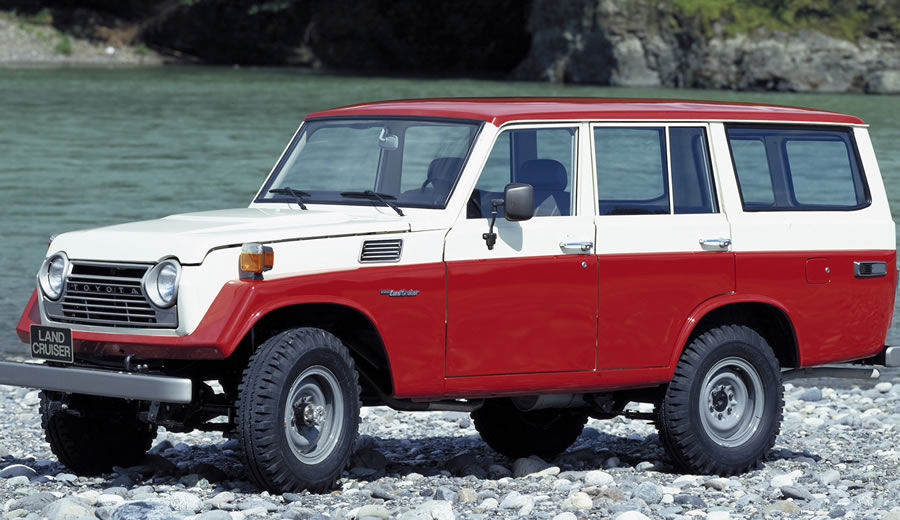


Land Cruiser J50, 1967 year 
Land Cruiser J50, 1967 year
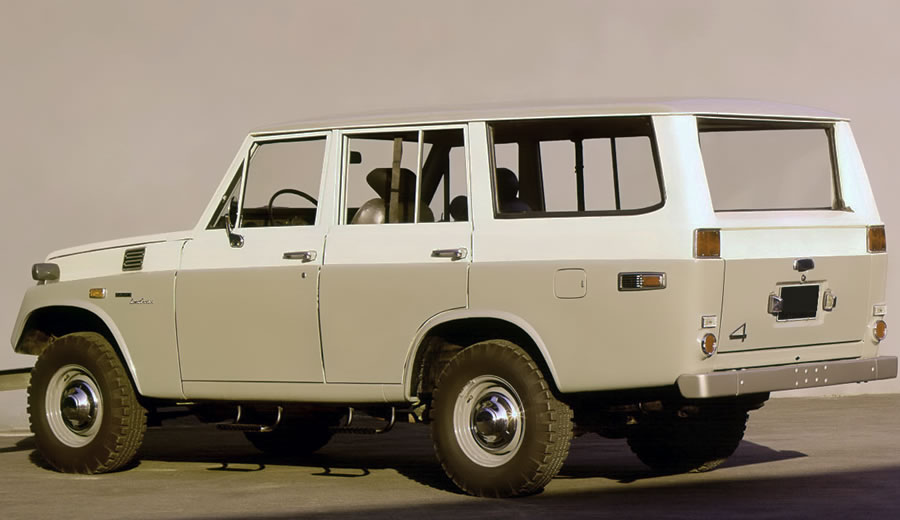
This generation, called "FJ55G" and "FJ55V", is the first four-door station wagon and is the forerunner of modern comfort-oriented Land Cruisers. The wheelbase was 2700 mm, length 4675 mm, width 1735 mm, height 1865 mm and unladen weight 1735-1865 kg. Production was carried out only in Japan.

The engines were petrol six-cylinder in-line engines with a capacity of 3.9 liters (3878 cm³, F, OHV) with a capacity of 145 hp, and since 1975 it has been replaced by a 4.2-liter engine (4230 cm³, 2F) 140 hp. Four-speed manual transmission, all-wheel drive. Maximum speed was 135 km/h.
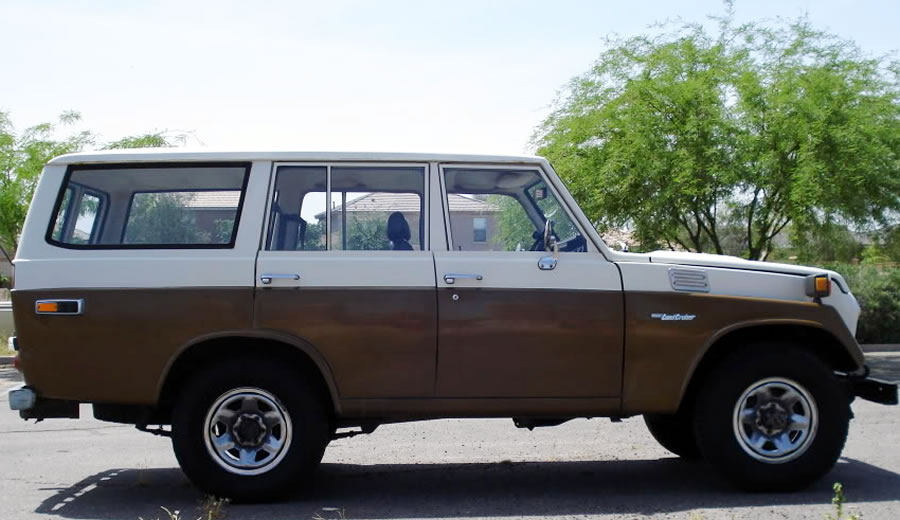
Land Cruiser J50, view side 
Land Cruiser J50, view side
Land Cruiser J50, view behind 
Land Cruiser J50, view behind
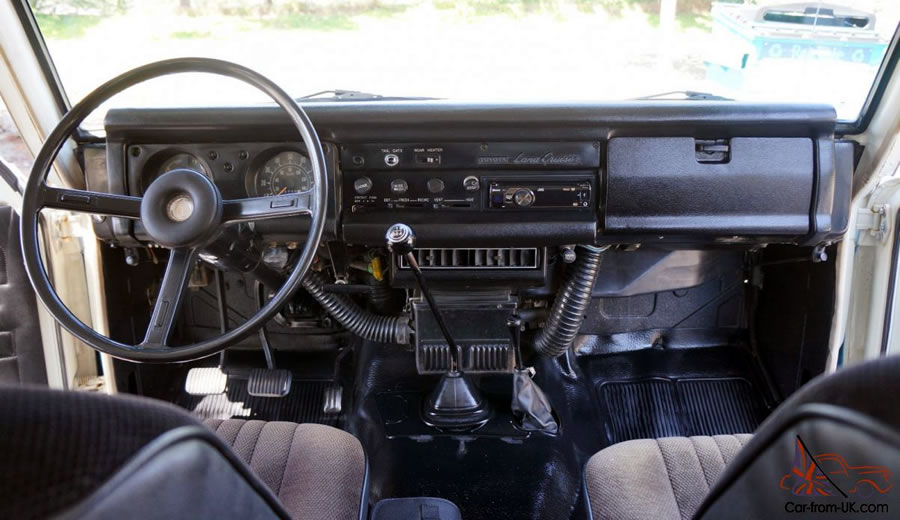
Land Cruiser J50, interior 
Land Cruiser J50, interior

Land Cruiser J60 (1980-1989)


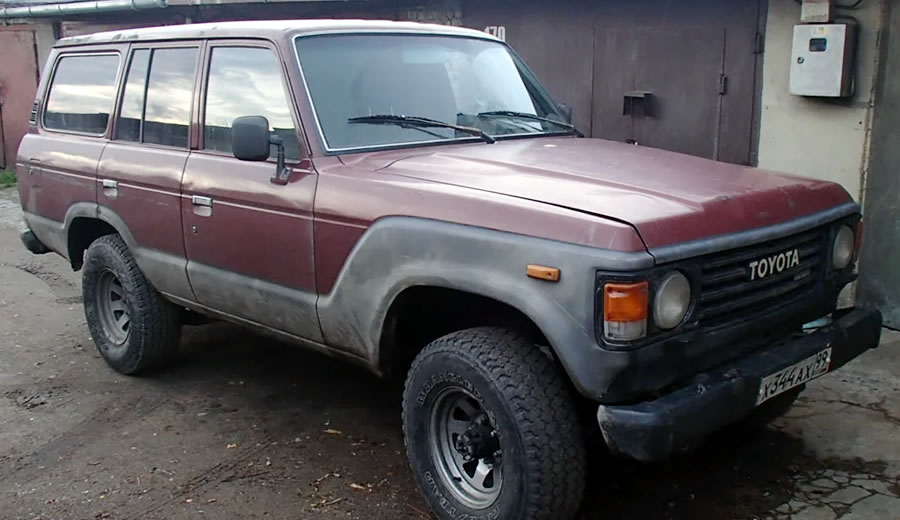
Land Cruiser J60, 1980 year 
Land Cruiser J60, 1980 year
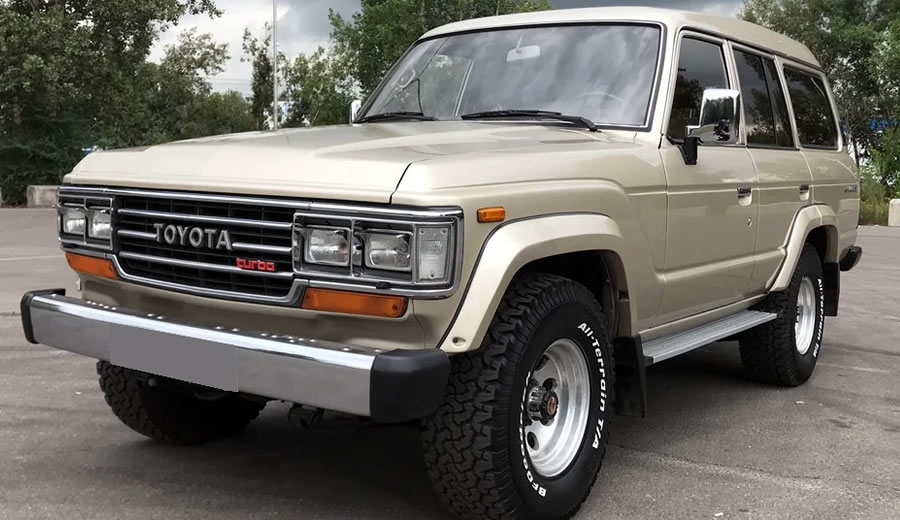
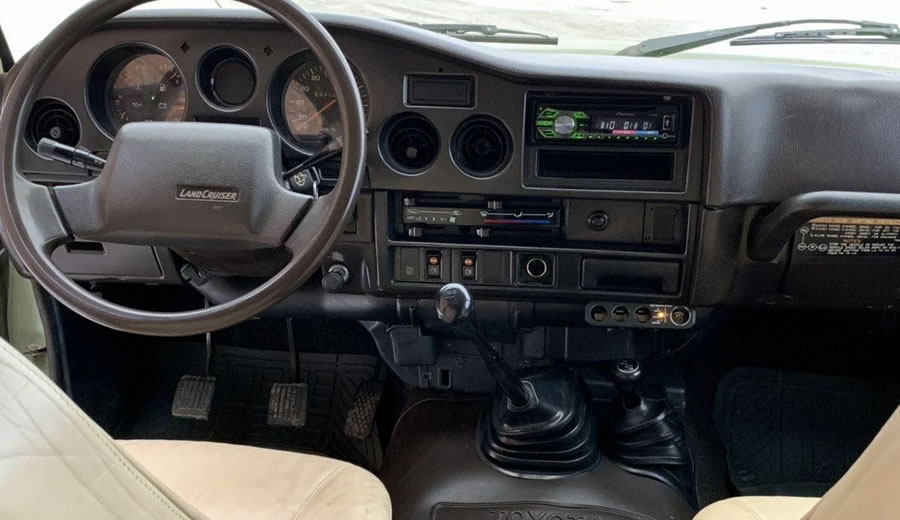
In 1980, the new Land Cruiser of the "J60" series was released, which continued the comfortable line of sports SUVs that continued to gain popularity. The body was a four-door station wagon with a wheelbase of 2730 mm, a length of 4675 mm, a width of 1800 mm, a height of 1750 mm and a curb weight of 1945 kg. The interior was improved, air conditioning, heated rear seats and other comfort options were added. Production took place in Japan and Venezuela, where the car was called "Toyota Samurai".

The petrol engines were only six-cylinder in-line engines with a capacity of 4.0 litres (3955 cm³, 3F, I6, 155 hp), 4.0 liters (3955 cm³, 3F-E, I6, injection, 155 hp) and 4.2 liters (4230 cm³, 2F, I6, 135 hp). There were also three models of 3.4-liter diesel engines (3432 cm³, 3B, I4, 98 hp), 4.0 liters (3980 cm³, 2H, I6, 107 hp) and 4.0 liters (3980 cm³, 12H-T, I6, turbocharged, 134 hp). The gearbox was a mechanical four-speed one "H41F" / "H42F" and a five-speed "H55F", and for the first time a four-speed automatic "A440F" was installed.
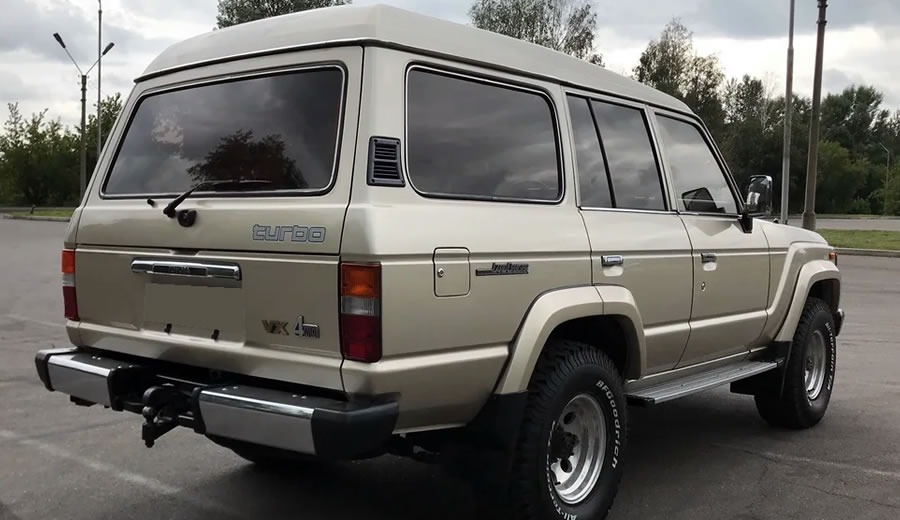
Land Cruiser J60, view behind 
Land Cruiser J60, view behind
Land Cruiser J60, restyling 
Land Cruiser J60, restyling
Land Cruiser J60, interior 
Land Cruiser J60, interior


Land Cruiser J70 (1984-present)


Land Cruiser J70, 1990 year 
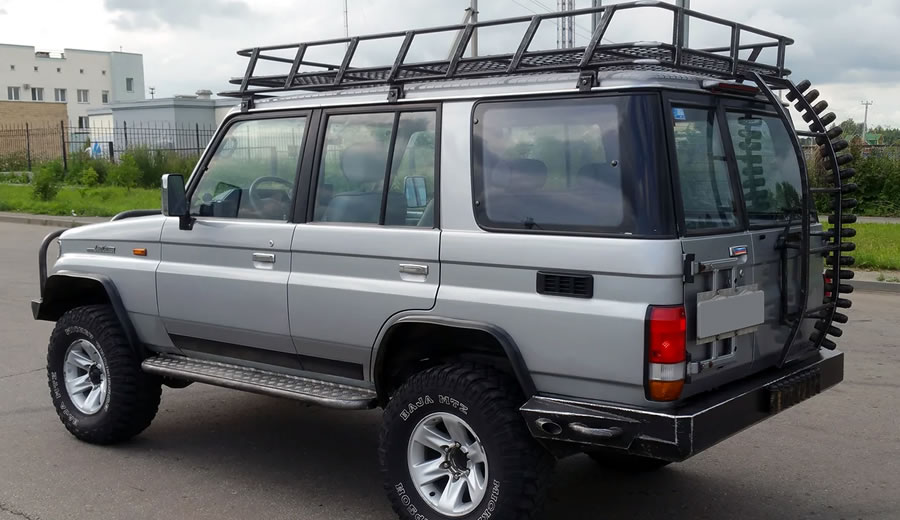
Land Cruiser J70, 1990 year
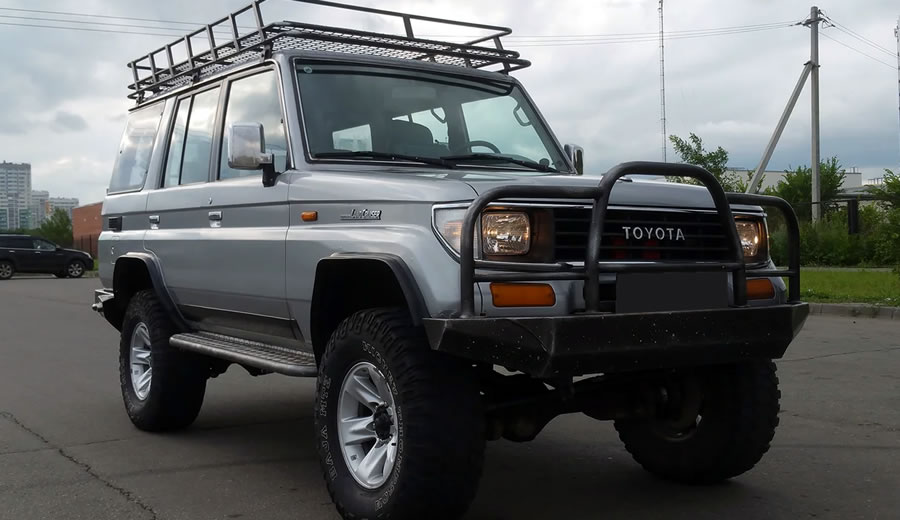
"Land Cruiser" the "J70" series replaced the "J40", which had been produced for over 20 years, and is an SUV focused not on comfort, like the "J50", but on off-roading. It is still being produced after several updates. The body was presented with two doors: a pickup ("75/77", wheelbase 3180 mm, length 5075 mm, width 1690 mm, height 1970 mm), hardtop and awning roof; three-door SUV ("71/71", wheelbase 2310 mm, length 4070 mm, width 1770 mm, height 1935 mm) and five-door SUV ("73/74", wheelbase 2980 mm, length 4995 mm, width 1870 mm, height 2070 mm). The exterior design has changed slightly, but technically the car has advanced significantly. Assembly was carried out in Japan, Venezuela and Portugal. In some countries there were names "Bundera" or "Land Cruiser II", and then as "Prado", which was later used for a separate line of SUVs since 1997 "Land Cruiser Prado" series "J90" (see description below).

Land Cruiser J70, view behind 
Land Cruiser J70, view behind
Throughout the long history of this series of petrol engines there have been four models with the following characteristics:
  • 2.4 liters (2366 cm³, 22R, I4, SOHC) with a capacity of 97 hp.
  • 4.0 liters (3955 cm³, 3F, I6, OHV) with a capacity of 155 hp.
  • 4.0 liters (3956 cm³, 1GR-FE, V6, DOHC) with a capacity of 236 hp.
  • 4.5 liters (4477 cm³, 1FZ-FE, I6, DOHC) with a capacity of 212 hp.

But mainly diesel engines were installed:
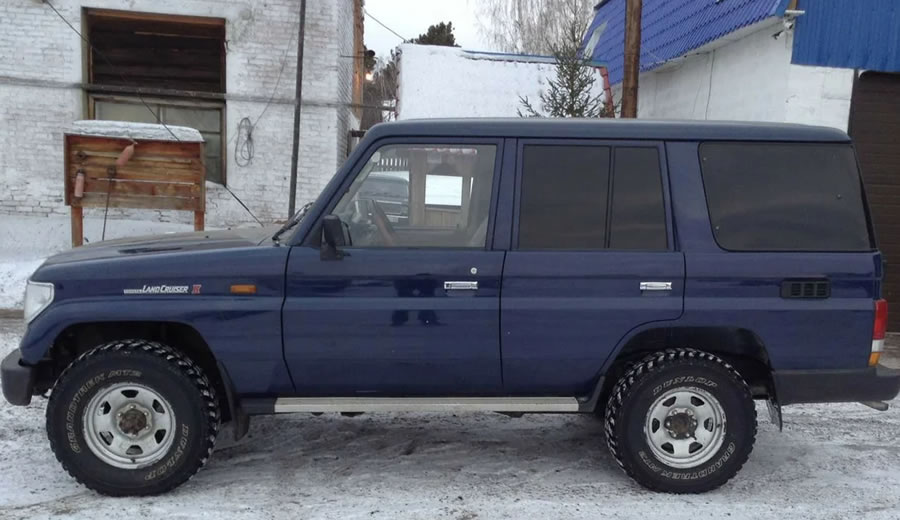
Land Cruiser J70, view side 
Land Cruiser J70, view side
  • 2.4 liters (2446 cm³, 2L, I4, SOHC) with a capacity of 86 hp.
  • 2.4 liters (2446 cm³, 2L-T, I4, SOHC, turbocharged) with a capacity of 90 hp.
  • 2.5 liters (2494 cm³, VM HR588, I5, OHV, turbocharged) with a capacity of 98 hp.
  • 3.0 liters (2982 cm³, 1KZ-T, I4, SOHC, turbocharged) with a capacity of 125 hp.
  • 3.4 liters (3432 cm³, 13B-T, I4, OHV, turbocharged) with a capacity of 120 hp.
  • 3.4 liters (3469 cm³, PZ, I5, SOHC) with a capacity of 113 hp.
  • 4.0 liters (3980 cm³, 2H, I6, OHV) with a capacity of 103 hp.
  • 4.2 liters (4164 cm³, 1HD-FTE, I6, SOHC, turbocharged) with a capacity of 164 hp.
  • 4.2 liters (4164 cm³, 1HZ, I6, SOHC) with a capacity of 129 hp.
  • 4.5 liters (4461 cm³, 1VD-FTV, V8, DOHC, turbocharged) with a capacity of 202 hp.
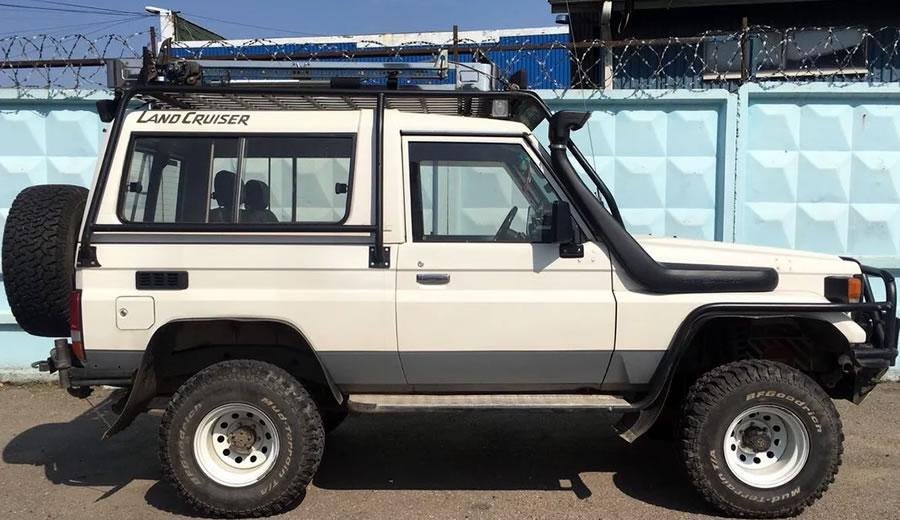
Land Cruiser J70, three-door 
Land Cruiser J70, three-door
The gearbox was either a five-speed manual or a four-speed automatic "A440F".

Over the more than 30-year history of this series, many changes have been made to the technical part, engines, interior and exterior.

Land Cruiser J80 (1990-2008)
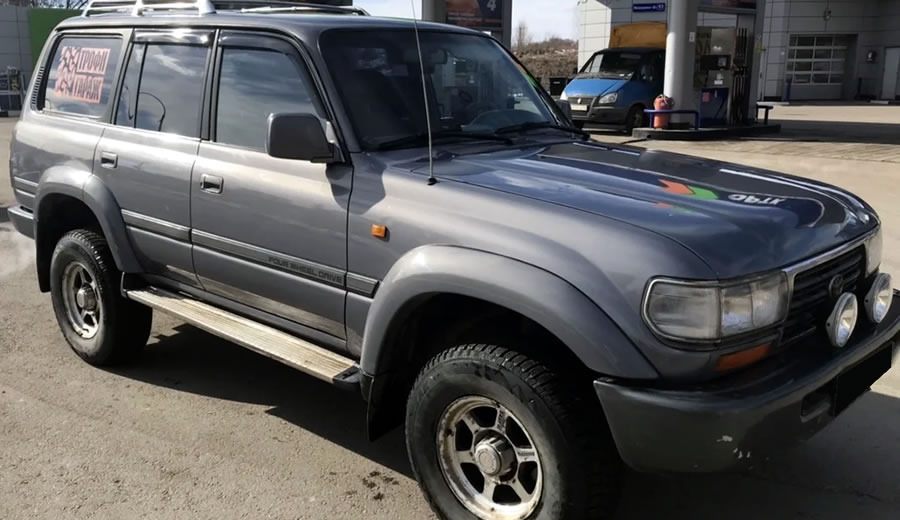


Land Cruiser J80, 1994 year 
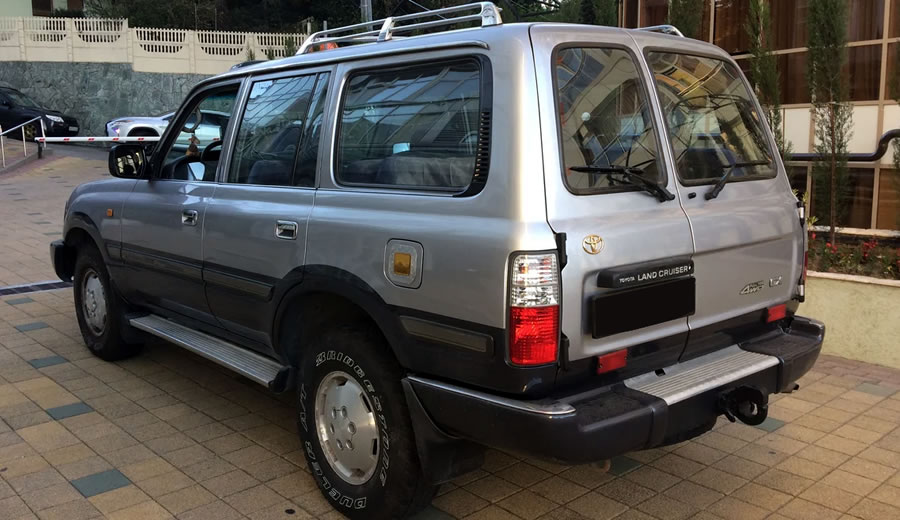
Land Cruiser J80, 1994 year
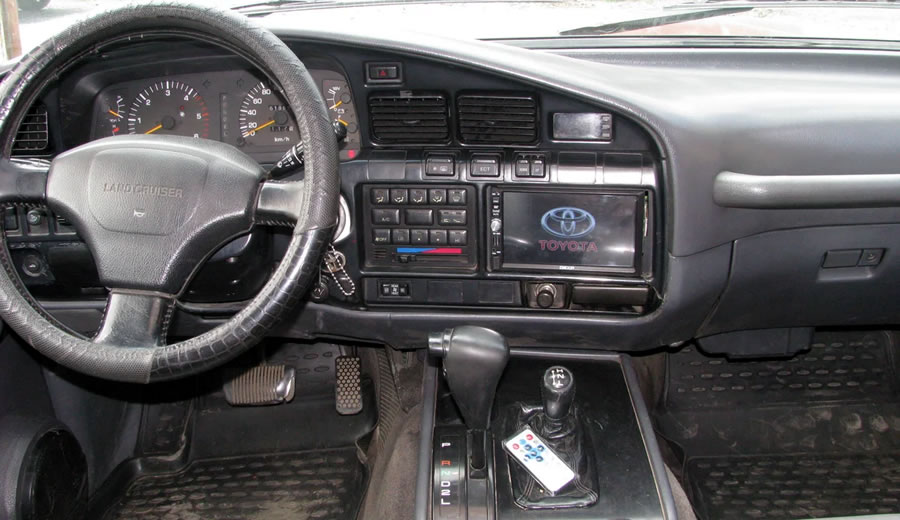
In October 1989, the Kruzak of the "J80" series was shown at the Tokyo Motor Show in Japan, and sales began in early 1990. The car replaced the "J60" - a comfortable series of SUVs. The body was a four-door station wagon, 4780-4820 mm long, 1830 mm wide (until 1992) and 1930 mm (since 1992), height 1785 (until 1992) and 1860 mm (since 1992), and also with a wheelbase of 2850 mm. The curb weight was 2084-2159 kg. The engine was located in the front longitudinally, the drive was full on all wheels. Since 1992, cars with anti-lock braking system had a viscous clutch, which transmitted no more than 30% of the torque to the non-slip axle. Air conditioning was installed in the basic configuration. Assembly was carried out in Venezuela and Japan.

Land Cruiser J80, view behind 
Land Cruiser J80, view behind
The petrol engines were in-line six-cylinder units with a capacity of 4.0 litres (3955 cm³, 3F-E, I6, OHV) with a capacity of 155 hp and 4.5 liters (4477 cm³, 1FZ-FE, I6, DOHC) with a capacity of 212 hp. There were also two models of diesel engines, both six-cylinder in-line engines with a volume of 4.2 liters (4164 cm³, 1HZ, I6, SOHC) with a capacity of 129 hp and 4.2 liters (4164 cm³, 1HD-T, I6, SOHC, turbocharged) with a capacity of 164 hp. The gearbox was four- and five-speed manual, as well as a four-speed automatic.

During the model's production, several improvements were made to the model. In December 1997, production of the "J80" in Japan was stopped and replaced by the next generation, and in Venezuela, production continued until 2008.
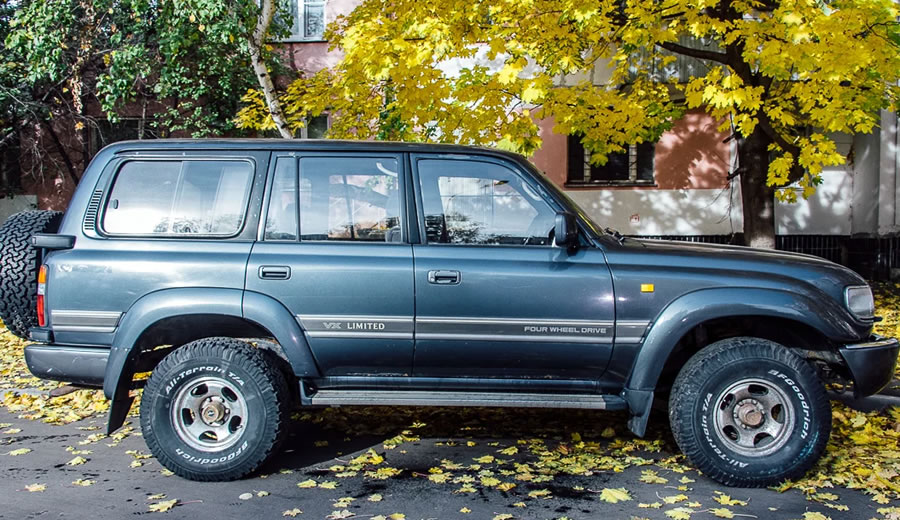
Land Cruiser J80, view side 
Land Cruiser J80, view side
Land Cruiser J80, interior 
Land Cruiser J80, interior
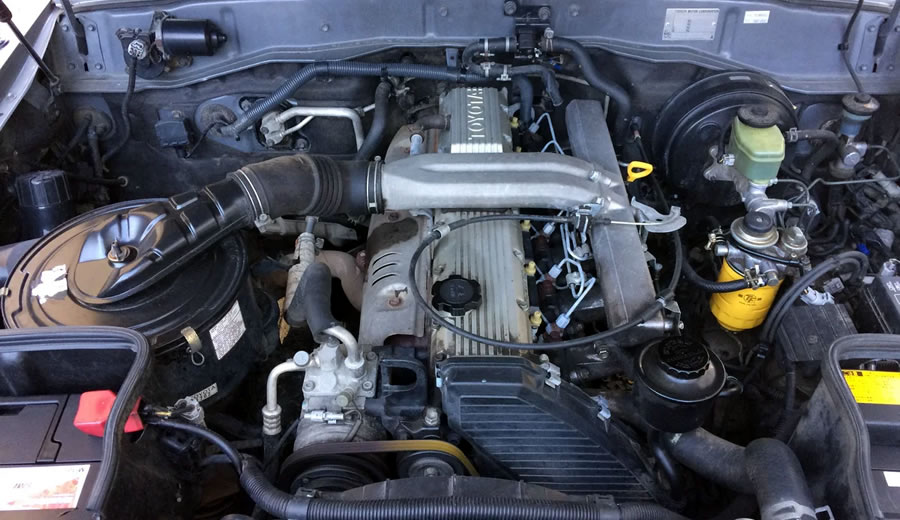
Land Cruiser J80, engine 
Land Cruiser J80, engine

Land Cruiser J100 (1998-2007)


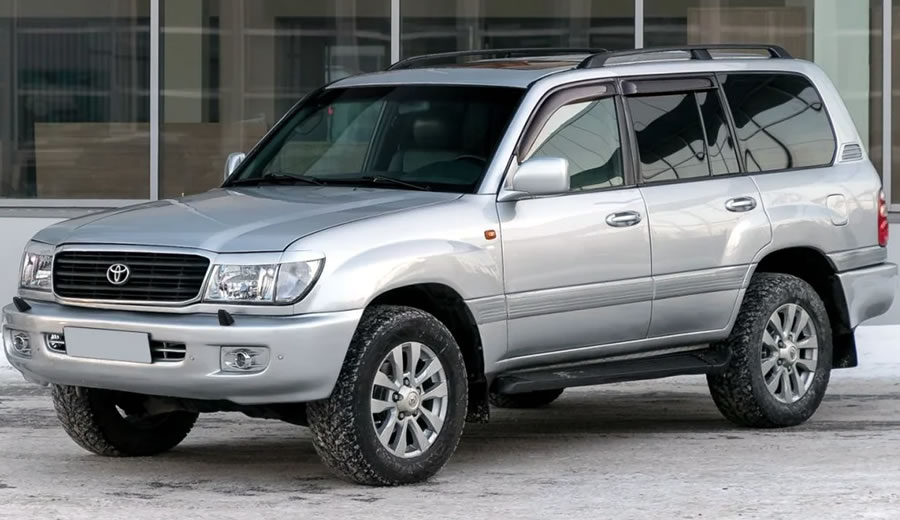
Land Cruiser J100, 2000 year 
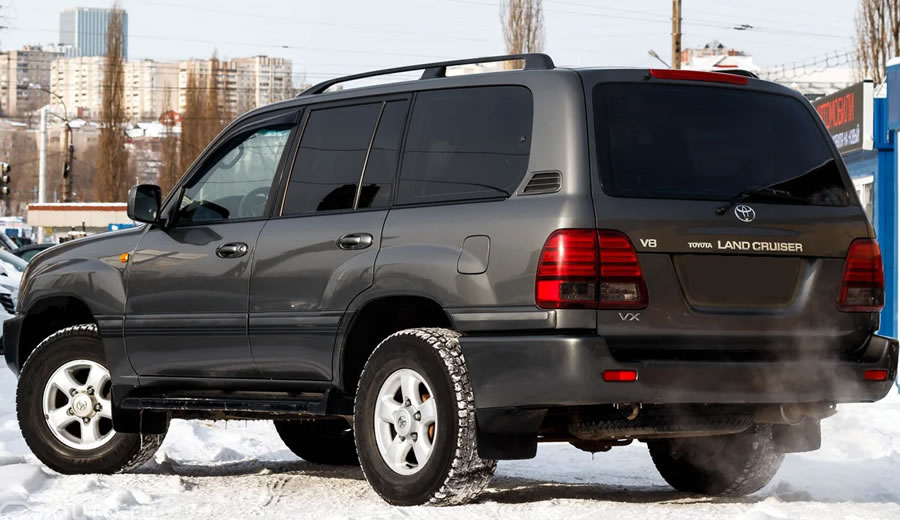
Land Cruiser J100, 2000 year
In October 1997, at the thirty-second Tokyo Motor Show, it was shown "Grand Cruiser" and in January 1998 the "J100" series appeared as a replacement for the "J80". There were two versions - "100" and "105". The "105" series carries the chassis and transmission from the "80" series with dependent spring front suspension and an in-line petrol engine. The "100" series with a new torsion bar independent suspension, with active height control and TEMS (electronically controlled shock absorbers), new transmission and V-shaped petrol engine. The design of both variants looks similar. The body is a four-door station wagon with a length of 4890 mm, a width of 1941 mm, a height of 1849 mm, a wheelbase of 2850 mm and a curb weight of 2320 kg. Assembly was carried out in China and Japan.

Land Cruiser J100, view behind 
Land Cruiser J100, view behind
The following petrol engines were installed: one six-cylinder in-line engine with a volume of 4.5 liters (4477 cm³, 1FZ-FE, I6) with a capacity of 212 hp and for the first time an eight-cylinder V-shaped 4.7-liter (4663 cm³, 2UZ-FE, V8) with a capacity of 271 hp. There were three models of diesel engines with the following parameters - all 4.2 liters (4164 cm³) - "1HZ" with a capacity of 129 hp, "1HD-T" with a turbocharger with a capacity of 164 hp and "1HD-FTE" with a turbocharger with a capacity of 164 hp. A five-speed manual gearbox was installed, as well as a four- or five-speed automatic (A343F, A440F).

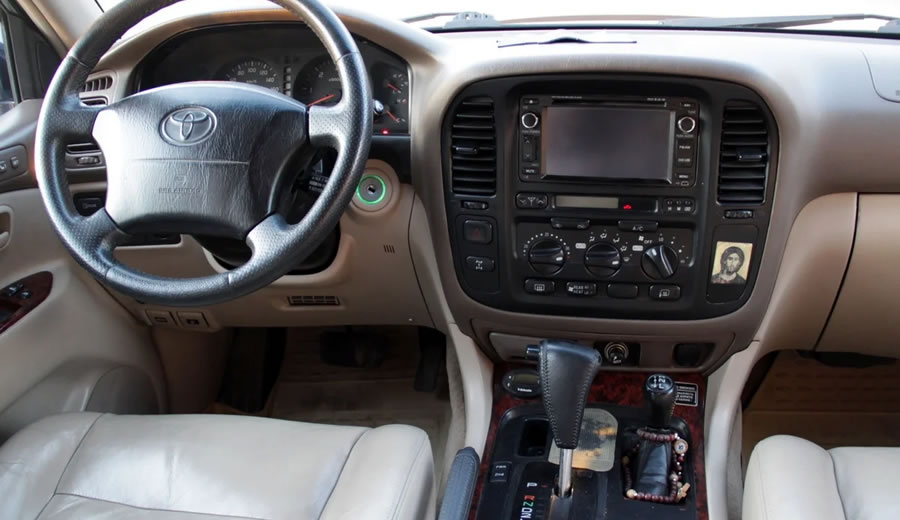
Land Cruiser J100, interior 
Land Cruiser J100, interior
In the 2003 model year, the car was restyled. The bumpers, radiator grille and interior were changed. An active night vision system appeared as an option "Night View", which was installed on cars for the first time in the world. In 2005, another update was carried out. The headlights, turn signals, taillights, radiator grille, and interior were changed.

The executive SUV has been sold on the domestic Japanese market since 1998 "Land Cruiser Cygnus", based on the "J100", but more "tricked out". In Russia, this car was sold under the brand "Lexus LX 470".

Land Cruiser J200 (2007-present)
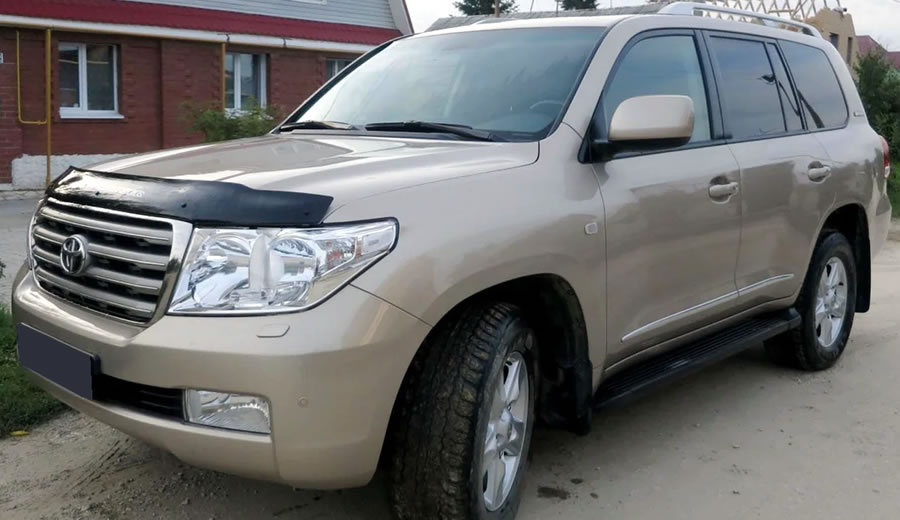


Land Cruiser J200, 2010 year 
Land Cruiser J200, 2010 year
In September 2007, the production of the next generation of the Land Cruiser SUV series "J200" was launched. Design development began in 2002, and prototype testing was conducted from 2004 to early 2007. The design and platform of the new car is the same as "Lexus LX 570". The frame is taken from a second-generation pickup truck "Toyota Tundra", which was shortened and strengthened. Larger brake discs and calipers were installed, and the front suspension was strengthened compared to its predecessor, the underside was protected by plates, the pillars and roof were strengthened to better protect passengers in a rollover. The body was a five-door station wagon, 4990 mm long, 1980 mm wide, 1970 mm high, with a wheelbase of 2850 mm and a curb weight of 2405-2740 kg. Assembly was carried out in Japan and China.

There were four models of petrol engines, all V-shaped six- or eight-cylinder with the following characteristics:
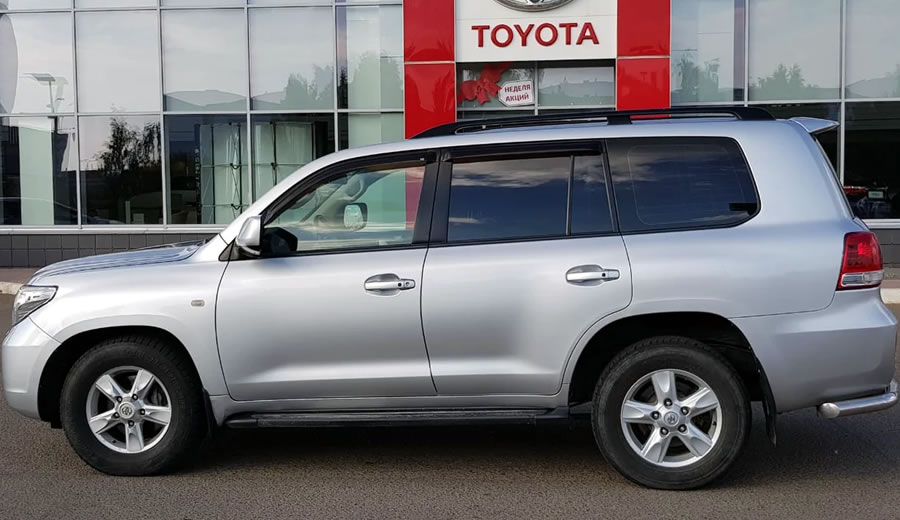
Land Cruiser J200, view side 
Land Cruiser J200, view side
  • 4.0 liters (3956 cm³, 1GR-FE V6) with a capacity of 236-285 hp.
  • 4.6 liters (4608 cm³, 1UR-FE V8) with a capacity of 318 hp.
  • 4.7 liters (4663 cm³, 2UZ-FE V8) with a capacity of 288 hp.
  • 5.7 liters (5663 cm³, 3UR-FE V8) with a capacity of 381 hp.

The diesel engine was a single V-8 with a capacity of 4.5 liters (4461 cm³, 1VD-FTV, V8, turbocharged) with a capacity of 202-268 hp. The gearbox was equipped with a five-, six- or eight-speed automatic, as well as a five-speed manual.
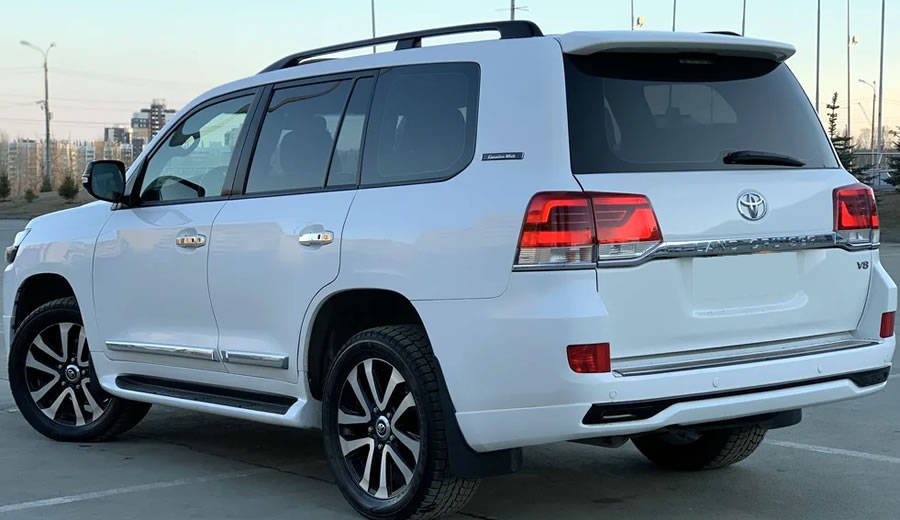
Land Cruiser J200, view behind 
Land Cruiser J200, view behind
Compared to its predecessor, the 200 series has been enhanced with many modern automotive options, features and systems such as smart entry, push button start/stop, climate control, 10 airbags, all-wheel drive control system, hill descent control, kinetic dynamic suspension (KDSS), rear view camera and more.

In 2011, the model was updated, which affected the improvement of engines. In August 2015, the second update was carried out, which affected the gearbox (eight-speed), the front of the car, the radiator grille, headlights with daytime running lights, bumpers and rear lights.
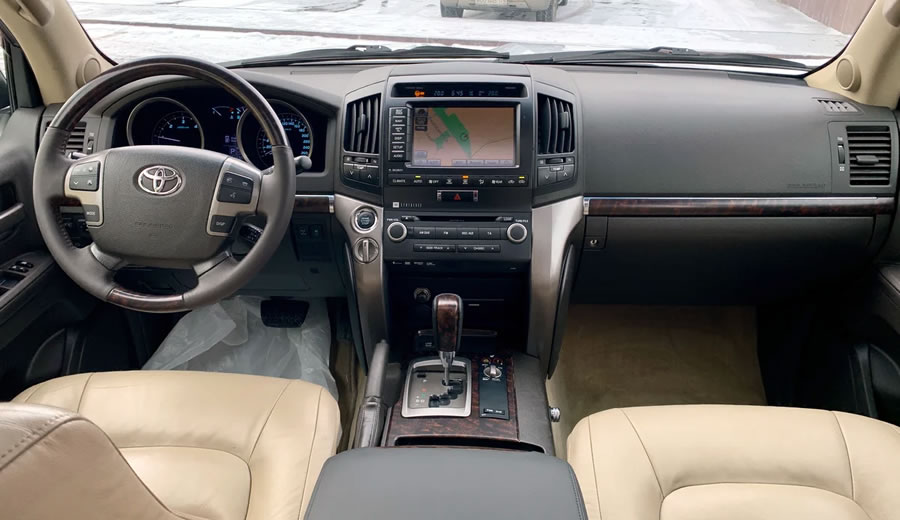
Land Cruiser J200, interior 
Land Cruiser J200, interior
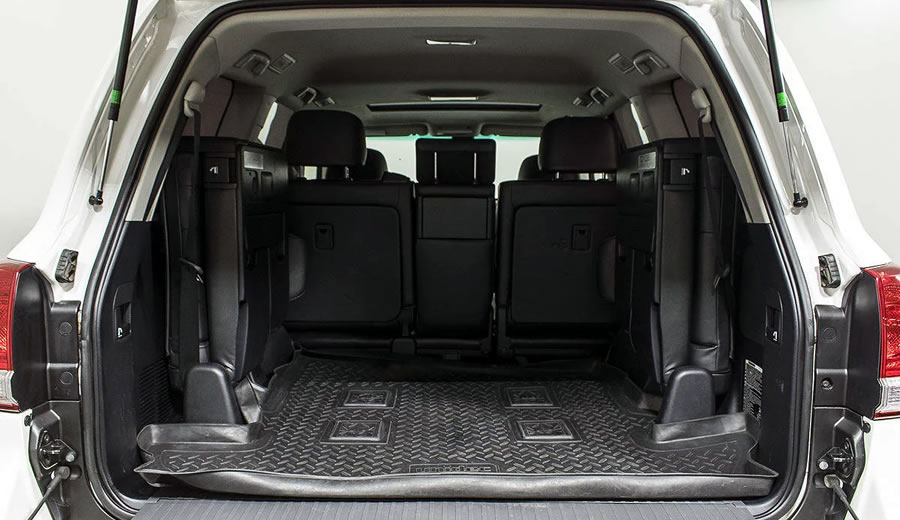
Land Cruiser J200, trunk 
Land Cruiser J200, trunk
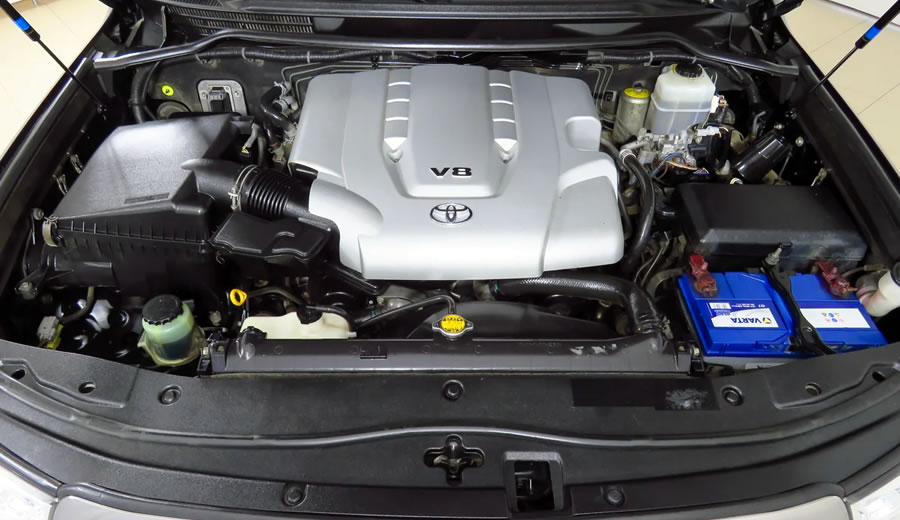
Land Cruiser J200, engine 
Land Cruiser J200, engine


Land Cruiser Prado (1990-present)


Prado 2018 year 
Prado 2018 year
Land Cruiser Prado — a full-size SUV with a load-bearing frame and all-wheel drive, produced from 1990 to the present by a Japanese company "Toyota Motor". In some countries it is called "Toyota Prado". It is a younger and smaller version of the classic "Land Cruiser". It has a two-speed transfer case, a rigid axle with differential at the rear, and independent suspension at the front. A more luxurious version is sold as the "Lexus GX". Currently shares a platform with "4Runner". The word "prado" is translated from Portuguese as "field or meadow".

The ancestor of the Prado is the "J70" series, produced since 1984, which in some countries was called that with a short body and a soft or hard top.

First generation (J70, 1990-1996)
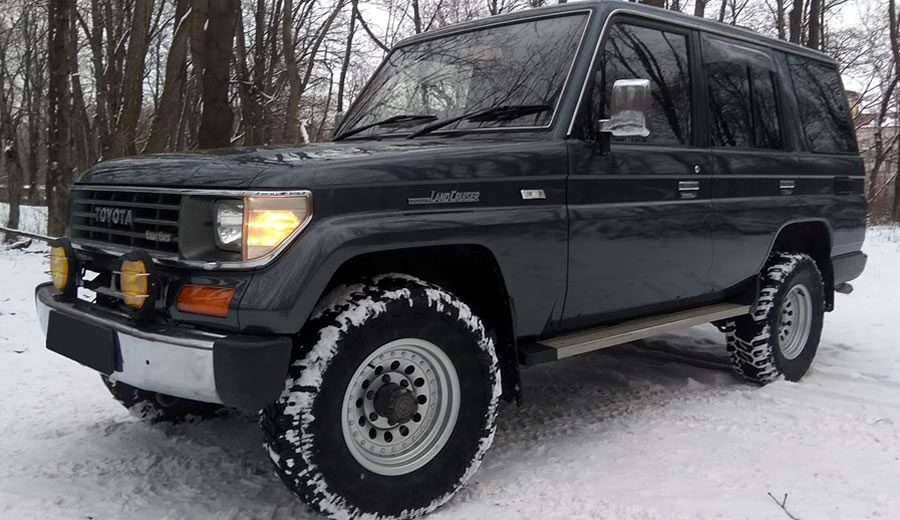


Prado J70, 1992 year 
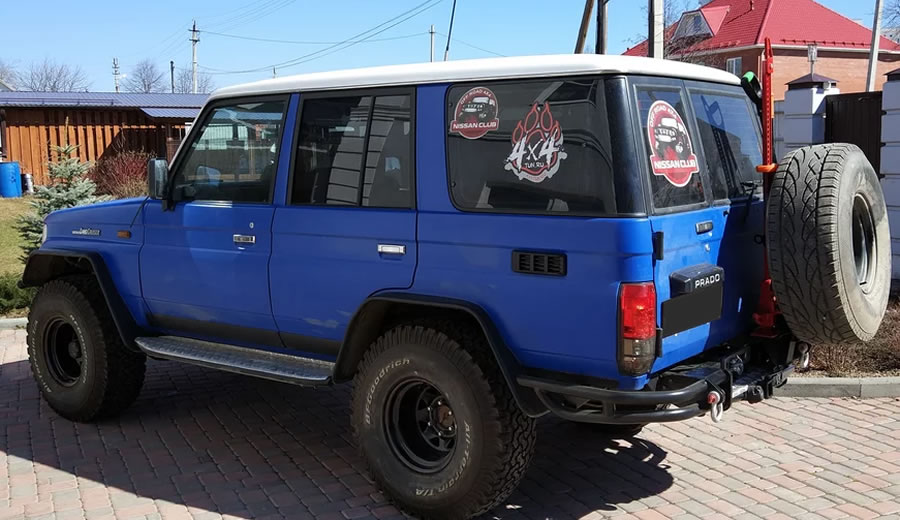
Prado J70, 1992 year
In April 1990, a new SUV of the "J70" series was presented under the name "Prado". The exterior design brought a new radiator grille, front wings, hood and headlights. The body is a three- or five-door station wagon with a length of 4585 mm, a width of 1690 mm, a height of 1885 mm, a wheelbase of 2730 mm and a curb weight of 1890 kg. The car was positioned as a comfortable car for the roads, as opposed to the classic one that was produced in parallel with it "Land Cruiser J70", which is positioned as an SUV.

Prado J70, view behind 
Prado J70, view behind
The petrol engines were four-cylinder in-line units with a capacity of 2.4 litres (2368 cm³, 22R-E) with a capacity of 105 hp and 2.7 liters (2693 cm³, 3RZ-FE) with a capacity of 150 hp. Diesel engines were also four-cylinder with a volume of 2.4 liters (2446 cm³, 2L-TE, turbocharged) 95 hp, 2.8 liters (2779 cm³, 3L) with a capacity of 90 hp and 3.0 liters (2982 cm³, 1KZ-TE, turbocharged) with a capacity of 130 hp. The transmission was either a four-speed automatic or a five-speed manual.

In 1993, it was updated, with minor changes to the instrument panel, suspension, brakes and interior trim.

Second generation (J90, 1996-2002)
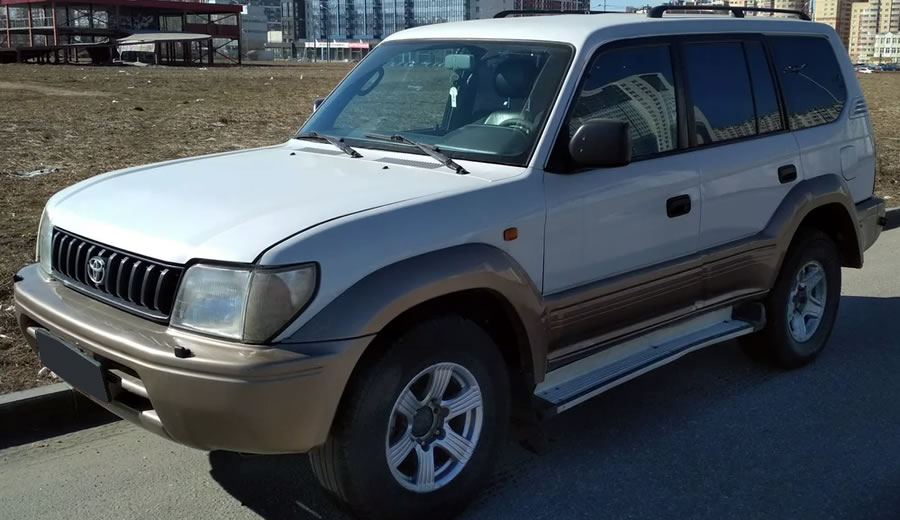


Prado J90, 1998 year 
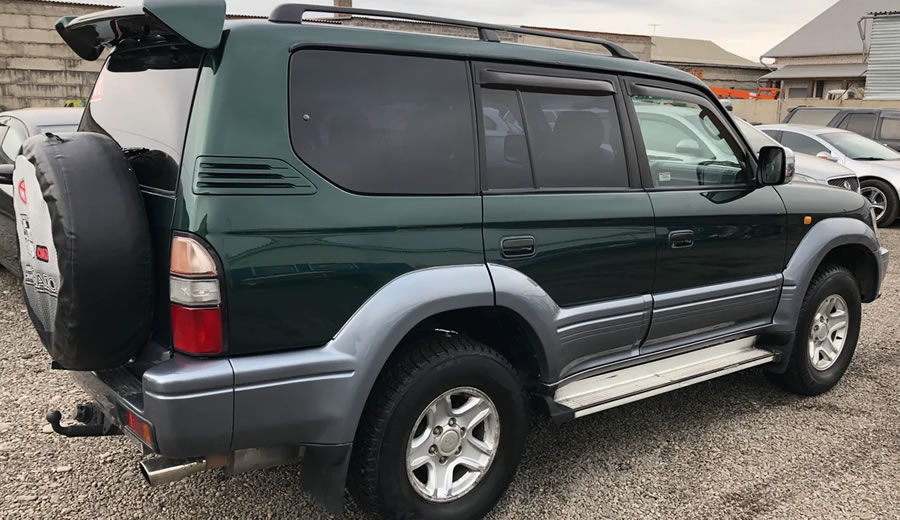
Prado J90, 1998 year
In May 1996, an independent series "J90" appeared, completely separating from the classic series "J70", which was produced until then. The body was a three-door station wagon with a short wheelbase (2370 mm) and a five-door station wagon with a long wheelbase (2675 mm). The length of the three-door was 4240 mm, the five-door 4675 mm, the width of all 1820 mm, the height 1880 mm and the curb weight of 1740-1960 kg. The front suspension became independent with double wishbones, which was also used on the Tacoma pickup truck and SUV "4Runner". Standard equipment included ABS and a monitor showing altimeter, thermometer and air pressure data. A TV display and radio were optional. There was a version with improved interior trim called "Challenger".

Prado J90, view behind 
Prado J90, view behind
There were two models of petrol engines, one four-cylinder with a capacity of 2.7 liters (2693 cm³, 3RZ-FE, DOHC, 150 hp) and a 3.4-liter V-6 (3378 cm³, 5VZ-FE, DOHC, 190 hp). Diesel engines were only four-cylinder, 2.8-liter (2779 cm³, 3L, SOHC, 90 hp), 3.0 liters (2986 cm³, 5L, SOHC, 97 hp) and 3.0 liters (2982 cm³, 1KZ-TE, SOHC, turbocharged, 145 hp). The gearbox was a five-speed manual or a four-speed automatic.

In mid-1999, the car was updated. Fog lights and an engine immobilizer were added.

Third generation (J120, 2002-2009)
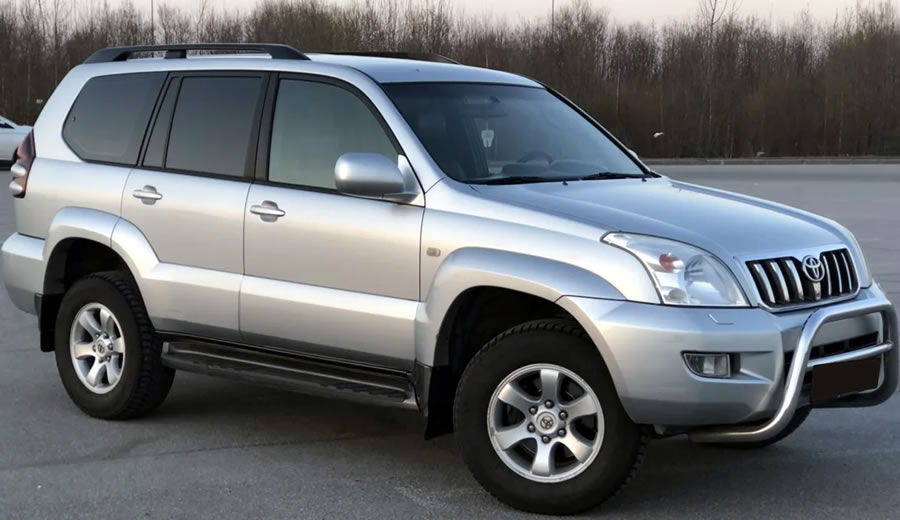


Prado J120, 2004 year 
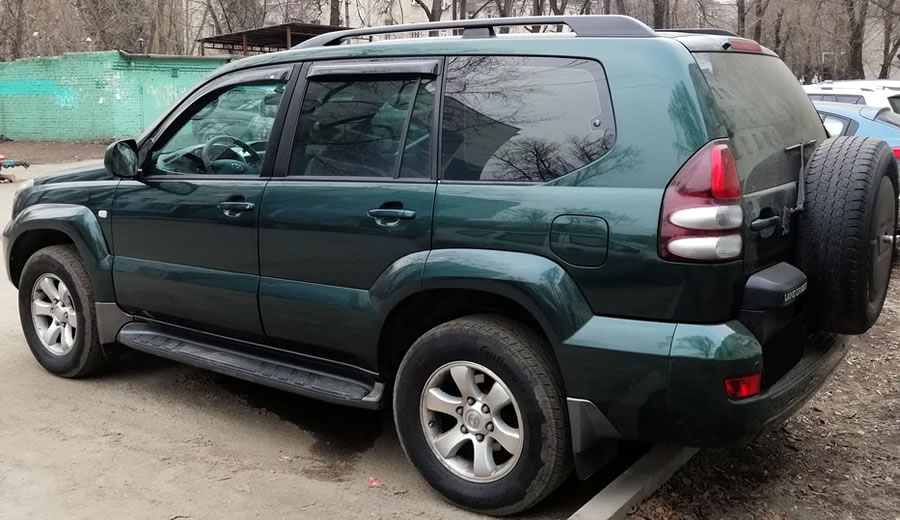
Prado J120, 2004 year
In September 2002, the third generation of Prado series "J120" was launched. It was still based on the platform used for "4Runner". The front suspension was significantly improved to increase its reliability. The body was in the form of a three-door station wagon (wheelbase 2450 mm, length 4405 mm, width 1875 mm, height 1865 mm, curb weight 1790 kg) or five-door (wheelbase 2790 mm, length 4850 mm, width 1875 mm, height 1855 mm, curb weight 1900 kg), which has three rows of seats. In Japan, there were six trim levels and equipment - "Gx", "Tx", "Tz", "Tx Limited", "Tzg" and "Tz Limited". Assembly was carried out in India and Japan.

Prado J120, view behind 
Prado J120, view behind
There were four models of petrol engines, two four-cylinder with a capacity of 2.7 liters (2693 cm³, 3RZ- FE, I4, DOHC, 150 hp) and 2.7 liters (2693 cm³, 2TR-FE, I4, DOHC, 158 hp), as well as two six-cylinder V-shaped 3.4-liter engines (3378 cm³, 5VZ-FE, V6, DOHC, 190 hp) and 4.0 liters (3956 cm³, 1GR-FE, V6, DOHC, 236 hp). Diesel engines were all four-cylinder, 3.0-liter capacity (2986 cm³, 5L-E, SOHC, 105 hp), 3.0 liters (2982 cm³, 1KZ-TE, SOHC, turbocharged, 145 hp) and 3.0 liters (2982 cm³, 1KD-FTV, DOHC, turbocharged, 170 hp). The transmission was either a four- or five-speed automatic, or a five- or six-speed manual.

in 2007, the car's equipment and safety systems were updated, and the "G-BOOK" subscription telematics service began to be offered as an option in Japan. Since 2006, two "Prado" clones have been produced under the name "Dadi City Steed" and "Dadi Shuttle".

Fourth generation (J150, 2009-present)
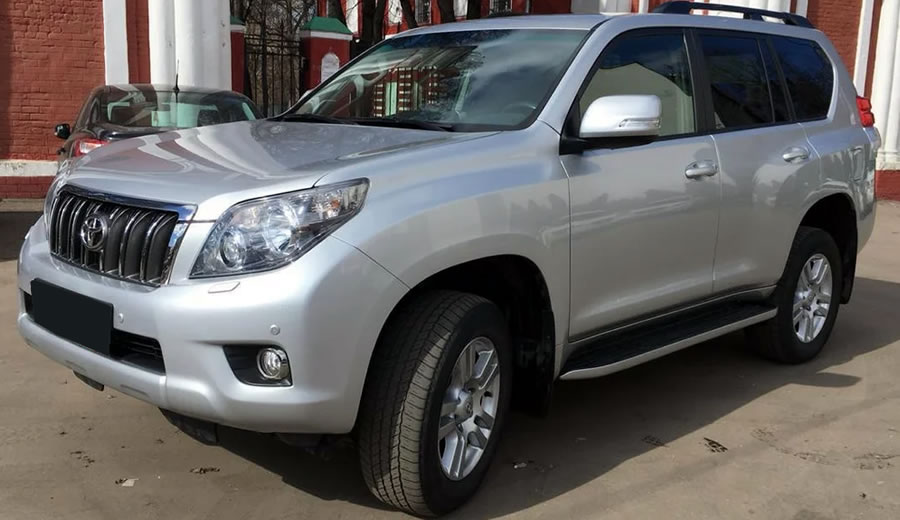


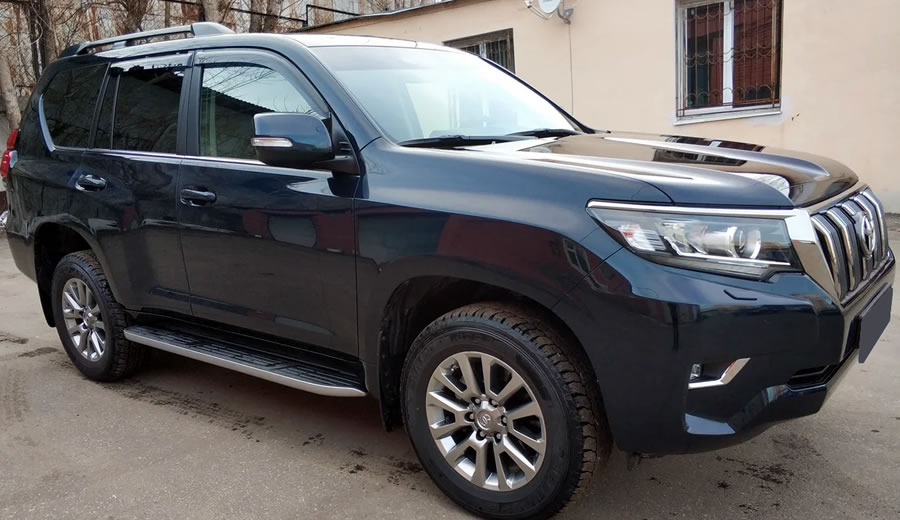
Prado J150, 2012 year 
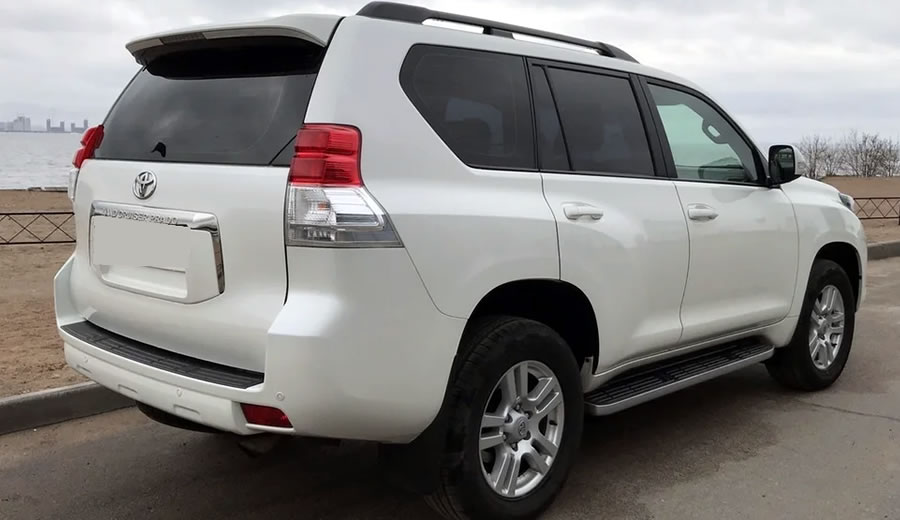
Prado J150, 2012 year
In October 2009, the fourth generation of the "J150" series appeared, which was presented at the International Motor Show in Frankfurt. The body was traditionally released in the form of a three-door and five-door station wagon. The length of the three-door car was 4485 mm, width 1885 mm, height 1830 mm, wheelbase 2450 mm and curb weight of 2060 kg. The five-door car was 4760 mm long, 1885 mm wide, 1845 mm high, wheelbase 2790 mm and curb weight of 2100 kg. This Prado is equipped with an improved all-wheel drive system and many electronic devices. The spare wheel can be located outside on the rear door or inside under the boot floor, but with a reduced fuel tank. With improved trim, the car is sold under the name "Lexus GX 460".

Prado J150, view behind 
Prado J150, view behind
The range of petrol engines looked like this: a four-cylinder 2.7 litre (2693 cm³, 2TR-FE, I4, 158 hp), as well as six-cylinder V-shaped 3.5 liters (3456 cm³, 7GR-FKS, V6, 276 hp) and 4.0 liters (3956 cm³, 1GR-FE, V6, 236 hp). There are also three modifications of diesel engines, all four-cylinder with a volume of 2.8 liters (2755 cm³, 1GD-FTV, I4, turbocharged, 175 hp), 3.0 liters (2986 cm³, 5L-E, I4, 105 hp) and 3.0 liters (2982 cm³, 1KD-FTV, I4, turbocharged, 170 hp). The gearbox was installed with a five- or six-speed manual or automatic, and since 2015 a six-speed automatic has been installed "Aisin AC60F".

In 2013, the model was updated. The equipment, front design and headlights were improved. In September 2017, the second update was carried out.
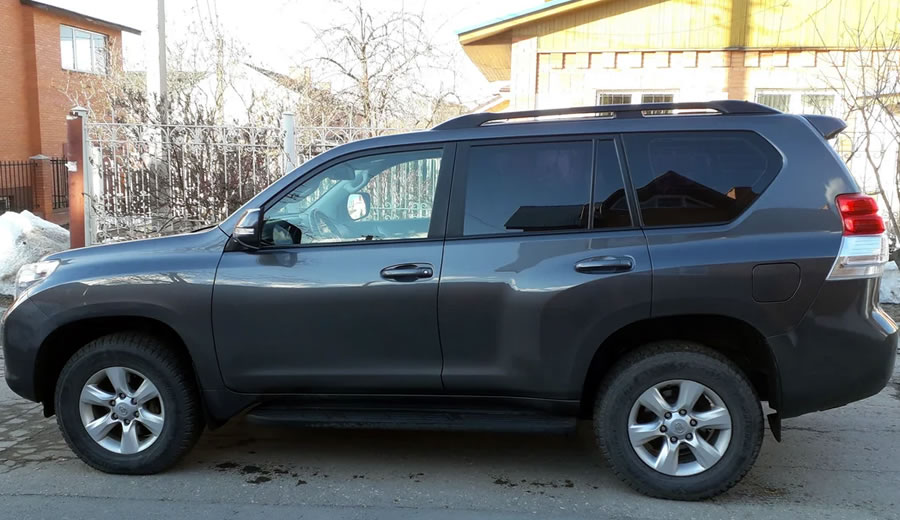
Prado J150, view side 
Prado J150, view side
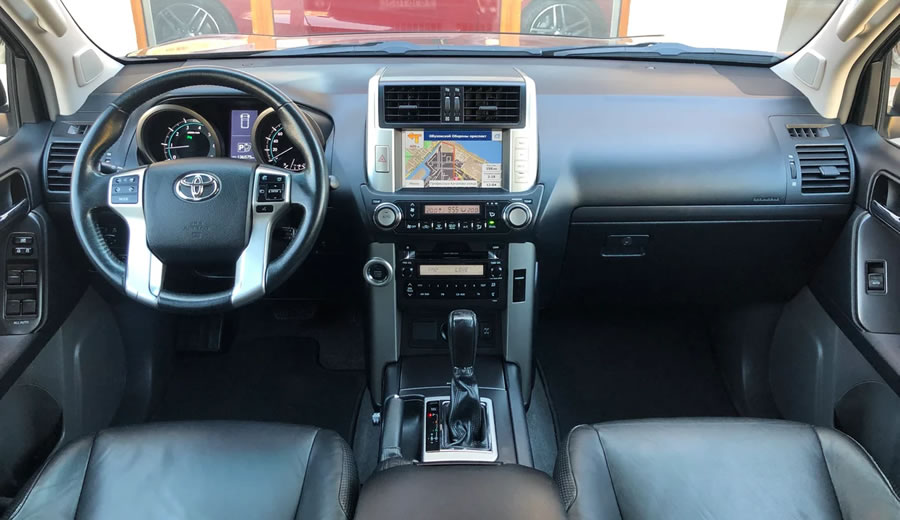
Prado J150, interior 
Prado J150, interior
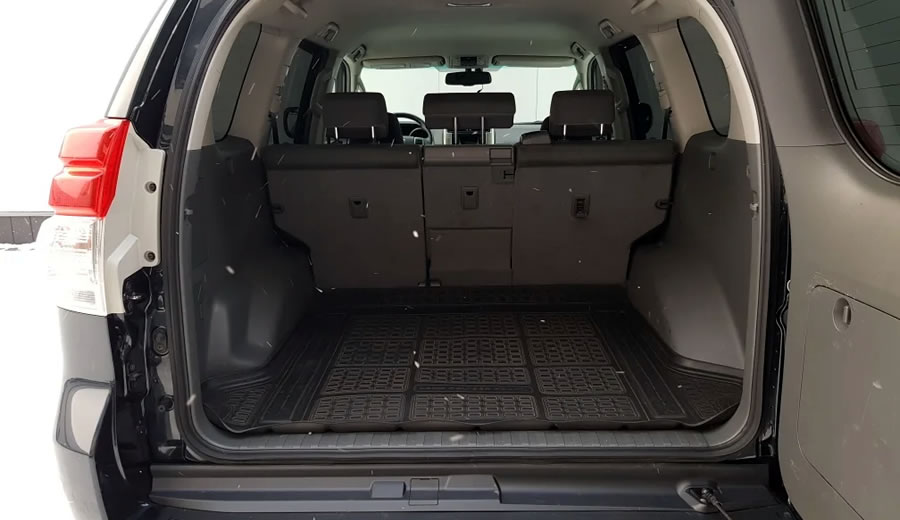
Prado J150, trunk 
Prado J150, trunk
Share information:
Link in different formats to this article
TEXTHTMLBB Code
Cruiser 100 (1998-2007) 
  • General information
  • Introduction to the guide
  • Controls and instruments
  • Maintenance
  • Power unit
  • Petrol engines
  • Diesel engines
  • Cooling and heating
  • Power and exhaust systems
  • Engine electrical equipment
  • Engine management systems
  • Transmission
  • Automatic gearbox
  • Transmission line
  • Chassis, running gear
  • Brake system
  • Car suspension
  • Steering
  • Body and interior
  • Exterior (external elements)
  • Interior (internal elements)
  • Doors, locks and windows
  • Electrical equipment
  • Equipment and devices
  • Electrical circuits
Cruiser 60/80 (1980-1997, petrol) 
  • General information
  • User manual
  • Maintenance
  • Power unit
  • Petrol engines 2F and 3F-E
  • Petrol engines 1FZ-FE
  • Engine overhaul
  • Engine electrical equipment
  • Cooling and heating
  • Fuel system (carburetor)
  • Fuel system (injector)
  • Toxicity reduction system
  • Transmission
  • Car gearbox
  • Clutch
  • Transfer case
  • Drive shafts and axles
  • Chassis, running gear
  • Brake system
  • Car suspension
  • Steering
  • Body and interior
  • Exterior and interior
  • Doors, locks and windows
  • Electrical equipment
  • Equipment and devices
  • Electrical circuits
Cruiser 70 (1985-1996, diesel) 
  • General information
  • User manual
  • Maintenance
  • Power unit
  • Engine adjustment
  • Engine repair
  • Fuel system
  • Control system
  • Turbocharging system
  • Cooling and lubrication system
  • Charge and start system
  • Transmission
  • Clutch
  • Mechanical gearbox
  • Automatic gearbox
  • Transfer case
  • Chassis, running gear
  • Car suspension
  • Brake system
  • Steering
  • Body and interior
  • Body elements
  • Heating and air conditioning
  • Electrical equipment
  • Equipment and devices
  • Electrical circuits
ToyotaMan.ru © 2018–2026 • Mobile version • Interesting about Toyota • Administration • Sitemap: EN BG BY UA RS HR RO PL SK HU • Search system • Bookmark
Camry Vista-V40 • Camry XV10 • Camry XV20 • Camry XV30 • Corolla Verso-AR10 • Corolla E80 • Corona T190 • Carina T170 • Carina T190 • Land Cruiser J70 (diesel) • Land Cruiser J60 (petrol) • Land Cruiser J100 • Highlander XU20 (petrol) • 4Runner N120 • RAV4 XA10 • Duet M100 • Dyna Y50 •
We require cookies to enable some interactive features. Is that ok with you?