



Share information:
Emission control system Toyota RAV4 1 (XA10)

General information about the exhaust emission control system
To prevent environmental pollution from incompletely burned and evaporated gases, to maintain the dynamic characteristics of the car, with economical fuel consumption, many systems are used to reduce the toxicity of...
To prevent environmental pollution from incompletely burned and evaporated gases, to maintain the dynamic characteristics of the car, with economical fuel consumption, many systems are used to reduce the toxicity of...

Technical characteristics of the toxicity reduction system
The technical characteristics of the sensors of the exhaust gas toxicity control and reduction system are given in Table. 7.1, 7.2, 7.3, 7.4.
The technical characteristics of the sensors of the exhaust gas toxicity control and reduction system are given in Table. 7.1, 7.2, 7.3, 7.4.
On-board diagnostics (OBD) system
Portable scanners are used to analyze engine management systems. All models are equipped with an OBD-II onboard diagnostic system. This system consists of an onboard computer, called the engine control module (PCM), and...
Portable scanners are used to analyze engine management systems. All models are equipped with an OBD-II onboard diagnostic system. This system consists of an onboard computer, called the engine control module (PCM), and...
Information sensors
Oxygen sensors (O2S — Oxidant Sensor) — are a solid electrolyte made of ZrO ceramic. At high temperatures, this electrolyte becomes electrically conductive and generates a characteristic galvanic charge, which indicates...
Oxygen sensors (O2S — Oxidant Sensor) — are a solid electrolyte made of ZrO ceramic. At high temperatures, this electrolyte becomes electrically conductive and generates a characteristic galvanic charge, which indicates...
Executive devices
EFI main relay electronic Fuel Injection (EFI) supplies voltage to the fuel pump. The relay is controlled by two electrical circuits. The first circuit is controlled by the engine control unit (PCM), and the second by...
EFI main relay electronic Fuel Injection (EFI) supplies voltage to the fuel pump. The relay is controlled by two electrical circuits. The first circuit is controlled by the engine control unit (PCM), and the second by...

OBD-II Trouble Codes
If the CHECK ENDINE indicator lamp comes on, it indicates that a malfunction has occurred during the last two trips. Figure 7.3. Location of the 16-pin Data Link Connector (DLC) OBD-II diagnostic codes can be retrieved...
If the CHECK ENDINE indicator lamp comes on, it indicates that a malfunction has occurred during the last two trips. Figure 7.3. Location of the 16-pin Data Link Connector (DLC) OBD-II diagnostic codes can be retrieved...
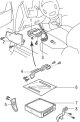
Engine control unit (PCM)
Attention! Vehicles are equipped with safety systems (SRS), including airbags and seat belt tensioners. Before working near the impact sensors, instrument panel, and steering column, disconnect the negative and then...
Attention! Vehicles are equipped with safety systems (SRS), including airbags and seat belt tensioners. Before working near the impact sensors, instrument panel, and steering column, disconnect the negative and then...

Replacing the throttle position sensor (TPS)
The throttle position sensor (TPS) is located at the end of the throttle shaft on the throttle body. By monitoring the output voltage from the TPS, the PCM adjusts fuel delivery based on the throttle valve opening angle...
The throttle position sensor (TPS) is located at the end of the throttle shaft on the throttle body. By monitoring the output voltage from the TPS, the PCM adjusts fuel delivery based on the throttle valve opening angle...

Replacement of the intake manifold absolute air pressure sensor on models from 2001
The intake manifold absolute air pressure sensor measures the intake manifold air pressure, which fluctuates depending on engine load and vehicle speed, and converts the information into an output voltage. The output...
The intake manifold absolute air pressure sensor measures the intake manifold air pressure, which fluctuates depending on engine load and vehicle speed, and converts the information into an output voltage. The output...

Replacing the Mass Air Flow (MAF) sensor on 2001 and later models
The air flow meter sensor is located on the air intake pipe. Air flow enters the engine through a heated wire element meter that forms part of a bridge circuit. The current passing through this wire element maintains...
The air flow meter sensor is located on the air intake pipe. Air flow enters the engine through a heated wire element meter that forms part of a bridge circuit. The current passing through this wire element maintains...

Replacing the engine air temperature (IAT) sensor on pre-2001 models
On 2001 and later models, the engine air temperature sensor is integrated into the mass air flow (MAF) sensor. The engine air temperature sensor is a thermistor, i.e. a resistor whose resistance changes depending on...
On 2001 and later models, the engine air temperature sensor is integrated into the mass air flow (MAF) sensor. The engine air temperature sensor is a thermistor, i.e. a resistor whose resistance changes depending on...

Replacing the coolant temperature (ECT) sensor
The coolant temperature sensor is a thermistor, i.e. a resistor whose resistance changes depending on temperature. As the temperature decreases, the resistance of the sensor increases and vice versa (see technical...
The coolant temperature sensor is a thermistor, i.e. a resistor whose resistance changes depending on temperature. As the temperature decreases, the resistance of the sensor increases and vice versa (see technical...

Replacing the crankshaft angle sensor (CKP)
The crankshaft angle (CKP) sensor determines fuel injection and ignition timing for each cylinder. On models before 2001 the sensor is installed under the timing belt cover, next to the crankshaft pulley. Replace the...
The crankshaft angle (CKP) sensor determines fuel injection and ignition timing for each cylinder. On models before 2001 the sensor is installed under the timing belt cover, next to the crankshaft pulley. Replace the...

Replacing the camshaft position (CMP) sensor on 1998 and later models
Figure 7.14. Camshaft position (CMP) sensor on pre-2001 models: 1 – electrical connector; 2 – camshaft position sensor (CMP) Figure 7.15. Camshaft position (CMP) sensor on 2001 and later models: 1 – O-ring; 2 – camshaft...
Figure 7.14. Camshaft position (CMP) sensor on pre-2001 models: 1 – electrical connector; 2 – camshaft position sensor (CMP) Figure 7.15. Camshaft position (CMP) sensor on 2001 and later models: 1 – O-ring; 2 – camshaft...

Replacing the oxygen (O2S) and air-fuel ratio (A/F) sensors
Vehicles are equipped with an OBD-II on-board diagnostic system in the engine management system, which provides feedback between the oxygen sensor and the engine control module (PCM). This is achieved by installing a...
Vehicles are equipped with an OBD-II on-board diagnostic system in the engine management system, which provides feedback between the oxygen sensor and the engine control module (PCM). This is achieved by installing a...

Replacing knock sensors
Replacing knock sensors must be done on a cold engine. The engine can be damaged by detonation caused by combustion of the fuel mixture. High compression ratios, which improve engine fuel efficiency and change the...
Replacing knock sensors must be done on a cold engine. The engine can be damaged by detonation caused by combustion of the fuel mixture. High compression ratios, which improve engine fuel efficiency and change the...

Replacing the vehicle speed sensor (VSS)
Figure 7.21. Vehicle speed sensor (VSS) location on top of transmission case on pre-2001 models Figure 7.22. Location of the vehicle speed sensor (VSS) on the top of the transmission case on 2001 and later models The...
Figure 7.21. Vehicle speed sensor (VSS) location on top of transmission case on pre-2001 models Figure 7.22. Location of the vehicle speed sensor (VSS) on the top of the transmission case on 2001 and later models The...

Replacing the Idle Air Control (IAC) Valve
The idle speed is set at the factory and does not require adjustment during vehicle operation. However, when replacing the throttle assembly, if the idle speed adjustment screw has been rotated, it is necessary to have...
The idle speed is set at the factory and does not require adjustment during vehicle operation. However, when replacing the throttle assembly, if the idle speed adjustment screw has been rotated, it is necessary to have...

Positive Crankcase Ventilation (PCV) system
Figure 7.25. Forced crankcase ventilation diagram: 1 – PCV valve; 2 – crankcase gases; 3 – fresh air The forced crankcase ventilation system ensures the extraction of crankcase gases and fuel vapors from the crankcase...
Figure 7.25. Forced crankcase ventilation diagram: 1 – PCV valve; 2 – crankcase gases; 3 – fresh air The forced crankcase ventilation system ensures the extraction of crankcase gases and fuel vapors from the crankcase...

Exhaust gas recirculation (EGR) system on 2001 and later models
To reduce the nitrogen oxide content in the exhaust gases, some of the gases are directed by the exhaust gas recirculation system to the intake manifold, resulting in a lower combustion temperature. The exhaust gas...
To reduce the nitrogen oxide content in the exhaust gases, some of the gases are directed by the exhaust gas recirculation system to the intake manifold, resulting in a lower combustion temperature. The exhaust gas...

Evaporative emission control system (EVAP)
The EVAP (fuel vapor recovery) system collects fuel vapors in a special container with activated carbon - an absorber, and when the engine is running, mixes them with fresh air and delivers them to the engine cylinders,...
The EVAP (fuel vapor recovery) system collects fuel vapors in a special container with activated carbon - an absorber, and when the engine is running, mixes them with fresh air and delivers them to the engine cylinders,...

Catalytic converter replacement
On models produced since 2001, the catalytic converter is integrated into the exhaust manifold. All vehicles are equipped with catalytic converters to reduce the amount of harmful substances emitted into the atmosphere...
On models produced since 2001, the catalytic converter is integrated into the exhaust manifold. All vehicles are equipped with catalytic converters to reduce the amount of harmful substances emitted into the atmosphere...
This section is available on: russian, bulgarian, belarusian, ukrainian, serbian, croatian, romanian, polish, slovak, hungarian
Similar sections for other Toyota models
➥ Toxicity reduction system Toyota Cruiser 60/80 (1980-1997, petrol)
Link in different formats to this article
TEXTHTMLBB Code
- General information
- Introduction to manual
- User manual
- Daily care
- Maintenance (petrol)
- Maintenance (diesel)
- Troubleshooting
- Power unit
- Gasoline engines (before 2000)
- Petrol engines (since 2001)
- Diesel engines
- Engine overhaul
- Cooling and heating
- Fuel system (petrol)
- Fuel system (diesel)
- Engine electrical equipment
- Control system (petrol)
- Control system (diesel)
- Transmission
- Manual gearbox
- Automatic gearbox
- Clutch and drive shafts
- Chassis, running gear
- Brake system
- Front suspension
- Rear suspension
- Steering system
- Body and interior
- Exterior (external elements)
- Interior (internal elements)
- Doors, locks and windows
- Electrical equipment
- Equipment and devices
- Electrical circuits
- General information
- User manual
- Maintenance
- Power unit
- Petrol engine 3S-FE
- Petrol engine 1AZ-FE
- Engine overhaul
- Cooling and air conditioning
- Fuel and exhaust system
- Ignition system
- Toxicity reduction system
- Transmission
- Clutch
- Mechanical gearbox
- Automatic gearbox
- Cardan and drive shafts
- Chassis, running gear
- Brake system
- Car suspension
- Steering
- Body and interior
- Exterior (external elements)
- Interior (internal elements)
- Doors, locks and windows
- Electrical equipment
- Equipment and devices
- Power devices
- Electrical circuits