
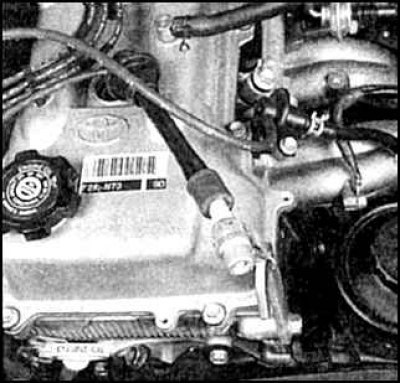
2. To do this, disconnect the wire from one of the candles, remove the insulating tip and fix the wire at a distance of about 6 mm from the bare area of the mass, or connect it to a calibrated spark gap. Turn on the starter and watch the spark plug wire. An intense blue spark should appear.
3. If there is a spark, remove the spark plugs and check.
4. If there is no spark, or sparking is unstable, then remove the distributor cap and check the condition of the cap and slider.
5. If moisture is detected, wipe the lid and slider dry, reinstall the lid, and retest.
6. If there are still no sparks, then disconnect the high-voltage wire of the ignition coil from the distributor cap and fix the wire at a distance of about 6 mm from the bare area of the mass.
7. If a spark appears, then the cause may be a malfunction of the distributor cap or runner.
8. If there is no spark, check all ignition coil primary circuit wiring.
9. Check if there is voltage to the coil from the ignition key.
10. Check ignition coil (see subsection 11.4) and an induction sensor.
11. If there is still no spark, substitute a known-good coil high voltage wire.
12. If the replacement does not work, then the electronic unit is faulty.