
Company Honda Company Ford Company Skoda Company Kia Company Mazda Company Mercedes Company Renault
English Русский
Български
Беларускі
Український
Српски
Hrvatski
Română
Polski
Slovenský
Magyar
Bookmark Articles Sitemap Contacts
ToyotaMan.ru


Camry Corolla Corona Carina Land Cruiser Highlander 4Runner RAV4 Others
RAV 4 XA20 (2000-2005) RAV 4 XA10 (1994-2000)

Checking and repairing the rear window defroster [Toyota RAV4 XA10]

  • Main
  • RAV4
  • XA10 (1994-2000)
  • Electrical equipment
  • Equipment and devices
  • Checking and repairing the rear window defroster
0
The rear window defroster consists of multiple horizontally arranged conductors sprayed onto the inside surface of the glass.

Minor wire breaks can be repaired without removing the rear window from the vehicle.

Check the rear window defroster as follows:

To detect a break in the rear window defroster wire, turn on the ignition and the rear window defroster switch.

Connect one voltmeter probe to the positive terminal of the heater and the other to the ground terminal. If the voltmeter doesn't show voltage, check the fuse protecting the heater's electrical circuit. If voltage is applied to the heater terminals, perform the following checks.
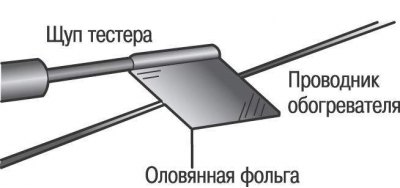


Figure 15.44. Using a foil-wrapped voltmeter probe to locate a break in the rear window defroster wire


Connect one probe of the voltmeter to the ground of the car, and wrap the second probe with foil and move the foil along the heater conductor (see figure 15.44).
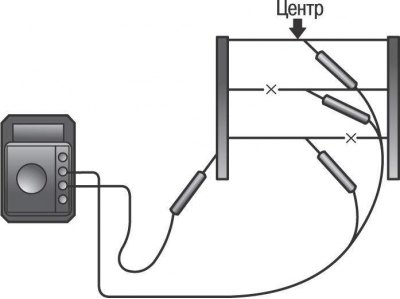


Figure 15.45. Using a voltmeter to locate a broken rear window defroster wire


Connect the voltmeter probe to the center of each rear window defroster wire. If the voltmeter shows a voltage of about 5.5 V, then the heater wire is good. If the voltmeter shows 0 V or 12 V, then there is a break in the heater wire (figure 15.45).

[The article was copied from the portal: toyotaman.ru]
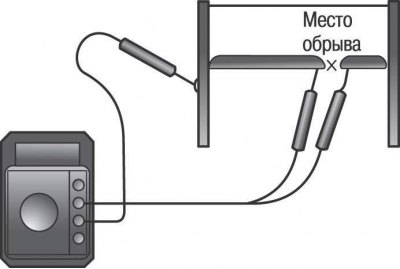


Figure 15.46. Using a voltmeter to locate a break in the rear window defroster wire


To locate a break in the heater wire, connect one voltmeter probe to the positive terminal of the heater and move the other probe along the heater wire from the negative terminal of the heater. The point at which the voltage shown by the voltmeter drops from a few volts to zero will be the point where the heater wire breaks (figure 15.46).

Before repairing the heater, turn it on for a few minutes.

Repair the rear window defroster as follows:

Repair the gap using a special repair kit.

Strip the conductors on both sides of the conductor break and degrease them.

Use adhesive tape to seal the glass on both sides of the conductor at the point of its break.

Prepare the conductive adhesive compound from the repair kit.


Apply conductive adhesive to the broken and undamaged areas of each conductor at a distance of 18 mm.

Allow the conductive adhesive to dry for 24 hours, then remove the adhesive tape.
This article is available at: russian, bulgarian, belarusian, ukrainian, serbian, croatian, romanian, polish, slovak, hungarian
The article material has been checked: Kolokoltsev Grigory
Share information:
◀ Previous
RAV 4 XA10: Equipment and devices
Next ▶

Radio antenna — removal and installation
Removal and installation tweeters
Removal and installation full-range speakers
Removal and installation the radio
Removal and installation the windshield wiper motor
Replacing headlight bulbs
Headlight adjustment
Headlight replacement
Horn — Removal, Checking and Installation
Replacing incandescent light bulbs
Similar articles on other Toyota models

➥ Checking and repairing rear window defroster wires Toyota Carina T190 (1992-1996)
➥ Checking and repairing the rear window defroster Toyota Cruiser 100 (1998-2007)
➥ Rear Window Defogger — Checking and Repairing Toyota Camry XV20 (1996-2001)
➥ Rear Window Defogger System — Checking and Repairing Toyota Highlander 1 (2000-2007, petrol)
➥ Rear Window Defogger — Checking and Repairing Toyota 4Runner N120 (1989-1995)
➥ Rear window defroster switch Toyota Corolla E80 (1983-1990)
Link in different formats to this article
Comments and feedback from visitors
No comments yet


Add two numbers 50 + 39


RAV 4 XA20 (2000-2005) 
  • General information
  • Introduction to manual
  • User manual
  • Daily care
  • Maintenance (petrol)
  • Maintenance (diesel)
  • Troubleshooting
  • Power unit
  • Gasoline engines (before 2000)
  • Petrol engines (since 2001)
  • Diesel engines
  • Engine overhaul
  • Cooling and heating
  • Fuel system (petrol)
  • Fuel system (diesel)
  • Engine electrical equipment
  • Control system (petrol)
  • Control system (diesel)
  • Transmission
  • Manual gearbox
  • Automatic gearbox
  • Clutch and drive shafts
  • Chassis, running gear
  • Brake system
  • Front suspension
  • Rear suspension
  • Steering system
  • Body and interior
  • Exterior (external elements)
  • Interior (internal elements)
  • Doors, locks and windows
  • Electrical equipment
  • Equipment and devices
  • Electrical circuits
RAV 4 XA10 (1994-2000) 
  • General information
  • User manual
  • Maintenance
  • Power unit
  • Petrol engine 3S-FE
  • Petrol engine 1AZ-FE
  • Engine overhaul
  • Cooling and air conditioning
  • Fuel and exhaust system
  • Ignition system
  • Toxicity reduction system
  • Transmission
  • Clutch
  • Mechanical gearbox
  • Automatic gearbox
  • Cardan and drive shafts
  • Chassis, running gear
  • Brake system
  • Car suspension
  • Steering
  • Body and interior
  • Exterior (external elements)
  • Interior (internal elements)
  • Doors, locks and windows
  • Electrical equipment
  • Equipment and devices
  • Power devices
  • Electrical circuits
ToyotaMan.ru © 2018–2026 • Mobile version • Interesting about Toyota • Administration • Sitemap: EN BG BY UA RS HR RO PL SK HU • Search system • Bookmark
Camry Vista-V40 • Camry XV10 • Camry XV20 • Camry XV30 • Corolla Verso-AR10 • Corolla E80 • Corona T190 • Carina T170 • Carina T190 • Land Cruiser J70 (diesel) • Land Cruiser J60 (petrol) • Land Cruiser J100 • Highlander XU20 (petrol) • 4Runner N120 • RAV4 XA10 • RAV4 XA20 • Duet M100 • Dyna Y50 •
We require cookies to enable some interactive features. Is that ok with you?