



Caution: Allow the engine to cool completely before starting the procedure. Avoid contact of coolant with your skin or painted vehicle parts. Rinse off any spilled liquid immediately with plenty of water. Antifreeze is toxic, do not swallow it. Never leave the liquid in an open container: children and animals, attracted by the sweet smell of antifreeze, can be poisoned. Antifreeze is also flammable, so do not store it near an open flame. For information on the civilized method of disposing of antifreeze, please contact your local authorities. There should be special containers for this in the garage. Do not pour antifreeze on the ground or down the drain.
Coolant temperature gauge sensor
Models produced before 2000
1. Drain the coolant (see Chapter 1A).
2. Disconnect the wiring connector from the coolant temperature gauge sensor (see Figure 7.2).
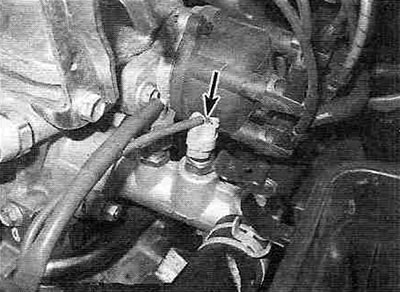
Figure 7.2. Coolant temperature gauge sensor - models with gasoline engines produced before 2000.
[View the full text on the portal: ToyotaMAN]
3. Using a socket head with a ratchet or an open-end wrench, unscrew the sensor.
4. Screw in the new sensor and tighten it securely. Do not apply sealant to the threaded portion of the sensor, as this may impair its electrical conductivity.
5. Connect the wiring connector, fill the cooling system and check for leaks and normal operation of the sensor.
Models produced since 2001
6. In models produced since 2001 (with both gasoline and diesel engines) the coolant temperature gauge sensor is an integral part of the engine coolant temperature sensor assembly. The procedure for replacing it is described in the chapter 6A or 6B.
Contact temperature sensor for turning on the cooling system fan
7. Raise the front of the vehicle and support it with safety stands.
8. Remove the lower engine guards. Drain the coolant (see chapter 1A or 1B).
9. Disconnect the wiring connector from the cooling system fan switch (see Figure 7.9).
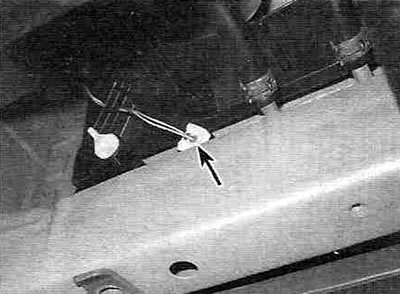
Figure 7.9. Cooling system fan switch.
10. Using a socket head with a ratchet or an open-end wrench, unscrew the sensor.
11. Screw in the new sensor and tighten it securely. Do not apply sealant to the threaded portion of the sensor, as this may impair its electrical conductivity.
12. Connect the wiring connector, fill the cooling system and check for leaks and normal operation of the cooling system fan.