
Company Honda Company Ford Company Skoda Company Kia Company Mazda Company Mercedes Company Renault
English Русский
Български
Беларускі
Український
Српски
Hrvatski
Română
Polski
Slovenský
Magyar
Bookmark Articles Sitemap Contacts
ToyotaMan.ru


Camry Corolla Corona Carina Land Cruiser Highlander 4Runner RAV4 Others
4Runner N120 (1989-1995)

Heater radiator — removal and installation [Toyota 4Runner N120]

  • Main
  • 4Runner
  • N120 (1989-1995)
  • Power unit
  • Cooling and heating
  • Heater radiator — removal and installation
0

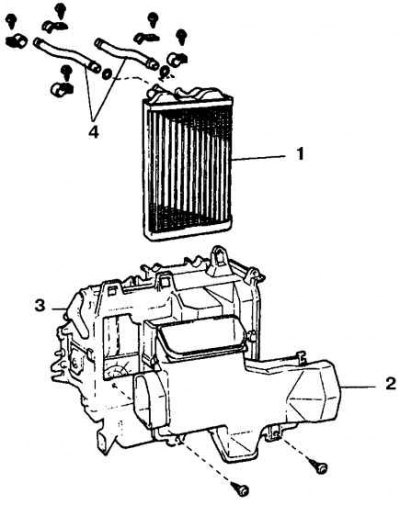
Front heater


1. Radiator; 2. Ventilation duct; 3. Body; 4. Tubes


Rear heater
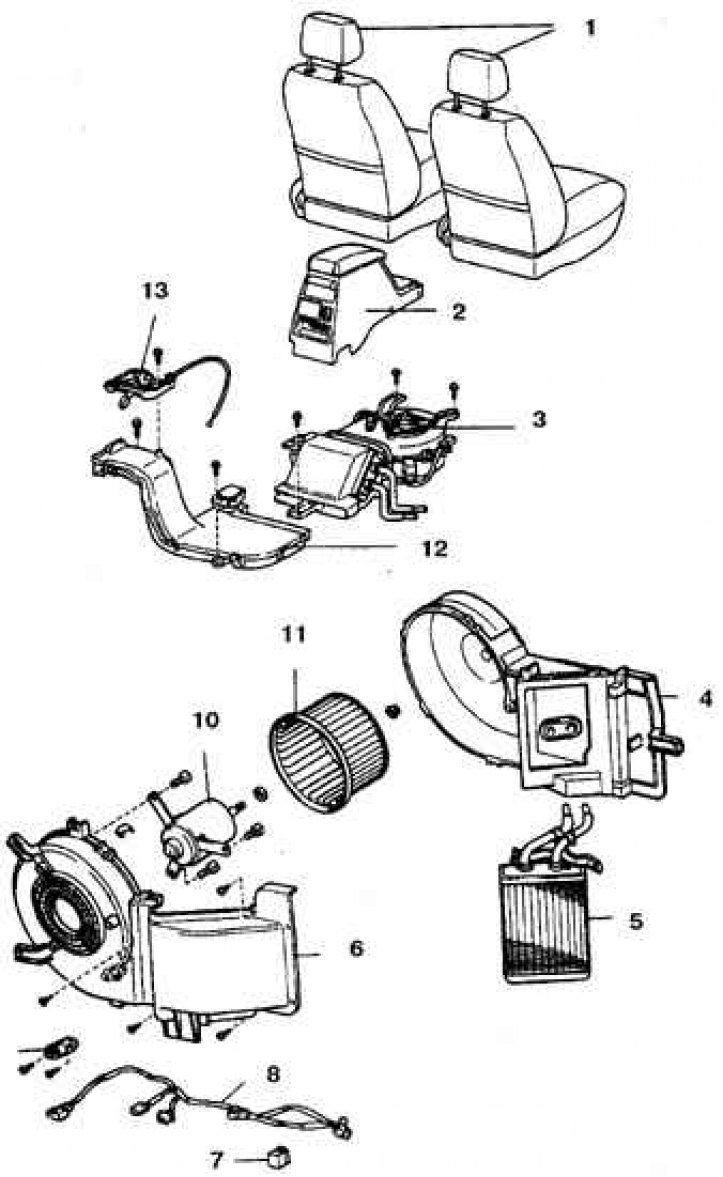


1. Front seats; 2. Rear center section; 3. Rear heater; 4, 6. Body; 5. Radiator; 7. Relay; 8. Wires; 9. Resistor; 10. Electric motor; 11. Impeller; 12. Rear air duct; 13. Control Panel


The original text is posted on [ToyotaMan.ru]

Please note: Both seats must be removed to access the rear air conditioning unit.


Removal and installation


1. Drain the liquid.
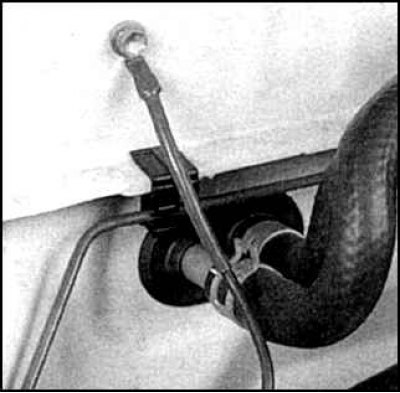


2. Disconnect and plug the heater hoses at the engine compartment bulkhead.


3. Remove the center section, storage compartment trim, ashtray, receiver, and front panel (see subsection 10.23). Remove the front panel reinforcement frame.

4. Disconnect the air conditioning unit controls.

5. Disconnect the connector and move the processor unit aside.

6. Disconnect the cables from the heater.

7. Remove the middle vent.

8. Remove the lower vent.

9. Loosen the screws securing the tubes to the heater.

10. Remove the radiator by pushing the block towards you as far as possible and disconnecting all interfering parts.

11. Assembly is carried out in reverse order.
This article is available at: russian, bulgarian, belarusian, ukrainian, serbian, croatian, romanian, polish, slovak, hungarian
The article material has been checked: Gribkov Vladimir
Share information:
◀ Previous
4Runner N120: Cooling and heating
Next ▶

Heater Fan Motor and Circuit — Check and Replace
Coolant Temperature Sensor — Checking and Replacing
Removal and installation the water pump
Checking the water pump
Oil cooler — removal and installation
Air conditioning unit control panel
Air conditioning system — design description
Checking the air conditioner refrigerant charge
Checking the heating system
Air Conditioning Compressor — Removal and Installation
Similar articles on other Toyota models

➥ Heater Radiator — Removal and Installation Toyota Camry XV20 (1996-2001)
➥ Heater radiator coolant temperature sensor Toyota Carina T190 (1992-1996)
➥ Heater radiator — removal and installation Toyota Cruiser 60/80 (1980-1997, petrol)
➥ Heater radiator — removal and installation Toyota Highlander 1 (2000-2007, petrol)
➥ Heater radiator — removal and installation Toyota RAV 4 XA10 (1994-2000)
➥ Removal and installation the radiator Toyota Corolla E80 (1983-1990)
Link in different formats to this article
Comments and feedback from visitors
No comments yet


Add two numbers 28 + 46


4Runner N120 (1989-1995) 
  • General information
  • User manual
  • Maintenance
  • Power unit
  • 4-cylinder engines
  • 6-cylinder engines
  • Engine overhaul
  • Cooling and heating
  • Fuel system
  • Transmission
  • Mechanical gearbox
  • Automatic gearbox
  • Transfer case
  • Clutch
  • Transmission line
  • Chassis, running gear
  • Brake system
  • Car suspension
  • Steering
  • Body and interior
  • Exterior (external elements)
  • Interior (internal elements)
  • Doors, locks and windows
  • Electrical equipment
  • Equipment and devices
  • Ignition system
  • Power devices
  • Electrical circuits
ToyotaMan.ru © 2018–2026 • Mobile version • Interesting about Toyota • Administration • Sitemap: EN BG BY UA RS HR RO PL SK HU • Search system • Bookmark
Camry Vista-V40 • Camry XV10 • Camry XV20 • Camry XV30 • Corolla Verso-AR10 • Corolla E80 • Corona T190 • Carina T170 • Carina T190 • Land Cruiser J70 (diesel) • Land Cruiser J60 (petrol) • Land Cruiser J100 • Highlander XU20 (petrol) • 4Runner N120 • RAV4 XA10 • RAV4 XA20 • Duet M100 • Dyna Y50 •
We require cookies to enable some interactive features. Is that ok with you?