
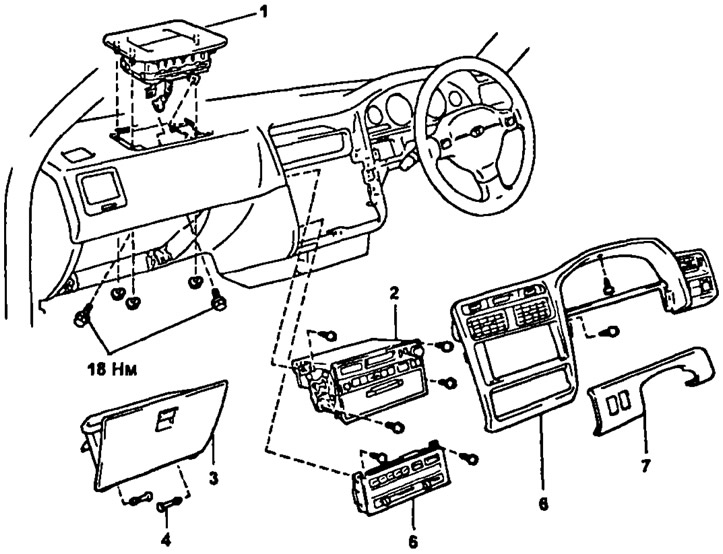
Passenger Airbag: 1 - passenger airbag, 2 - radio, 3 - glove box lid, 4 - glove box lid hinges, 5 - A/C control panel, 6 - center trim panel, 7 - lower trim panel
Removing the passenger airbag
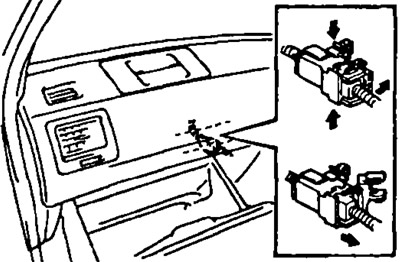
1. Disconnect the airbag connectors.
- A) Remove the connectors from the fasteners on the instrument panel.
- b) Disconnect connectors.
2. Remove the following parts (see body)
- A) Bottom trim panel.
- b) Top trim panel.
- V) Radio.
- G) Air conditioning control panel.
3. Remove the passenger airbag.
- A) Remove the lid hinges and glove box lid.
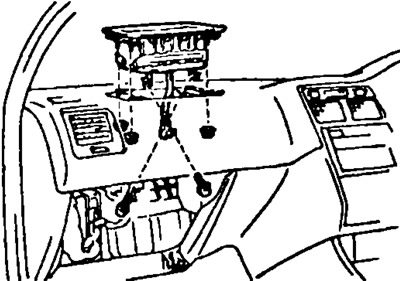
- b) Remove 2 bolts and 3 nuts and remove airbags.
Passenger airbag installation
1. Install the airbag in the dashboard,
2. Assure 2 bolts in the dashboard. Tightening torque 18 Nm.
3. Install the removed parts.
Removing the SRS sensor
1. Remove the center console trim and center console.
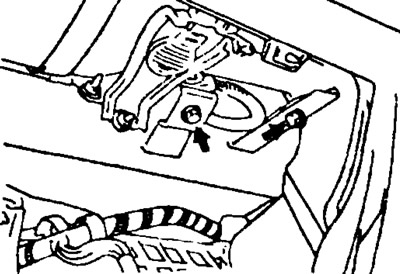
2. Remove the airbag sensor.
- A) Disconnect the connector.
- b) Remove 3 screws and remove sensor.
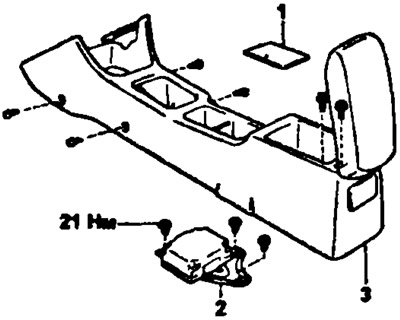
1 - center console trim, 2 - airbag sensor, 3 - center console
Installing the SRS sensor
1. Install the sensor, tighten the three bolts. Tightening torque 21 Nm.
2. Connect the connector.
3. Install the removed parts.
System Diagnostics
1. Checking the warning light for the airbag system.
Set the ignition switch to position "ACC" or 'ON", check that the warning light comes on and goes out after about 6 seconds.
Note: If the indicator occasionally comes on or stays on even when the ignition switch is in the "OFF", then check for a short circuit in the target of the indicator.
2. Reading fault codes.
- V) Set the ignition switch to position "ACC" or "ON" and wait approximately 20 seconds.
- b) Short the leads "Ts" And "E1" diagnostic socket.
Note: Incorrect connection of pins may damage the system.
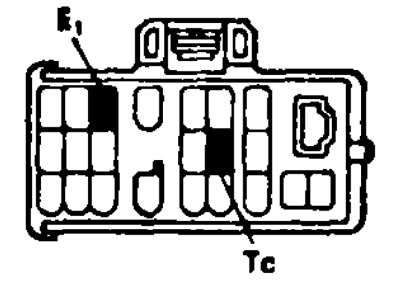
- V) If there is no fault, the indicator will flash 1-2 times per second.

- G) If a fault is present, the indicator will flash at a variable rate. Determine fault codes.
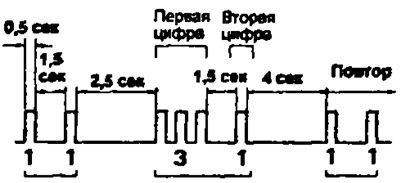
Note:
- Refer to ABS Diagnosis for the definition of the DTC.
- When two or more fault codes are indicated, they are displayed starting from the lower number.
- If a code is displayed that is not listed in the table, the airbag sensor is faulty.
Table of fault codes for the airbag system
| Code | Malfunction | Cause of malfunction | signal lamp |
| Norma | Normal system state | — | does not burn |
| Supply voltage drop | Battery, airbag sensor | lit | |
| 11 | Short circuit in the circuit el. igniter (on "earth") | Email igniter (driver and front passenger airbags), contact, airbag sensor, wiring | lit |
| 12 | Short circuit in the circuit el. igniter (on "B+") | Email igniter (driver and front passenger airbags), contact, airbag sensor, wiring | lit |
| 13 | Short circuit in circuit "0" email igniter | steering wheel pad (igniter), contact, cushion sensor | lit |
| 14 | Gap in the scheme "0" email igniter | steering wheel pad (igniter), contact, airbag sensor, wiring | lit |
| 31 | Malfunction of the system control unit | Airbag sensor | Lit |
| 53 | Short circuit in circuit"ran. igniter | Front passenger airbag (email igniter), contact, airbag sensor, wiring | lit |
| 54 | Gap in the scheme "R" email igniter | Front passenger airbag (email igniter), contact, airbag sensor, wiring | lit |