



Contents: Control unit ↓ Actuator ↓ Rear wheel speed sensors ↓ Brake light switch ↓ Diagnostics and repair ↓
Location of ABS system units
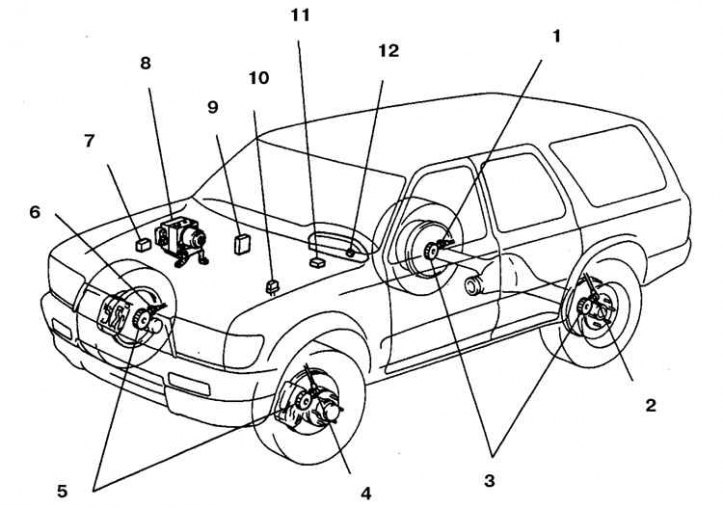
1, 2. Rear speed sensor; 3, 5. Speed sensor rotor; 4, 6. Front speed sensor; 7. Relay; 8. Actuator; 9. Control unit; 10. DLC1 connector; 11. Deceleration sensor; 12. Control lamp
The vehicles are equipped with an automatic brake release system (ABS system), designed to increase the stability of the vehicle under conditions of sudden braking. The pressure in the brake circuit is regulated depending on the speed of rotation of the wheels, registered by sensors.
The vehicles are equipped with an automatic brake release system (ABS system), designed to increase the stability of the vehicle under conditions of sudden braking. The pressure in the brake circuit is regulated depending on the speed of rotation of the wheels, registered by sensors.
Control unit
Mounted on the right mudguard. The unit receives signals from the brake light switch and the speed sensors of each wheel, on the basis of which the pressure in the hydraulic drive of this wheel is regulated. If the wheel rotation speed differs from the base, the control unit opens the electromagnetic valve of the actuator and the fluid under excess pressure flows into the reservoir. The wheel is partially released. After the rotation speed is equalized, the valve closes and the pressure increases again. Numerous repetitions of such cycles stabilize the rotation speed of all wheels and increase the stability of the car. The control unit also has a self-diagnostic function.
Actuator
It consists of a system of solenoid valves that are triggered by signals from the control unit.
Rear wheel speed sensors
Induction type sensors are mounted on each wheel. Sinusoidal signals from the sensor are sent to the control unit.
Brake light switch
Ensures that the rear lights are switched on and the control unit is ready when braking.
Diagnostics and repair
After starting the engine, the ABS system indicator lamp lights for 3 seconds, then goes out. Check the handbrake, brake hydraulic drive, sensor and actuator connectors, and system wiring. If the handbrake is released, the hydraulic drive is in good condition, all system contacts and connectors are in normal condition, then the ABS system is faulty and the car should be taken to a service station.