



Location of anti-lock braking system units (ABS systems)
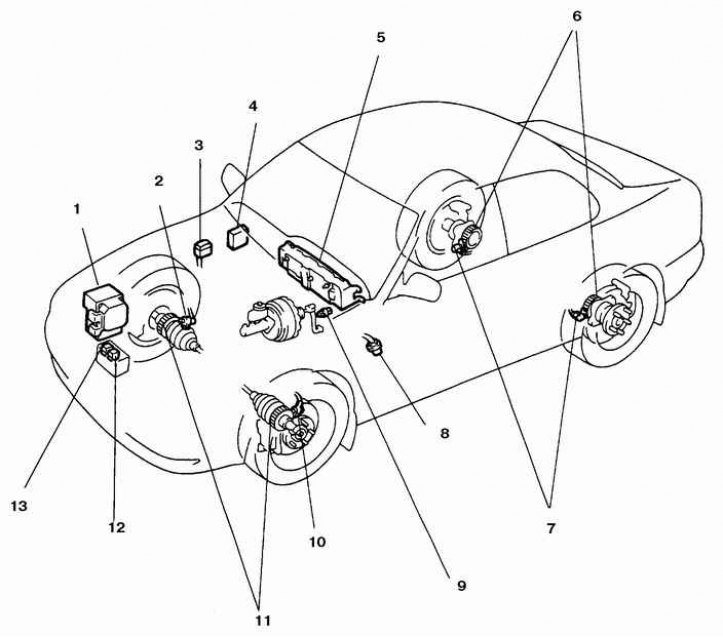
1. Actuator; 2, 10. Front speed sensors; 3. Diagnostic connector (DLC1); 4. Control unit; 5. ABS system health indicator light; 6, 11. Speed sensor rotors; 7. Rear speed sensors; 8. Diagnostic connector (DLC1); 9. Brake light switch; 12. ABS motor relay; 13. Solenoid valve traction relay
ABS system units
Actuator
The actuator consists of a master cylinder, an electro-hydraulic pump and 4 solenoid valves.
Attention! ABS systems are supplied by Bosch and Nippondenso. The actuator of the Bosch system is a monoblock design and contains a built-in processor control unit and a relay of solenoid valves, while in the Nippondenso system these components are mounted separately.
The electric pump is designed to pump fluid into the actuator receivers, through which fluid is supplied under pressure to the brake circuit.
Solenoid valves control the pressure in the brake circuit when the ABS system is activated, the valve block contains 4 valves, 1 valve per wheel.
Wheel speed sensors
Rotary type sensors are mounted on each wheel. Signals from the sensors are sent to the control unit.
The front sensors are mounted on the steering knuckle, next to the toothed rings of the rotors. The rotors are structurally integrated with the front outer CV joints of the axle shafts.
The rear sensors are mounted on the rear axle brackets, the rotors are structurally integrated with the rear hub.
ABS control unit
The Nippondenso system control unit is mounted under the front bulkhead of the body, the Bosch system control unit is mounted in the actuator. The unit receives signals from the brake light switch and the speed sensors of each wheel. These signals are the initial data for adjusting the pressure in the hydraulic drive of this wheel. The control unit also has a self-diagnostic and failure memory function.
If the system fails, the control lamp on the instrument panel lights up, and a failure code is entered into the memory, which can be read to determine the nature of the malfunction or the faulty unit.
Diagnostic codes
The fault code is stored in memory until the contents of the memory cells are erased or until the fault is corrected.
When the ignition is turned on, the ABS indicator lamp lights up and goes out after the engine is started. If the lamp remains lit, a fault has been registered in the ABS system.
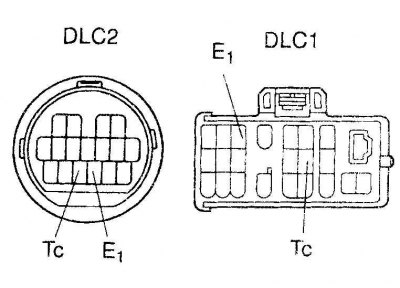
To access the fault codes, turn the ignition key to the OFF position (the engine is not working). In the Nippondenso system, remove the jumper (see photo) terminals of the diagnostic connector. On systems of both types, short-circuit the terminals E1 and Tc of the connector, turn the ignition key to the ON position (the engine is not running) and read the codes.
Nippondenso ABS Diagnostic Connector Jumper
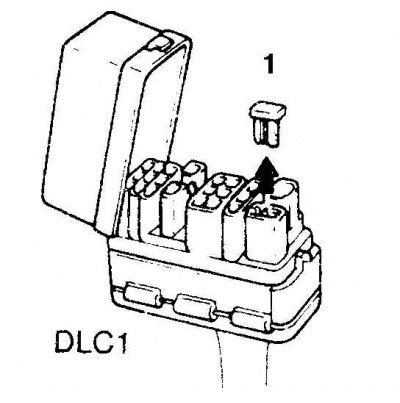
1. Jumper
Jumper terminals on two types of diagnostic connectors used
The official source is on the portal [toyotaman.ru]
The numbers of the two-digit code are determined by the number of flashes of the control lamp, separated by a pause of 1.5 seconds (for example, code 34 - 3 flashes, a pause of 1.5 seconds and 4 flashes).
The following code (if there is another malfunction) appears 2.5 seconds after the first. If the system is working properly, the lamp flashes with a period of 0.5 seconds.
Determine the nature of the failure using the attached table.
After reading, erase the codes by short-circuiting the E1 and Tc connector terminals, and turn the ignition key to the ON position (the engine is not running) and press the pedal at least 8 times within 5 seconds. Remove the jumper and replace the connector cover. Take the car to a service station.
ABS System Fault Code Table
Code | Nature of the malfunction | Actions taken |
11 | Open circuit in solenoid relay circuit | Check the solenoid valve relay and relay circuit wiring |
12 | Short circuit in solenoid valve relay circuit | Same |
13 | Open circuit in the pump motor relay relay | Check the pump relay and relay circuit wiring |
14 | Short circuit in pump motor relay circuit | Same |
21 | Right front wheel solenoid circuit faulty | Check actuator solenoid and circuit |
22 | Left front wheel solenoid circuit faulty | Same |
23 | Right rear wheel solenoid circuit faulty | Same |
24 | Left rear wheel solenoid circuit faulty | Same |
25 | Open or short circuit in SMC1 circuit | Check the system actuator and chain |
26 | Open or short circuit in SMC2 circuit | Check the system actuator and chain |
27 | Open or short circuit in SRC1 circuit | Check the system actuator and chain |
28 | Open or short circuit in SRC2 circuit | Check the system actuator and chain |
31 | Right front wheel speed sensor is faulty | Check the speed sensors, wiring and sensor connector |
31 | No signal from the right front wheel speed sensor | Check the speed sensor, wiring and sensor connector |
32 | No signal from left front wheel speed sensor | Same |
33 | No signal from the right rear wheel speed sensor | Same |
34 | No signal from left rear wheel speed sensor | Same |
35 | Open circuit in the right front wheel speed sensor circuit | Same |
36 | Open circuit in the left front wheel speed sensor circuit | Same |
37 | The number of teeth of the speed sensor rotor is not normal | Check the sensor rotor for proper operation (presence of all teeth) |
38 | Open circuit in the right rear wheel speed sensor circuit or in the sensor itself. | Check the speed sensor, wiring and sensor connector |
39 | Open circuit in the left rear wheel speed sensor circuit or in the sensor itself | Check the speed sensor, wiring and sensor connector |
41 | Battery voltage too low | Check the charging system: generator (see subsection 3.4.10), battery (see subsection 3.4.9), voltage regulator (see subsection 3.4.11). |
43 | Brake Release Control System Failure | Check all ABS system wires and connectors |
44 | Open or short circuit in the NE signal circuit | Check all wires and connectors from the ABS control unit |
49 | Open circuit in the brake light switch circuit or in the switch itself | Check the switch and switch circuit |
51 | The actuator motor is blocked | Check for short circuit in motor and relay circuit, check battery |
53 | PCM circuit failure | Check all wires and connectors from the ABS control unit |
58 | Open circuit in the brake light switch circuit or in the switch itself | Check the switch and switch circuit |
61 | Engine management system failure | Check for engine management system fault codes (see subsection 7.2.) |
62 | Control unit failure | The control unit needs repair or replacement |
The lamp burns continuously | Control unit failure | The control unit needs repair or replacement |