



Contents: Check and replace ↓ Checking and assembly ↓
Generator parts (typical variant)
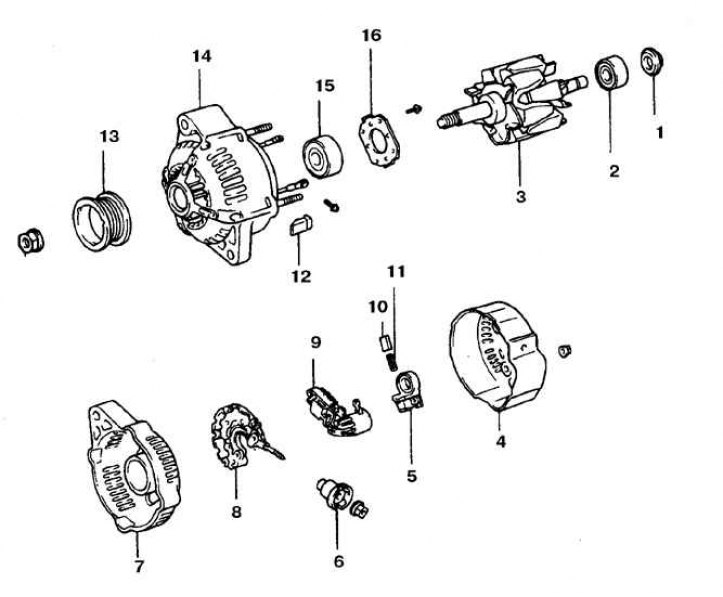
1, 16. Bearing cover; 2, 15. Bearing; 3. Rotor; 4. Back cover; 5. Brush holder; 6. Insulating bushing; 7. Rear bearing housing; 8. Rectifier contact plate; 9. Voltage regulator; 10. Brush; 11. Spring; 12. Buffer; 13. Pulley; 14. Front cover
Check and replace
1. Remove the generator.
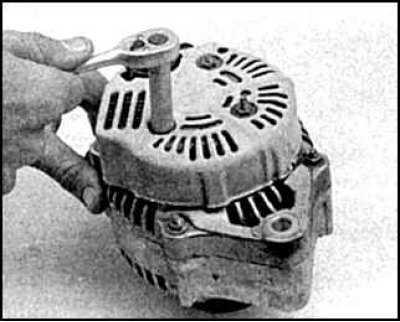
2. Unscrew the nuts of the rear cover.
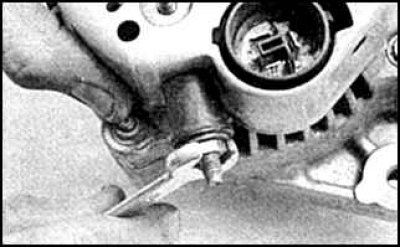
3. Unscrew the generator terminal nut.
4. Remove the terminal insulating sleeve and the back cover.
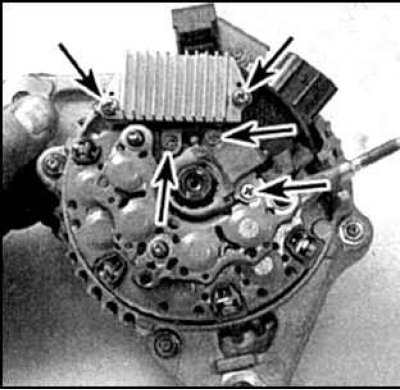
5. Remove the screws of the voltage regulator and brush holder (indicated by arrows).
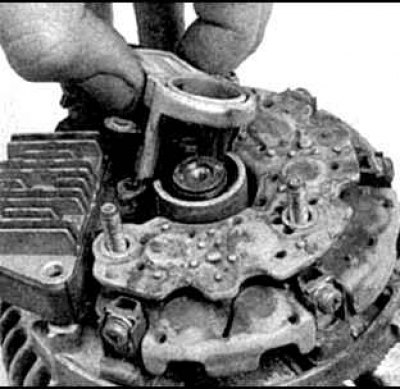
6. Remove the brush holder.
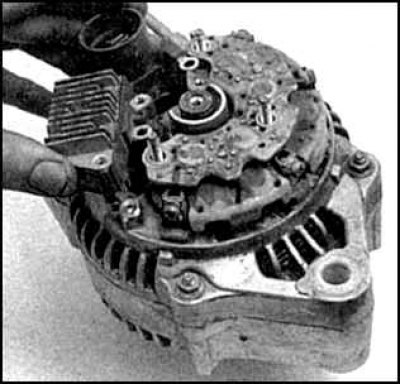
7. Remove the voltage regulator.
8. Further disassembly is only necessary to replace the brushes.
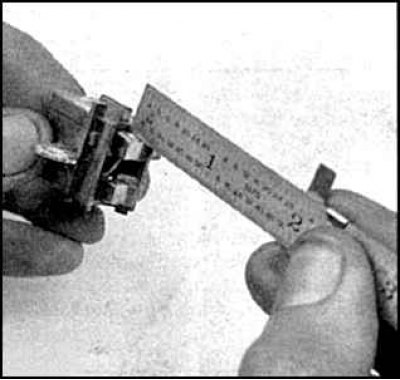
9. Measure the length of the protruding part of the brushes.
10. If the brush length is less than the maximum permissible, replace the brush holder with the brushes. Some cars only allow replacement of the brushes by re-soldering them.
11. Make sure the brushes move freely in the brush holder.
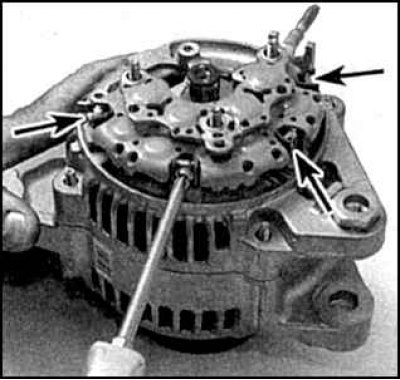
12. Remove the straightener (the arrows indicate the mounting screws).
13. Remove 4 buffers and mudguard.
14. Mark the position of the front and back covers.
15. Loosen the nut and remove the pulley.
16. Remove 4 nuts and detach the rear bearing housing.
17. Remove the thrust washer and take out the rotor.
The full article is posted on the website: ToyotaMan.ru
Checking and assembly
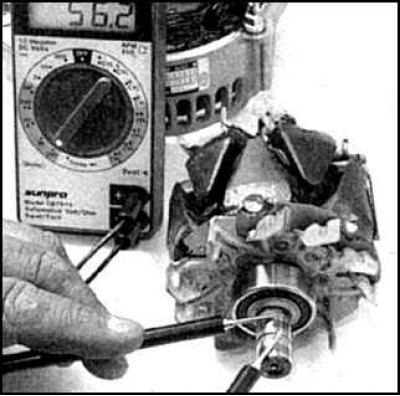
1. Check the resistance between the contact rings, which should be 2-4 ohms.
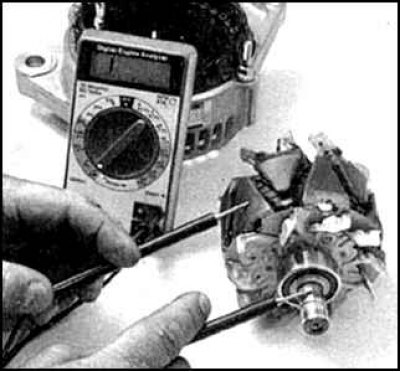
2. Check the circuit between the rotor shaft and the slip rings. The ohmmeter should show infinite resistance.
3. The rotor is faulty if the results of both tests are unsatisfactory, or in the case of increased wear of the rings.
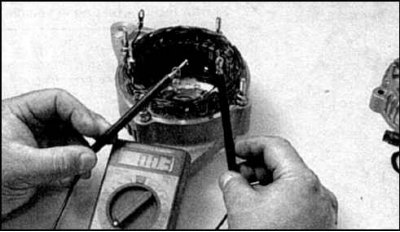
4. Check the resistance between the stator winding terminals.
5. If the resistance is high, or the ohmmeter shows an open circuit, then the stator is faulty.
6. Check the short circuit of the stator windings to the housing (core).
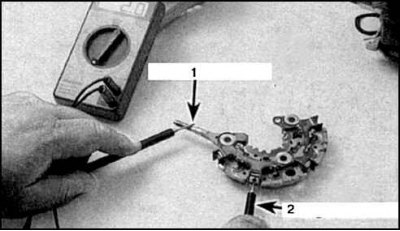
7. Place the positive probe of the ohmmeter on the terminal and the negative probe on the ground. The device should show a closed circuit (1 – positive probe, 2 – negative probe).
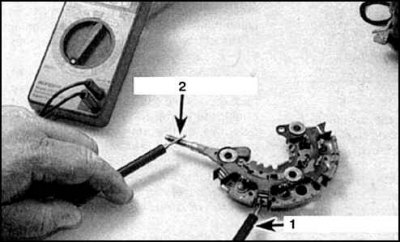
8. When changing the polarity of the ohmmeter connection, a break should be observed (1 – positive probe, 2 – negative probe).
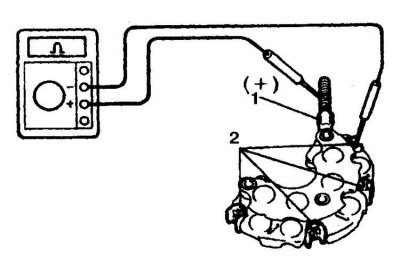
9. Check the diodes of the positive branch of the rectifier (1 - positive terminal, 2 - diode terminals).
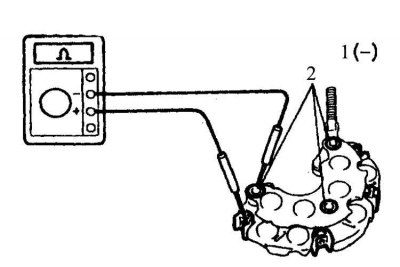
10. Check the diodes of the negative branch of the rectifier (1 - negative terminal, 2 - diode terminals).
11. Assembly is carried out in reverse order.
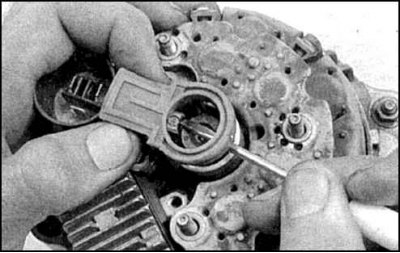
12. When installing the brush holder, press the brushes.