



Starting circuit mounting locations
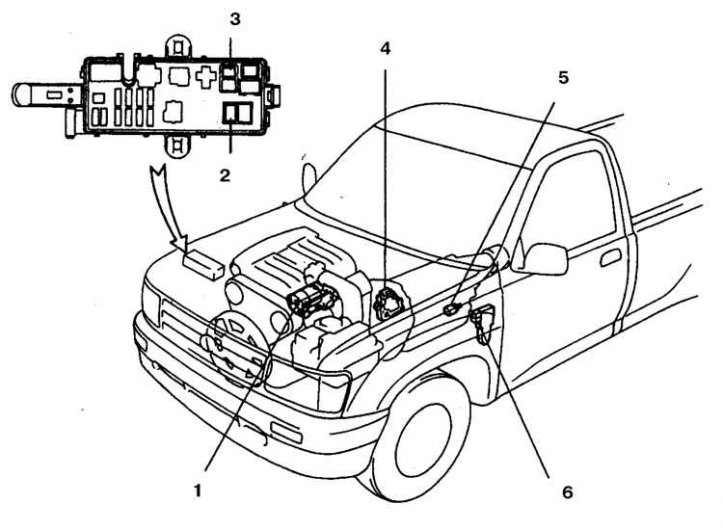
1. Starter; 2. Insert FL-ALT (80A); 3. Park/Neutral switch; 4. Insert FL-AM1 (40 A); 5. Traction relay switch; 6. Auxiliary relay
1. If the starter motor does not turn at all when you turn the key, make sure the transmission lever is in neutral.
2. Make sure the battery is charged, check the cleanliness and reliability of the cable fastening on the battery and on the starter solenoid relay.
3. If the starter motor turns on when the key is turned, but the crankshaft does not turn, then the cause is the jamming of the starter overrunning clutch. In this case, the starter assembly should be replaced.
4. If the starter motor does not rotate when the key is turned, but the traction relay clicks, then the traction relay contacts, battery and starter motor are faulty (or the crankshaft turns with difficulty).
5. If the click emitted by the relay is not heard when the starter is turned on, the reasons for the failure may be a faulty battery or a burnt-out fuse (the circuit is open), malfunction of the auxiliary starter relay or the traction relay itself.
6. To check the traction relay, short-circuit the battery connection terminal () and the ignition key wire terminal with a jumper. If the starter motor starts, the traction relay is OK, and the ignition switch, starter auxiliary relay, traction relay switch, or wiring are faulty.
7. If the starter motor still does not start, remove the starter assembly with the traction relay for disassembly, inspection and repair.
8. If the starter turns the crankshaft, but at a very low speed, first check the battery charge level and the reliability of the connections. The starter will also turn the engine at a low speed if the crankshaft rotates with difficulty or if the engine oil is too viscous.
9. Warm up the engine, then disconnect the high-voltage wire of the coil from the distributor cap and connect it to ground.
10. Connect the voltmeter, turn on the starter and read the steady-state voltmeter reading. The voltage on the battery at normal crankshaft speed should be about 9 V.
[Publication Reprinted from a web portal: ToyotaMan.ru]
11. If the battery voltage is equal to or greater than 9 V, and the crankshaft rotation speed is low, then the starter motor is faulty.
12. If the voltage is less than 9 V at low rotation speed, the probable causes are burning of the traction relay contacts, malfunction of the starter motor, or self-discharge of the battery.