
Battery charging system
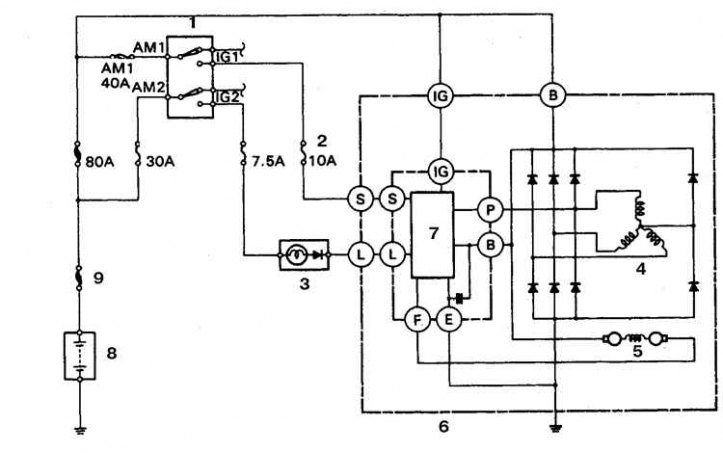
1. Ignition key; 2. Fuse-link 10 A; 3. Control lamp charge; 4. Stator winding; 5. Rotor winding; 6. Generator; 7. Voltage regulator; 8. Battery; 9. Main fusible link
Typical location of fuse links
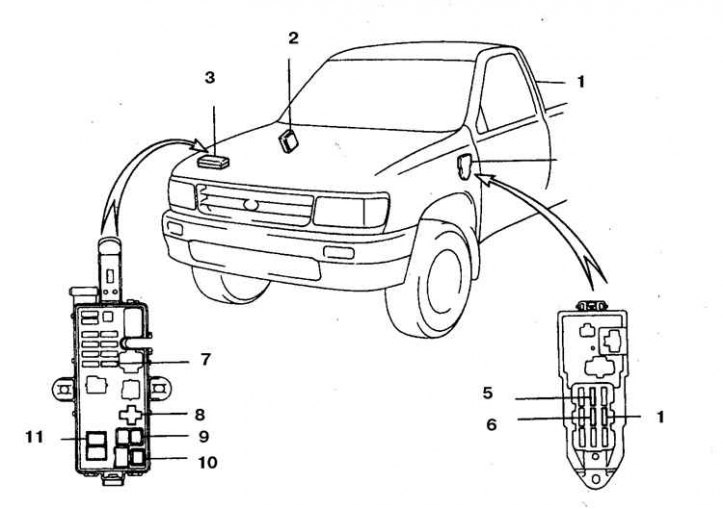
1. Connection box N 1; 2. Mounting block; 3. Processor unit; 4. Fusible insert STOP 15 A; 5. Fuse-link IGN 15 A; 6. Fuse link GAUGE 10 A; 7. Fusible insert of the processor unit for 15 A; 8. Main relay; 9. Fusible insert AM1 for 40 A; 10. Fusible insert AM2 for 30 A; 11. Fuse link ALT FL 80 A
The charging system consists of an alternator, voltage regulator, battery, fusible link and connecting wires. When these devices work together, power is provided to such consumers as the ignition system, lighting and signaling devices, a radio receiver, etc. The generator is driven by a belt in front of the engine.
The voltage regulator is designed to maintain the generator voltage at a given levehp a sharp increase in voltage at the output of the generator, the regulator prevents surges and overloads in the power circuit. Periodic maintenance of the charging system is generally not required. However, you should periodically inspect the alternator drive belt, battery and connecting wires. The charge control lamp on the instrument panel lights up when the ignition is switched on and goes out after the engine is started. If the lamp does not go out after starting the engine, then the charge circuit is faulty. Some vehicles are equipped with a voltmeter. If the voltmeter shows a very high or very low voltage, then the charge circuit needs to be checked.
Precautionary measures
When connecting the wires of the vehicle's on-board network and external devices, the following precautions should be observed.
When connecting the battery to the generator, always observe the polarity of the connection.
Before repairing any part of the car with electric welding, disconnect the wires from the generator and battery.
Do not start the engine with the charger connected.
The generator is connected directly to the battery, so if the generator leads are shorted or overloaded, arcing and fire may occur.