Contents: Checking the rotor ↓ Stator check ↓ Checking the brushes ↓ Checking the rectifier unit ↓ Checking bearings ↓
Checking the rotor
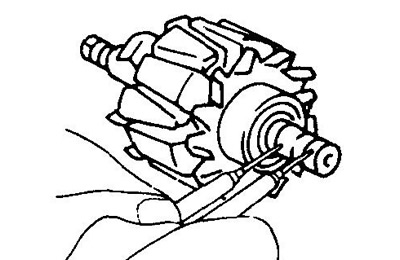
1. Check if there is a break in the excitation winding.
Using an ohmmeter, measure the resistance between the slip rings.
- Nominal resistance (in a cold state) — 2.7 - 3.1 Ohm
If the resistance tends to infinity, i.e. the circuit is open, then replace the rotor.
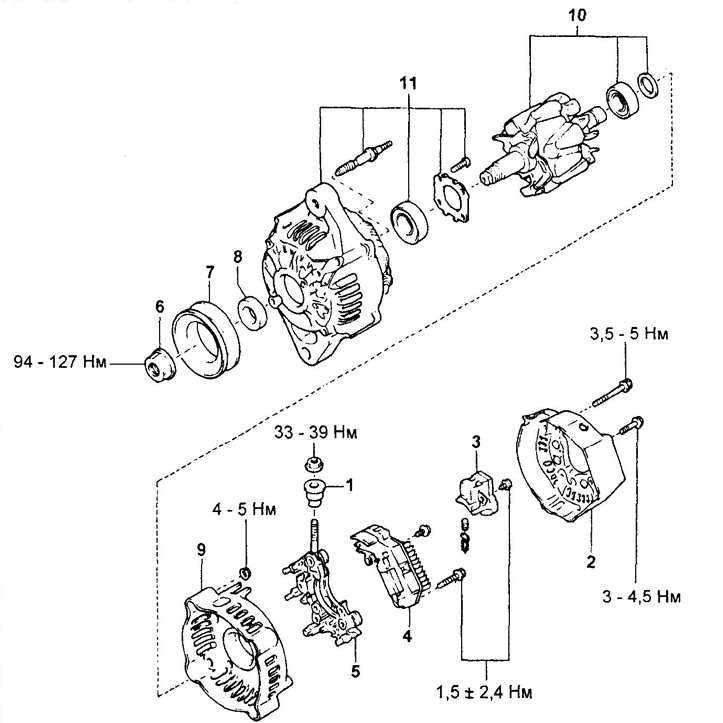
Disassembly and assembly of the generator.
1 - output isolator,
2 - back cover,
3 - brush holder,
4 - voltage regulator,
5 - rectifier block,
6 - nut,
7 - pulley,
8 - spacer,
9 - body,
10 - rotor,
11 - drive side cover.
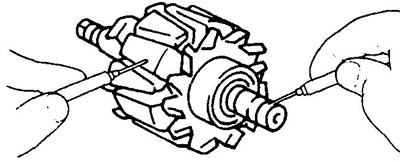
2. Check if the excitation winding is shorted to ground.
Using an ohmmeter, measure the resistance between the rotor pole and the slip ring.
If the resistance is 0 (the circuit is closed), replace the rotor.
3. Check the slip rings.
a) Check the working surfaces of the contact rings. They should not have any burrs or chips.
b) Using a caliper, measure the diameter of the slip rings.
- Nominal diameter - 14.2 -14.4 mm
- Minimum allowable - 12.8 mm
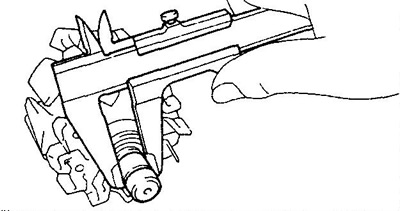
If the slip ring diameter is less than the minimum allowable, replace the rotor.
Stator check
1. Check if there is a break in the stator winding.
(The text is quoted from the source website: «www.ToyotaMAN.ru»)
Using an ohmmeter, measure the resistance between the terminals of the stator winding coils.
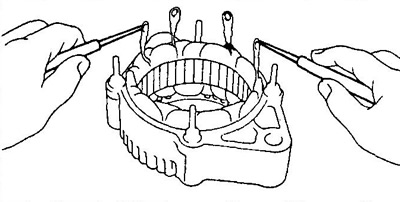
If the resistance tends to infinity, i.e. the circuit is open, replace the stator.
2. Check if the stator winding is shorted to ground.
Using an ohmmeter, measure the resistance between the stator housing and the terminals of the stator winding coils.
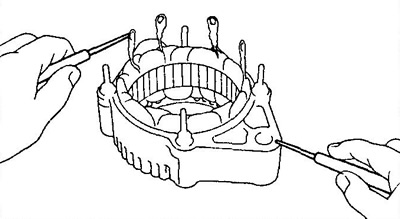
If the resistance is "0", i.e. the circuit is closed, replace the stator.
Check the voltage regulator.
Using an ohmmeter, measure the resistance between the terminals of the voltage regulator.
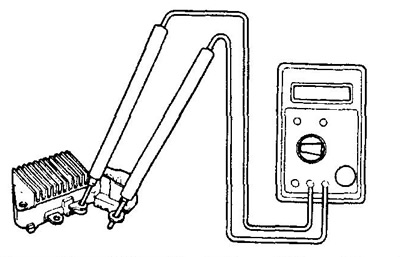
If the resistance tends to infinity, i.e. the circuit is open, replace the voltage regulator.
Checking the brushes
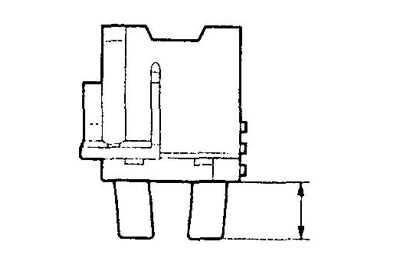
1. Measure the length of the protruding part of the brushes.
- Nominal length - 10.5 mm
- Minimum allowable - 1.5 mm
Checking the rectifier unit
1. Checking the positive valve.
a) Connect the negative probe of the ohmmeter to the positive terminal of the rectifier block, and connect the positive probe in series to each of the other three terminals.
Make sure there is conductivity (closed circuit) in all three dimensions.
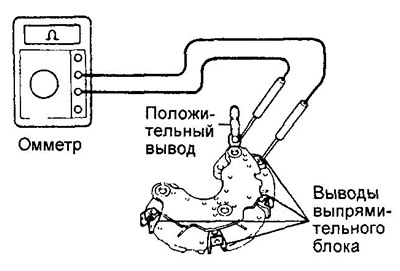
b) Reverse the polarity of the tester probes and repeat the procedure in point (c). Make sure that the circuit is open in all three measurements (resistance tends to infinity).
If the conditions are not met, replace the rectifier unit.
2. Checking the negative valve.
a) Connect the positive probe of the ohmmeter to the negative terminal of the rectifier unit, and connect the negative probe in series to each of the other three terminals. Check for conductivity (closed circuit) in all three dimensions.
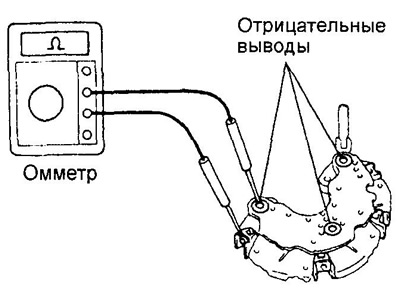
b) Reverse the polarity of the tester probes and repeat the procedure in step (a). Make sure that the circuit is open in all three measurements (resistance tends to infinity).
If the conditions are not met, replace the rectifier unit.
Checking bearings
1. Check the front bearing. Make sure that the rear bearing moves smoothly and without sticking.
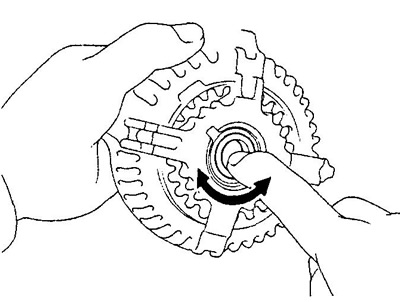
2. Replace the bearing if necessary.
a) Unscrew 4 screws and remove the bearing holder.
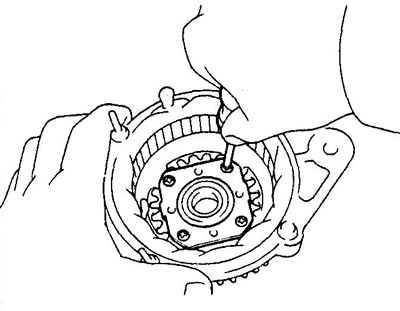
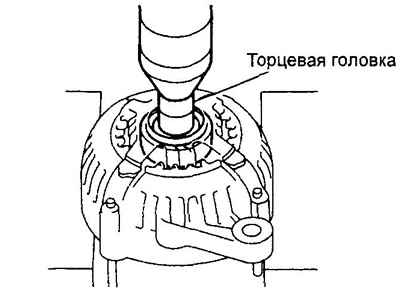
b) Using a press and a socket head of the appropriate size, press out the front bearing.
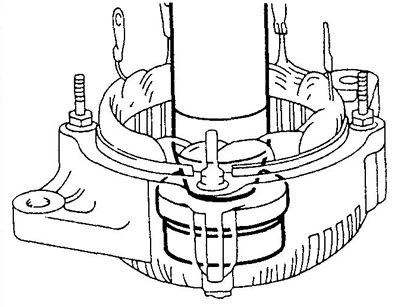
c) Using a special punch and press, press the new front bearing into the generator cover on the drive side.
d) Install the bearing holder and tighten the 4 screws that secure it.
- Tightening torque - 2.6 Nm
3. Checking the rear bearing.
Make sure the rear bearing moves smoothly and without binding.
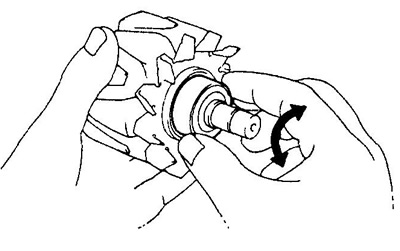
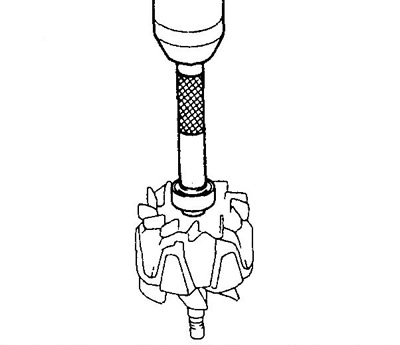
4. Replace the rear bearing if necessary.
a) Using a puller, remove the rear bearing and bearing cap.
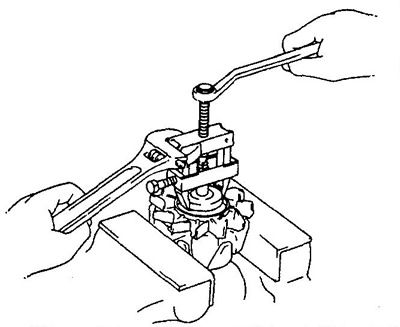
b) Using a press, install the new rear bearing onto the rotor shaft.
c) Install the bearing cover.