



Contents: General description ↓ Examination ↓ Replacement ↓ Front catalytic converters ↓ Rear catalytic converter ↓
Note: Since emission control system components such as the catalytic converter are covered by warranty, contact your dealer's service department before attempting to replace the catalytic converter yourself.
Note: The front catalytic converter is integrated into the exhaust manifold. For the procedure for replacing the exhaust manifold, refer to Chapter 2A or 2B.
General description
1. A catalytic converter is an emission control device installed in the exhaust system. It reduces the levels of pollutants in the exhaust stream. There are two types of catalytic converters. An oxidation catalytic converter reduces levels of hydrocarbons (HC) and carbon monoxide (CO) by adding oxygen to the exhaust stream to produce water vapor (H2O) and carbon dioxide (carbon dioxide) (CD₂). A reductive catalytic converter reduces nitrogen oxides (NO₂) by removing oxygen from the exhaust gas to produce nitrogen (N) and oxygen. Both types of converters are combined into a single three-way catalytic converter that reduces all three pollutants.
2. The amount of oxygen entering the catalytic converter is a critical parameter for its operation because without oxygen it cannot perform the conversion of harmful pollutants into safe components. The catalytic converter is most effective at collecting and storing oxygen when it is neutralizing the exhaust gases that result from the combustion of the air-fuel mixture with an ideal (stoichiometric) air-fuel ratio, i.e. 14.7:1. If the air-fuel ratio is less (leaner) than the stoichiometric ratio over an extended period of time, the catalytic converter will store even more oxygen. But if the air-fuel ratio is richer than the stoichiometric ratio over any period of time, the oxygen content of the converter may become completely depleted. When this condition occurs, the catalytic converter will not perform any neutralization at all!
3. Since the ability of the catalytic converter to store oxygen is an important factor for its effective operation, this parameter can also be considered as an indicator reflecting the possible inability of the catalytic converter to perform its work. The PCM monitors the oxygen content at the catalytic converter inlet and outlet by comparing the voltage signals coming from the front and rear oxygen sensors. When the catalytic converter works correctly, very little oxygen is registered at the output of the catalytic converter, because the latter captures, stores and releases oxygen necessary to neutralize HC, CO and NO, and more harmless components. If the catalytic converter does not perform its work, the rear oxygen sensor informs the PCM that the oxygen content in the neutralized exhaust gases is increasing. When the amount of oxygen at the neutralizer outlet reaches the prescribed threshold value, the PCM generates a Diagnostic Fault code (DTC) and turns on the fault warning lamp (MIL), also known as the "Check engine Warning lamp (check the engine)".
Examination
4. Catalytic converter testing equipment is very complex and expensive. If you suspect that the converter on your vehicle is malfunctioning, contact your dealer or other specialized service station for diagnosis and repair.
5. Whenever the vehicle is raised for underbody maintenance, inspect the catalytic converter for leaks, corrosion, dents, or other damage. Inspect the welds/bolts on the flange connections that connect the front and rear ends of the converter to the exhaust system. If damage is found, the converter should be replaced.
6. Although catalytic converters do not fail very often, they can become clogged. The easiest way to check for a reduction in catalytic converter flow is to use a vacuum gauge to diagnose the effect of a blockage in the exhaust system on the intake vacuum.
- a) Connect a vacuum gauge to the intake manifold vacuum control port (see chapter 2B).
- b) Warm up the engine to operating temperature, shift the gearbox into the park position (automatic transmission) or neutral position (manual transmission) and apply the parking brake.
- c) Take the vacuum reading at idle and record it.
- d) Quickly open the throttle valve to almost the fully open position and release it to return to the closed position. Take and record the vacuum reading.
- d) Perform the test three more times, recording the readings after each test.
- e) If after the fourth check the reading is more than 25 mmHg lower than the value recorded at idle, the exhaust system may be blocked (the catalytic converter may be clogged or the exhaust pipe or muffler may be clogged/deformed).
Replacement
Caution! Do not service the catalytic converter until it has cooled down completely.
(View the full text on the portal: «ToyotaMAN.ru»)
Front catalytic converters
Models with four-cylinder engines
Note: On 2001-2003 four-cylinder models, there are two front catalytic converters. On Toyota vehicles, they are referred to using the abbreviation WU TWC, which literally translates to heated three-way catalytic converter. They are an integral part of the exhaust manifold. On 2004 and later four-cylinder models, there is one front catalytic converter (also type WU-TWC), and it is also an integral part of the exhaust manifold.
7. Refer to paragraph "Exhaust manifold assembly with catalytic converter" in Chapter 2A.
1999-2003 models with V6 engine
Note: On 1999-2003 V6 models, heated three-way catalytic converters (WU-TWC) are located directly under the exhaust manifolds, where they are bolted.
8. Raise the front of the vehicle and place secure supports underneath it.
9. To remove the three-way catalytic converter for the front bank of cylinders, unscrew the two nuts that serve to secure the upper end of this converter to the exhaust manifold, and the two nuts that serve to secure the lower end of the converter to the connecting pipe (fig. 18.9, a, b).
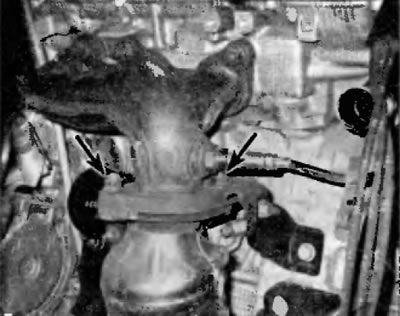
Fig. 18.9, a. To disconnect the upper end of the front three-way catalytic converter from the front exhaust manifold on a V8 engine, remove the two nuts
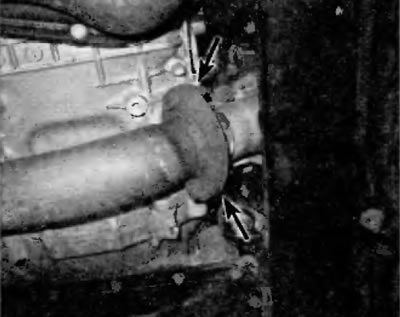
Fig. 18.9, b. To disconnect the lower end of the front three-way catalytic converter from the connecting pipe on the V6 engine, unscrew the two nuts and remove the bolts
10. To remove the rear bank three-way catalytic converter, loosen the nuts and remove the bolts that connect the converter to the rear exhaust manifold, connecting pipe and rear catalytic converter (fig. 18.10).
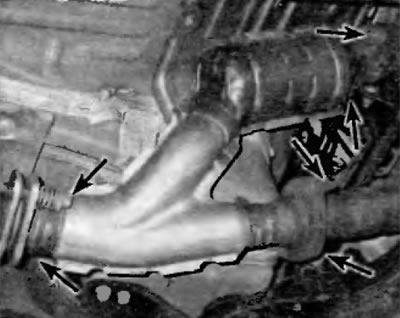
Fig. 18.18. To disconnect the three-way catalytic converter from the rear exhaust manifold, connecting pipe and rear catalytic converter, pull back the nuts and remove the bolts
11. Installation is performed in the reverse order of removal.
2004 and later models with V6 engine
Note: On 2004 and later models with V6 engines, the exhaust manifold and three-way catalytic converter are welded together and therefore cannot be serviced separately.
12. Refer to paragraph "Exhaust manifolds complete with catalytic converters" in Chapter 2B.
Rear catalytic converter
Note: The rear catalytic converter, which on Toyota and Lexus vehicles is a three-way catalytic converter (TWC), is located underneath the vehicle. It is located between the flange at the rear end of the exhaust manifold and the muffler, to which it is connected by a short pipe. The three-way catalytic converter, short pipe, and muffler are welded together into a single unit.
13. Raise the front of the vehicle and place secure supports underneath it.
14. See pictures 16.1, b, c in chapter 4.