



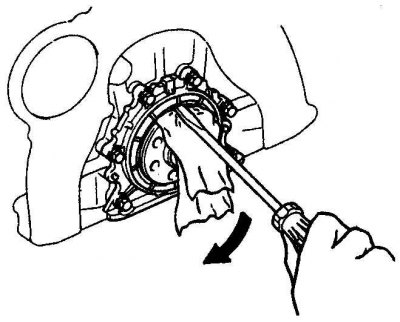
2. The seal can be removed without dismantling the oil pan or removing the seal holder. However, this method is not recommended, since the seal is installed in the holder with great tension, and therefore the seal can be damaged either in the holder itself or during installation. If you still want to try, then use a screwdriver to remove the old seal.
3. Lubricate the crankshaft journal and the working edges of the new oil seal with universal grease and carefully install the oil seal in place. The working edge of the oil seal is very hard, so when installing it on the crankshaft, push the oil seal carefully, using a smooth object. Press the oil seal into place with light blows. Do not apply sharp blows, otherwise the oil seal may be damaged.
4. The method described below is recommended, but this requires opening the seal at the rear of the pan and removing the seal retainer.
5. Unscrew the two rearmost bolts of the pan, which are screwed into the holder. Use a spatula to open the seal between the rear part of the pan and the seal holder. Unscrew the bolts, remove the holder and remove the remains of the gasket. Remove the seal from the split plane of the pan.
Attention! Cover the open part of the tray with a clean rag to prevent any sealant residue from getting in when fastening the tray during assembly.
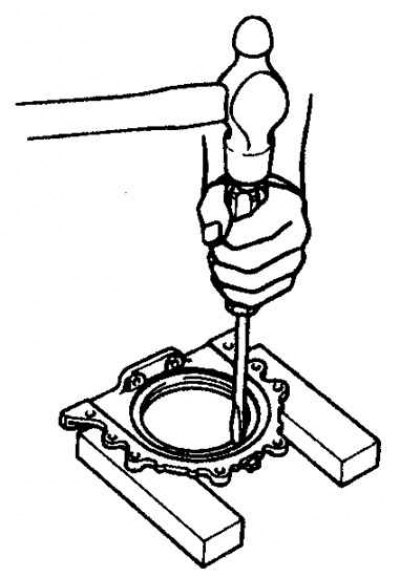
6. Place the holder with the seal on two wooden blocks and knock out the seal from the back side with a screwdriver.
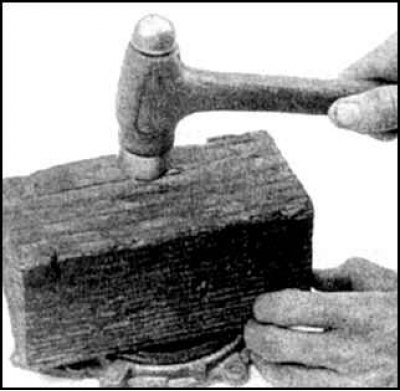
7. Press the new seal into the holder using a hammer and a wooden spacer.
8. Lubricate the working edges of the new oil seal and the crankshaft journal with universal grease. Install the new oil seal retainer gasket on the cylinder block. Apply drops of RTV sealant to the exposed part of the oil pan, especially to the plane adjacent to the cylinder block.
9. Carefully place the oil seal with the holder on the crankshaft journal.
10. Tighten the holder bolts to the specified torque.
11. Then assembly is carried out in reverse order.