



When working with batteries, you must wear protective glasses. The electrolyte is very aggressive. Never allow acid droplets or particles containing lead compounds to come into contact with eyes, skin or clothing.
When charging batteries, an explosive gas mixture is released. When working with wires and electrical devices, the use of fire, sparking devices, open fire-hazardous lighting devices and smoking are prohibited. Avoid sparking when handling wires and electrical devices.
Before carrying out any work on the vehicle's electrical system, disconnect the negative cable from the battery.
Checking the electrolyte level
Under normal vehicle operating conditions, the battery requires virtually no maintenance. At high ambient temperatures, it is recommended to check the electrolyte level in the battery from time to time.
In an opaque serviceable battery, measure the electrolyte level using a hollow glass tube, closing one end with your finger. In the taken "sample", the height of the liquid column inside the tube will correspond to the height of the electrolyte level above the upper edge of the plates.
Be sure to check the electrolyte level when charging the battery. It should always be between the "MIN" and "MAX" marks located on the longitudinal sides of the battery.
If the electrolyte level drops, add distilled water to the appropriate jars up to the "MAX" mark. This should be done before the electrolyte level drops below the "MIN" mark.
Caution! Do not fill the battery with electrolyte above the required level, as it will leak out through the vent. This may result in damage to the paintwork and corrosion of the body.
After adding electrolyte, tightly close the corresponding battery jars with caps.
Checking the density of the electrolyte
Check the density of the electrolyte in the battery every 3 months.
The test is carried out using a hydrometer. When determining the density of the electrolyte, take into account its temperature. If the electrolyte temperature is below 15°C, for every 10°C below this temperature, subtract 0.007 g/cm³ from the measured density; above 15°C - add 0.007 g/cm³.
After determining the density of the electrolyte in each cell of the battery, determine the degree of its discharge according to the table. 15.3.
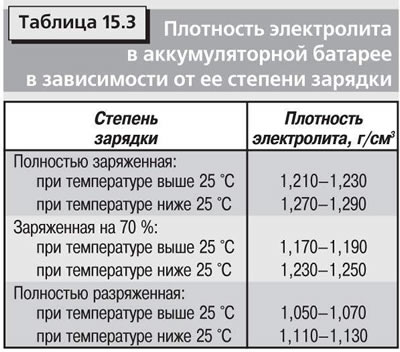
Measure the density of the electrolyte in each jar. A difference in density of 0.04 g/cm³ or more between any two cells indicates electrolyte loss or plate sulfation.
If the electrolyte density between any two cans differs by more than 0.04 g/cm³, the battery must be replaced. If the electrolyte density is lower than required, but the same in all cells, the battery must be charged.
Check the performance of a maintenance-free battery only with a voltmeter. The charge level of a battery with a built-in indicator is determined by the color of the indicator. The green color of the indicator corresponds to a full charge, black indicates the need for charging, and blue indicates a low electrolyte level in the battery.
The original article is on the portal: www.toyotaman.ru