



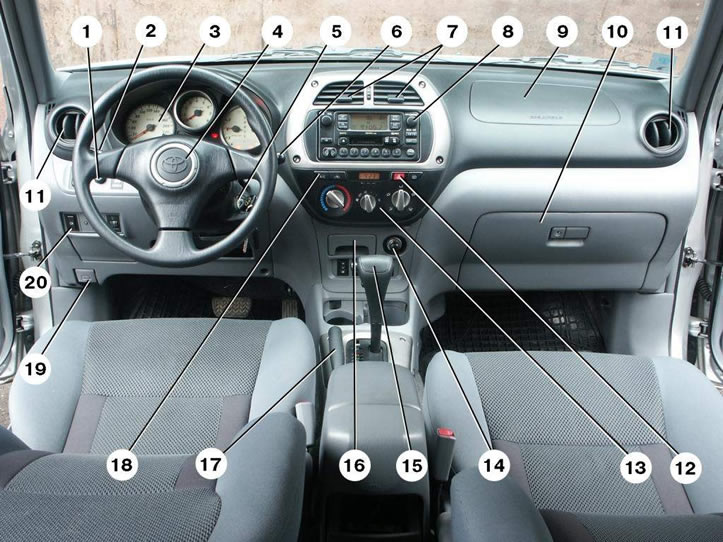
Figure 1.1. Controls, instruments and equipment on vehicles produced since 2001: 1 – instrument lighting control; 2 – steering column switch for low/high beam headlights; 3 – instrument cluster; 4 – Driver airbag/sound signal; 5 – ignition switch; 6 – steering column switch for windshield wipers and washers; 7 – central ventilation grilles; 8 – car radio; 9 – passenger airbag; 10 – glove box; 11 – side ventilation grilles; 12 – Hazard warning light switch; 13 – Heating and ventilation control panel; 14 – cigarette lighter; 15 – selector lever; 16 – ashtray; 17 – parking brake lever; 18 – air conditioning button; 19 – hood opening handle; 20 – Rear fog light switch
The main vehicle controls and instrument cluster are shown in the figure 1.1. and 1.2.
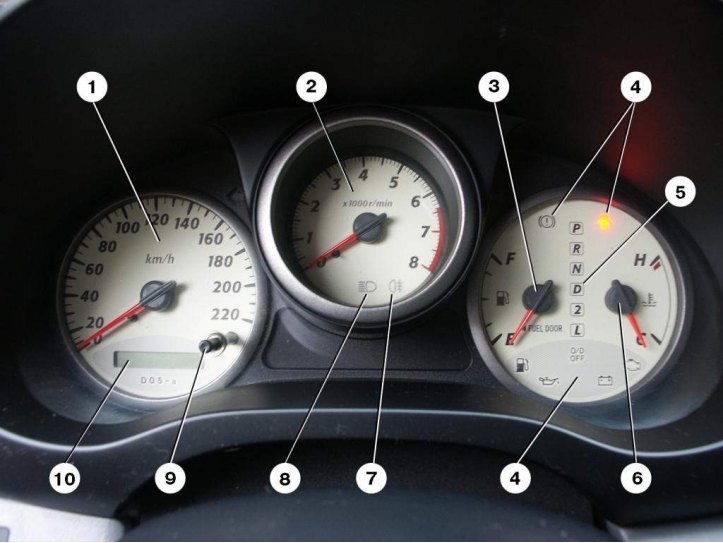
Figure 1.2. Instrument cluster: 1 – speedometer; 2 – tachometer; 3 – fuel level indicator; 4 – maintenance indicators and other indicator lights; 5 – Automatic transmission operating mode indicator; 6 – coolant temperature gauge; 7 – front fog light indicator lamp; 8 – high beam indicator lamp; 9 – odometer reset button; 10 – total mileage odometer and two daily mileage odometers
The instrument cluster includes the following elements:
1 – The speedometer shows the instantaneous speed of the car.
2 – Tachometer.
The tachometer needle should under no circumstances enter the red zone of the scale.
Timely upshifts save fuel and reduce engine and transmission noise.
You should shift to a lower gear as late as possible, shortly before the engine starts jerking.
During the break-in period, avoid running the engine at high crankshaft speed.
3 – Fuel level indicator.
The indicator works when the ignition is on. The car's fuel tank capacity is approximately 58 liters.
4 – Maintenance indicators and other light indicators:
 – brake system malfunction indicator.
When the parking brake is applied and the ignition is on, the lamp lights up. It should go out when the parking brake is released.
The lamp lights continuously when the brake fluid level drops. In this case, stop the car, check and, if necessary, top up the brake fluid level to normal. Check the tightness of all brake drive components and their connections;
 – low battery indicator.
The lamp lights up when the ignition is turned on and goes out after the engine starts. The generator is driven by a durable V-belt.
If the lamp lights up while driving, stop, turn off the engine and check the condition of the V-belt.
If the belt tension is weakened or broken, you cannot continue driving - the engine cooling system pump will also not be activated. Replace the belt if necessary.
If the lamp is on and the alternator drive belt is in good condition, you can continue driving to the nearest service center, but to reduce the discharge of the battery, you should turn off all non-essential power consumers;
 – low engine oil pressure indicator.
Caution! If the light remains on despite the engine oil level being normal, do not continue driving. In this case, the engine must not be allowed to run even at idle speed - qualified assistance is required.
If this lamp lights up while driving, stop, turn off the engine and check the oil level, topping it up to normal if necessary.
 – malfunction indicator.
The automatic control system, with the ignition on and while driving, constantly monitors the performance of certain functions and the condition of individual elements of the vehicle.
This lamp in the instrument cluster alerts you to any malfunctions or the need for repairs or maintenance.
 – low fuel level alarm.
When this lamp lights up, refuel the vehicle.
 – open door alarm.
If even one door is not closed, the lamp will remain lit and will go out after all doors are closed.
5 – Automatic transmission operating mode indicator.
Indicates what gear the automatic transmission is in when the vehicle is moving or what position it is in when the vehicle is stationary.
6 – Coolant temperature gauge.
The indicator works when the ignition is on.
If the needle is in the lower blue area of the scale, avoid increasing engine speed and engine load.
Caution! If the gauge needle is in the upper zone, the coolant temperature is too high. Stop the vehicle, turn off the engine, and determine the cause of the high coolant temperature.
When the vehicle is moving under normal conditions, the arrow should be in the middle zone of the scale.
Under high engine load and high outside air temperature, the needle may occasionally move to the red upper area of the scale;
 – front fog light indicator lamp;
 – high beam indicator lamp.
The lamp lights up when the high beam headlights are on and when the headlight signal is on.
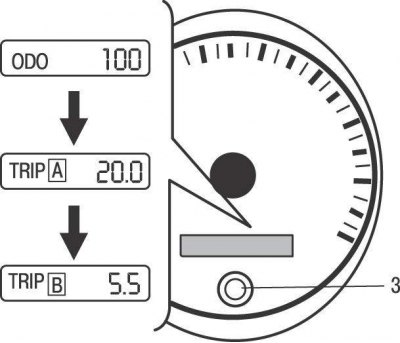
Figure 1.3. Using the trip meter
9 – Daily mileage odometer reset button (figure 1.3).
The trip odometer reset button is used to reset the readings to zero and to switch the display from one odometer to another. To switch the display from one odometer to the other, quickly press and release the button. Each time the button is pressed, the display switches between odometer A and odometer B. To reset odometer A to zero, display odometer A, then press and hold the reset button until the reading is reset to zero. The odometer B is reset in the same way.
10 – Total mileage odometer and two daily mileage odometers.
The total mileage odometer shows the total mileage of the vehicle.
The two trip odometers show two different distances traveled independently of each other since the last time each odometer was reset to zero. You can use one odometer to calculate fuel consumption and another to measure daily mileage. When the power is disconnected, all data from both odometers is lost.