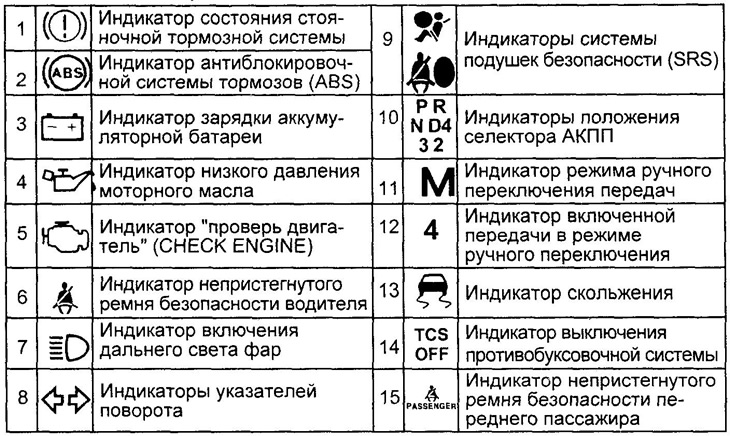
a) The indicator lights up if:
- parking brake engaged;
- low brake fluid level or brake booster leak;
- the electrical circuit of the indicator is faulty.
b) If the indicator lights up while driving, you must slow down, pull off the road and carefully stop the car. You can slow down by braking with the engine and using the parking brake, but do not forget to press the brake pedal to turn on the brake lights to warn drivers behind you about braking.
Check the parking brake, it may be on. If the parking brake is off and the indicator lights up after it is off, there is a problem with the brake system. Check the brake fluid level in the reservoir.
If the brake fluid level is low, check the vehicle's braking efficiency in a safe location. If you think the brakes are still working well, carefully drive the vehicle to the nearest repair facility. If the brakes do not work, the vehicle must be towed or removed for repair.
Warning: Driving a vehicle with low brake fluid is dangerous.
If the brake fluid level is normal, then the brake booster may not be working effectively or the indicator electrical circuit may be faulty.
2. Anti-lock braking system (ABS) indicator.
After the ignition is turned on, the indicator lights up for a few seconds and then goes out. If the indicator lights up while driving or the indicator does not light up or does not go out when the engine is turned on, there may be a malfunction in the anti-lock braking system. The anti-lock braking system (ABS) is turned on when the vehicle speed exceeds 10 km/h and is turned off when the vehicle speed is less than 5 km/h.
Caution: Pressing the brake pedal repeatedly may cause the indicator to come on for a few seconds.
3. Battery charge indicator.
a) The indicator lights up when the ignition key is turned to the "ON" position and should go out after the engine starts.
b) If the indicator lights up while driving, the charging system is faulty or the alternator drive belt is loose (broken). However, the engine will continue to run until the battery is completely discharged. Turn off additional equipment (air conditioner, fan, radio, etc.) and move to the repair site.
4. Low engine oil pressure indicator.
a) The indicator lights up when the ignition key is turned to the "ON" position and should go out after the engine starts.
b) The indicator lights up if the engine oil pressure is too low.
c) If the indicator flashes or lights up while driving, you must pull over to the side of the road and turn off the ignition.
The indicator may flash after sudden braking or when the engine is idling. There is no malfunction if the indicator goes out with a slight increase in engine speed.
The light may come on when the engine oil level is too low. However, this light is not intended to indicate low oil levels, so check the level periodically with the dipstick.
5. Indicator "check engine" ("CHECK ENGINE").
The indicator comes on when the ignition key is turned to the "ON" position for a few seconds and then goes out, informing the driver that the engine management system is being checked. If the indicator remains on or comes on while driving, this indicates that there is a fault in the electronic engine management system.
In this case, it is necessary to go to the repair site and diagnose the engine control system.
6. Driver's seat belt indicator.
The indicator lights up when the ignition is turned on for a few seconds and then goes out. If the driver is not wearing a seat belt, the indicator on the instrument cluster starts flashing continuously.
7. The high beam indicator lights up when the high beam headlights are turned on.
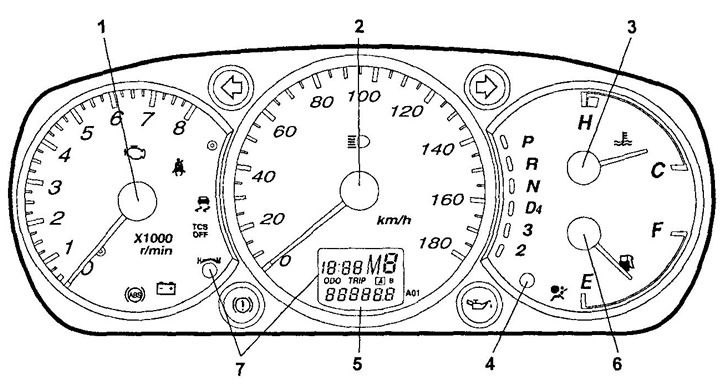
Possible variant of the instrument cluster (type 1).
1 - tachometer,
2 - speedometer,
3 - coolant temperature indicator,
4 - button for switching and resetting the mileage counter to zero,
5 - odometer and trip meter,
6 - fuel quantity indicator,
7 - hours.
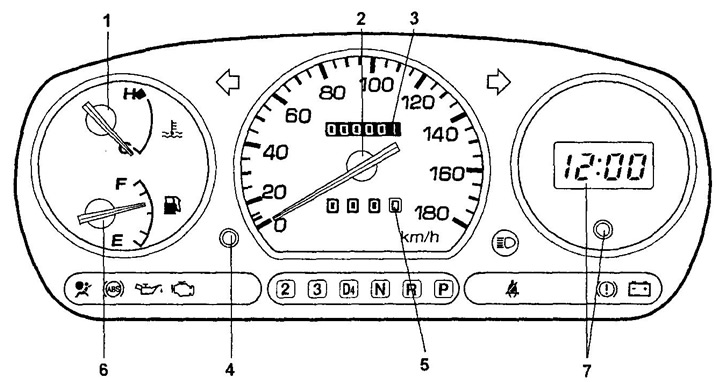
Possible variant of the instrument cluster (type 2).
1 - coolant temperature indicator,
2 - speedometer,
3 - odometer,
4 - button to reset the mileage counter to zero,
5 - mileage counter,
6 - fuel quantity indicator,
7 - hours.
8. Turn signal indicators. The indicators flash when the turn signals or hazard warning lights are on. Excessive flashing of the indicators indicates a poor connection in the turn signal circuit or a failure of the turn signal bulb.
9. Airbag system (SRS) indicator.
The indicators light up when the ignition switch is in the "ON" or "ACC" position. After a few seconds, the indicators go out. If the indicators do not light up or light up while driving, there is a malfunction in the SRS components.
10. Automatic transmission selector position indicators ("P", "R", "N", "D4", "3" or "2").
When the automatic transmission selector is moved to any position, the corresponding indicator "P", "R", "N", "D4", "3" or "2".
11. Manual gear shift mode indicator.
The indicator lights up when manual gear shift mode is engaged.
12. Gear engaged indicator in manual shift mode.
The indicator lights up when manual gear shift mode is engaged and shows the gear engaged.
13. Slip indicator.
The indicator lights up when the ignition key is turned to the "ON" position for a few seconds and then goes out. The indicator flashes after the TCS and VSC systems start working and when the wheels slip. If the indicator lights up when the ignition is turned on and does not go out, this indicates that there are malfunctions in the TCS and VSC systems.
14. Traction control system (TCS OFF) indicator.
The indicator lights up when the ignition switch is in the "ON" position. After a few seconds, the indicator goes out. When you press the "TRC OFF" switch, the system stops working and the indicator lights up. If the indicator does not light up or lights up (flashes) while driving, the system is faulty.
15. Front passenger seat belt indicator.
The indicator lights up when the ignition is turned on for a few seconds and then goes out. If the front passenger is not wearing a seat belt, the indicator lights up constantly.