



Contents: Checking the condition of the tires…↓ Outer edge wear ↓ Wear of the central part ↓ Uneven wear ↓
Checking the condition of the tires and their pressure
1. Regularly checking your tires will save you from the inconvenience of flat tires and will also provide you with vital information about the condition of your steering and suspension, warning you of any potential problems.
2. Normal tire wear can be monitored using a tire depth gauge (see picture).
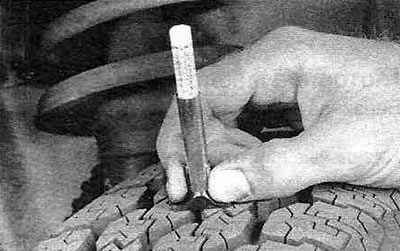
Use a tread depth gauge to determine tire tread wear.
When the tread depth reaches the specified minimum, the tire will need to be replaced.
3. Notice anything abnormal (uneven) tread pattern wear (see picture). Deviations such as bald spots or one-sided wear indicate problems with the front wheel alignment and/or balance. With such problems you should contact a tire shop or auto repair shop.
4. Carefully inspect the tires for punctures, cuts, stuck nails, etc. Sometimes a tire with a stuck nail will hold its pressure for some time or deflate slightly. If your tire pressure is gradually dropping, check the valve core and tighten it securely. Inspect the tread and make sure there are no objects stuck in it. If you suspect a puncture, apply a soapy solution to the suspected area - the bubbles will indicate its presence.
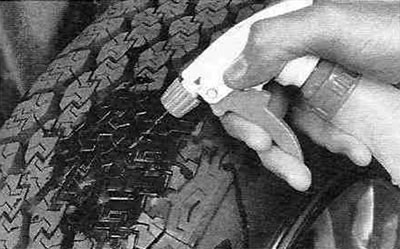
Apply soapy water to the suspected area of the tread - if air is escaping from the probable puncture, bubbles will appear.
5. Carefully inspect the inner sidewalls of each wheel for any signs of brake fluid leakage. If you find them, have your brakes checked immediately.
6. Correct tire pressure will increase tire life, improve traction and vehicle handling. Tire pressure cannot be accurately determined by eye, especially if the tires are radial. It's a good idea to have your own pressure gauge in the glove compartment, as the pressure gauges used at gas stations are not always reliable.
7. The pressure is checked only in cold tires. "Cold" in this case means that the machine has not been used for at least three hours prior to the inspection. When heated, tire pressure can increase by 0.6-1.2 kPa.
8. Unscrew the valve cap that comes out of the wheel rim or hub cap and tightly, without distorting, place the pressure gauge nipple on the valve core (see picture).
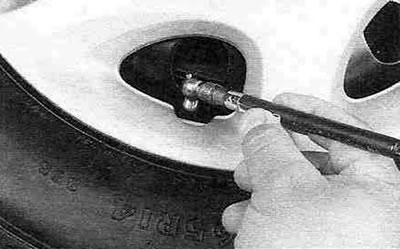
Check your tire pressure at least once a week using a tire pressure gauge (don't forget about the spare tire).
Compare the pressure gauge reading with the recommended value printed on the plate on the left door. Be sure to tighten the cap tightly to prevent dirt and moisture from getting into the valve core. Check all tires and, if necessary, inflate to the recommended value.
9. Don't forget about the spare tire - it also needs to be kept at the correct pressure (check your car's owner's manual). Please note that the pressure specified for a compact spare tire is significantly higher than for regular tires.
Outer edge wear
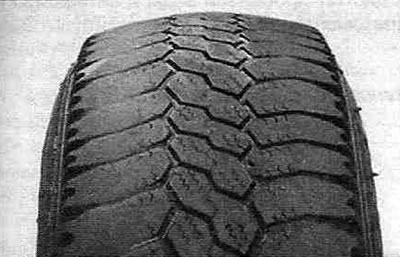
Insufficient tire pressure on both sides
This can cause the tires to overheat because low pressure causes the tire to become deformed and the tread pattern to not adhere properly to the road surface. This can result in loss of traction and increased tire wear, not to mention the risk of sudden tire failure due to overheating.
Check your tire pressure and adjust it to the correct level.
On the one hand, the wheel alignment is broken
Repair or replace suspension components.
Taking corners at high speed
Slow down!
Wear of the central part
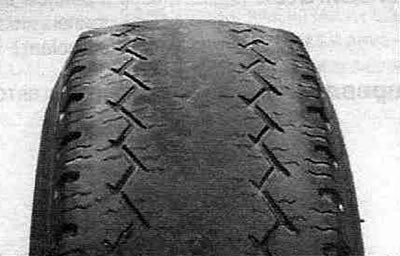
Overinflated tires
Excessive pressure can cause rapid wear of the central part of the tire tread, accompanied by poor traction, lack of smoothness (shaking) and the risk of damage to the tire from shock loads.
Check your tire pressure and adjust it to the correct level.
If you have increased the tire pressure to carry a heavy load or to maintain high speed, be sure to reduce it back to normal.
Uneven wear
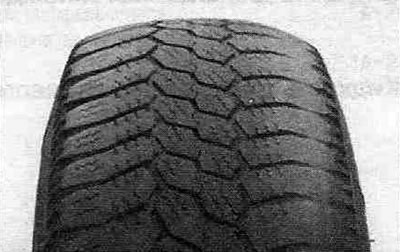
Front wheels may wear unevenly due to misaligned wheel alignment. Most tire shops or auto repair shops can check and adjust your wheel alignment.
Wheel alignment or caster angle is out of adjustment.
Repair or replace suspension components.
Poor suspension performance
Repair or replace suspension components.
Imbalance
Balance the wheel.
Front wheel alignment failure
Adjust the front wheel alignment angles.
Note: The rough edge of the tread with this type of wear is best determined by touch.
This troubleshooting chart will help you determine the condition of your vehicle's tires, possible causes of abnormal wear, and perform the necessary procedures to correct them.