



Contents: Clutch lock switch ↓ Starter unlock switch ↓
Clutch lock switch
The switch is designed to block engine starting if the clutch pedal is not depressed.
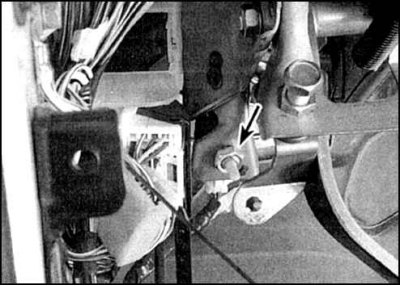
Clutch lock switch (indicated by the arrow) mounted on a bracket at the top of the pedal, secured with 2 nuts, which adjust its position relative to the pedal.
Checking, adjusting and replacing
1. Make sure that the engine starts only when the pedal is depressed.
2. Otherwise, the switch is faulty. Check for voltage at the switch.
3. If there is voltage, then check the ground connection of the second terminal of the switch with the pedal released.
4. If the switch circuit is faulty, correct the fault and retest the switch.
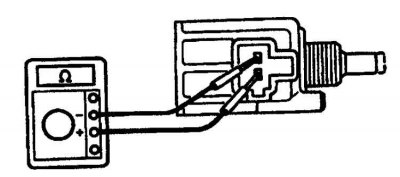
5. If the circuit is in good condition, check the switch contacts for closure. When the pusher is pressed, the contacts should close; when the pusher is released, the contacts should open. Otherwise, replace the switch.
Starter unlock switch
This switch allows the engine to be started without pressing the clutch pedal, which may be necessary in difficult driving conditions (for example uphill). The switch button is located on the left side of the front panel, the canceling switch itself is part of the clutch locking switch.
Checking, adjusting and replacing
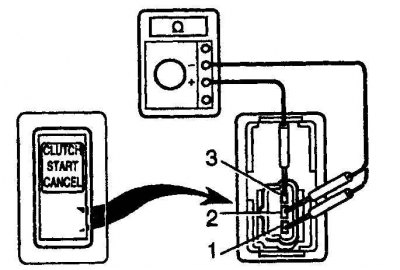
1. Turn the switch to the Off position and connect the (+) lead of the ohmmeter to pin 2 of the switch and the (-) lead of the ohmmeter to pin 1. The ohmmeter should show a break between these pins.
2. In the same position of the button, connect the (+) - output of the ohmmeter to output 3 of the switch, and the (-) - output of the ohmmeter to output 1. Between these outputs, the ohmmeter should show a break. There should also be no circuit between outputs 2 and 3.
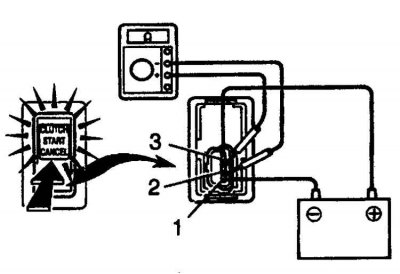
3. Apply 12V power to terminal 3, and connect the (-) battery to terminal 1 (+) - ohmmeter terminal to terminal 2 of the switch, and the (-) - ohmmeter terminal to terminal 1. With the button pressed (in the On position) between these terminals the ohmmeter should show a circuit.
4. When the switch is in the Off position there should be a break between these terminals.
5. Disconnect the battery and turn the switch to the On position. The ohmmeter should show a break between terminals 1 and 2.
6. If the test results differ from those described above, replace the switch.
7. To adjust, loosen the lock nut and rotate the switch until the plunger protrudes 7.5–8.3 mm relative to the lock nut.
8. To replace, remove the lower trim, disconnect the connector, unscrew the lock nut and remove the switch. Installation is performed in the reverse order.