



Checking the steering and suspension

Note: Detailed illustrations of steering and suspension components are provided in chapter 10.
While the car is on wheels
1. With the front wheels in a straight-ahead position, rock the steering wheel. Excessive play (see Figure 13.1) indicates increased wear of the front wheel hub bearings, steering column joints, and steering gear.
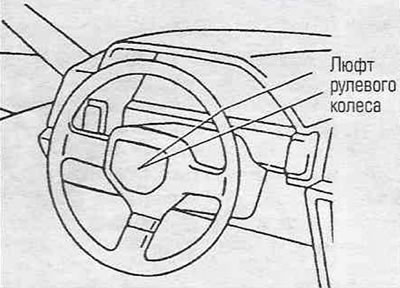
Figure 19.1. Steering wheel play is the distance it travels from the starting point to the point where the front wheels begin to turn.
Repair procedures are described in chapter 10.
2. Other symptoms, such as vehicle swaying on poor roads, poor handling when turning, or steering wheel sticking, indicate a faulty steering mechanism and/or suspension components. Rock the car from every corner. If the car body does not return to its original position after one or two oscillations, this means that the shock absorbers/struts are worn out and need to be replaced. At the same time, make sure that there are no creaking or unusual knocking sounds in the suspension.
3. Make sure there are no shock absorber leaks. "Sweating" is acceptable, but it is important to be able to distinguish it from dripping. Leaking shock absorbers are replaced in pairs on the same axle. For information on suspension components, see. also in chapter 10.
Under the car
4. Raise the vehicle with a jack and place it on safety supports (see "Raising the car with a jack and placing it on safety supports").
5. Check for uneven wear and bulges in the tires (see "Weekly checks"). Check the tightening and fixation of the hub nuts (in the center of the wheel). Replacement of wheel bearings is described in chapter 10.
6. Ask an assistant to rock the steering wheel left and right, checking for any play or binding in the steering column joints. Make sure that the steering rod boots and clamps are intact and that there are no grease leaks. Check for excessive play in the steering tips. Check the condition of the elastic bushings of the suspension components. If the wheels do not immediately respond to steering wheel turns, find the cause of the play. Check all suspension and steering components for loose bolts, disconnected or broken parts.
7. Check the condition of the ball joints by prying the lower arms with a tire iron and trying to rock them up and down (see Figure 19.7).
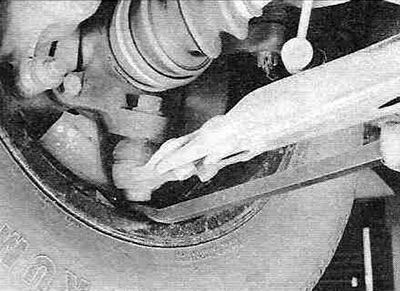
Figure 19.7. To determine the wear of the ball joint, use a crowbar to pry up the lower arm and try to rock it up and down.
If there is even a small amount of play, the ball joints are replaced as described in chapter 10.
8. Check the integrity of the ball joint boots (see Figure 19.8).
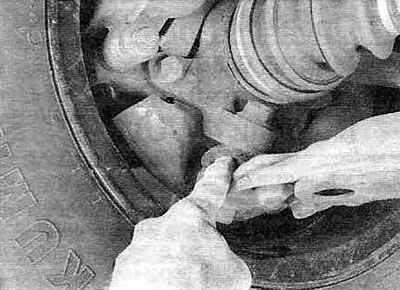
Figure 19.8. Press your finger on the ball joint boot to ensure there is no damage.
If the anthers are damaged, the bearings most likely do not have long to serve - replace them as described in chapter 10.
9. Check the condition of the rear suspension elastic bushings. For more information, please see chapter 10.