



Catalytic converter
Note: On 2001 and later models, the front catalytic converter is integrated into the exhaust manifold. The procedure for removing and installing the exhaust manifold is described in chapter 2B.
General description
1. A catalytic converter is a device that reduces the toxicity of exhaust gases and is built into the exhaust system. All models covered in this manual are equipped with three-way catalytic converters. A three-way catalyst reduces hydrocarbons (HC) and carbon monoxide (CO) by converting them into water (H₂O) and carbon dioxide (CO₂) during combustion. The same reaction removes oxygen from nitrogen oxides (N₂O₃), leaving behind pure nitrogen (N₂).
Examination
2. The testing equipment for catalytic converters is highly complex and expensive. If you suspect a faulty catalytic converter, contact your dealership or a suitably equipped specialist workshop for assistance.
3. Whenever the vehicle is lifted for maintenance or repair, check the external condition of the neutralizer for any punctures, burnouts, or mechanical damage. The welds/bolts at both ends of the neutralizer must be intact. The damaged neutralizer is replaced with a new one.
4. Although the neutralizer is very durable, its service life is not unlimited; it can simply become clogged with soot or crack due to temperature changes (for example, when driving through puddles). The simplest way to check the performance of the neutralizer is vacuum diagnostics along the intake tract:
- Attach a vacuum gauge to the intake manifold (see Chapter 2G).
- Warm up the engine to operating temperature, move the automatic transmission selector lever to the Park or Neutral position and apply the parking brake.
- Take vacuum gauge readings at idle speed.
- Open the throttle, bring the engine speed to almost maximum and quickly close the throttle.
- Repeat the test three more times, recording the instrument readings.
- If after the fourth check the vacuum gauge reading is lower than at idle, then there is damage in the exhaust system (the catalytic converter is clogged with soot or the exhaust pipe is flattened).
Removal and installation
5. Before loosening the nuts on the exhaust manifold flange mounting studs, soak them in liquid wrench and wait for the specified time for the product to work.
6. Loosen the nuts and separate the catalytic converter from the exhaust system (see figure 18.6,a,b).
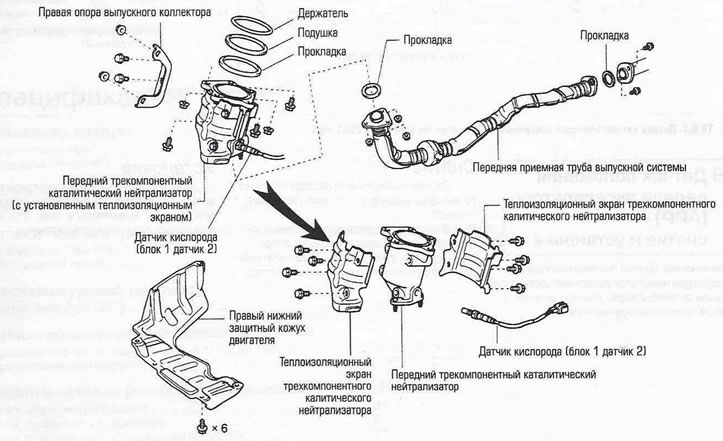
Figure 18.6,a. Catalytic converter parts in models produced before 2000.
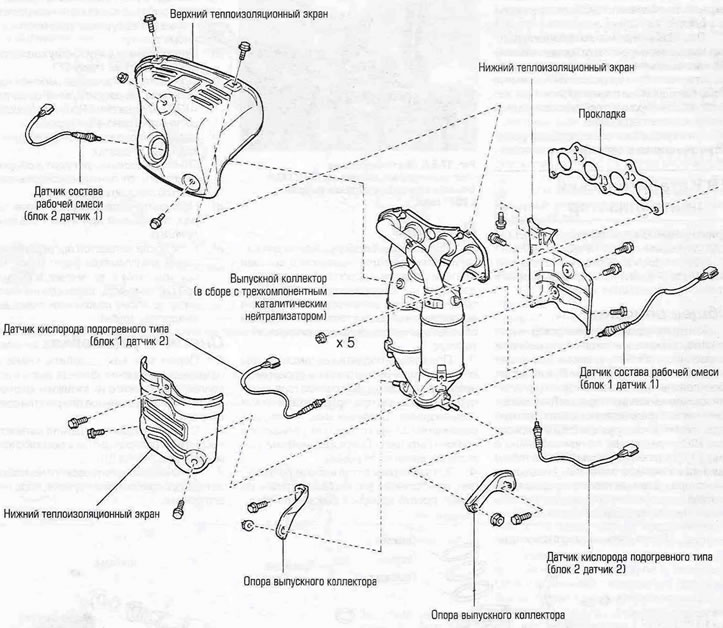
Figure 18.6,b. Catalytic converter parts in models produced since 2001.
7. Installation of the catalytic converter is carried out in the reverse order of its removal.