



When disassembling the hydraulic drive of one wheel, you can limit yourself to bleeding only the circuit that was disassembled.
Press the brake pedal several times and remove the residual vacuum in the booster.
Before bleeding, restore the fluid level in the tank and maintain the level during bleeding, not allowing the tank to empty. Fill only with fresh fluid.
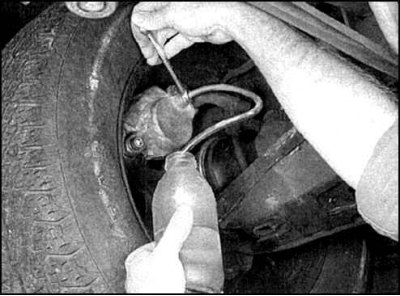
1. Start bleeding from the rear right wheel. Attach a hose to the fitting, lower the other end of the hose into a container with brake fluid.
2. Have an assistant slowly press and hold the brake pedal.
3. Loosen the nipple and after 2 seconds, when the flow of liquid flowing out with bubbles weakens, tighten the nipple. Ask the assistant to release the pedal.
4. Repeat the procedure until no more bubbles are visible in the flowing liquid. Tighten the nipple.
5. Perform these steps in the following order: left rear wheel, right front, left front, pressure regulator. When finished, restore the fluid level in the reservoir.
6. Check the pedal stiffness and brake operation.
Attention! If the pedal is "soft", repeat bleeding. If air cannot be removed, the cause may be air getting into the ABS system valves. Therefore, if the pedal is "soft" after repeated bleeding and the BRAKE or ANTI-LOCK lamps are on, tow the car to a service station for a scanner check.
The official source is on the portal ToyotaMan