
Company Honda Company Ford Company Skoda Company Kia Company Mazda Company Mercedes Company Renault
English Русский
Български
Беларускі
Український
Српски
Hrvatski
Română
Polski
Slovenský
Magyar
Bookmark Articles Sitemap Contacts
ToyotaMan.ru


Camry Corolla Corona Carina Land Cruiser Highlander 4Runner RAV4 Others
4Runner N120 (1989-1995)

Checking the compression in the engine cylinders [Toyota 4Runner N120]

  • Main
  • 4Runner
  • N120 (1989-1995)
  • Power unit
  • Engine overhaul
  • Checking the compression in the engine cylinders
0
The results of the compression test in the engine cylinders allow us to judge the condition of a group of parts in the upper part of the engine (pistons, rings, valves and cylinder head gaskets). Namely, a decrease in compression may be caused by leaks in the combustion chambers due to wear of the piston rings, damage to the valve heads and seats, or burnout of the cylinder head gasket.

Caution: To obtain accurate test results, the engine must be warmed up to normal temperature and the battery must be fully charged.


1. Start by cleaning the areas around the spark plugs using compressed air (if you don't have a compressor, blow out the areas with a car or even a bicycle pump). This is necessary to prevent dirt from getting into the cylinders when measuring compression.

2. Remove the spark plugs (see subsection 2.29).

3. Open the throttle valve fully and secure it in this position.

4. Disconnect the central high-voltage wire from the ignition distributor cap, connect it to ground on the cylinder block. For reliability, connect to ground using a special short-circuiting piece of wire with alligator-type clamps on both ends. It also does not hurt to remove the fuse of the electronic fuel injection system on the mounting block, which will ensure complete shutdown of the electric fuel pump when measuring compression.
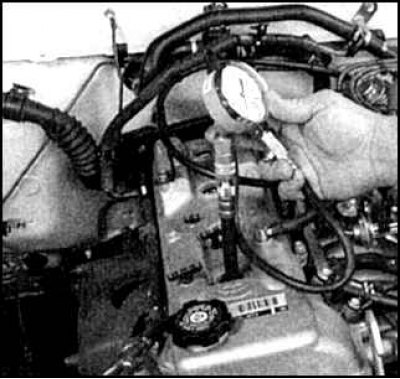


5. Insert the compression gauge into the spark plug hole.


6. Turn on the starter and turn the crankshaft a few revolutions, monitoring the readings of the compression gauge. On a serviceable engine, the pressure should increase quickly. Low pressure after the first stroke of the piston and a slow increase during subsequent compression strokes indicates wear of the piston rings. If the pressure is low after the first stroke of the piston and does not increase during subsequent compression strokes, then the cause is a leak in the valves or a leaky cylinder head gasket (the cause may also be the formation of cracks in the head). Reduced compression can also be caused by carbon deposits on the valve heads. Record the highest compression reading.

7. Repeat the measurement procedure for the remaining cylinders and compare the results with the standard data.

8. Inject a little engine oil into each cylinder through the spark plug hole (about three full syringe oilers), then repeat the tests.

9. If the compression increases after adding oil, then we can make a clear conclusion that the piston rings are worn out. If the compression increases slightly, then the leak is through the valves or the cylinder head gasket. Leakage through the valves can be caused by burnt-out valve seats and/or chamfers, as well as deformation of the valve stems or the formation of cracks on them.

10. If the compression is equally low only in two adjacent cylinders, then the most likely cause is a burnt gasket between these cylinders. Confirmation of this conclusion will be the appearance of traces of coolant in the combustion chambers or in the crankcase of the cylinder block.


11. If the compression reading in one cylinder is 20 percent lower than in the other cylinders and the engine idles unevenly, the cause may be wear on the camshaft cam that controls the exhaust valve.

12. If the compression value exceeds the norm, the combustion chamber is covered with carbon deposits. In this case, the cylinder head must be removed and the carbon removed.

13. If the compression in all cylinders is low, or varies greatly between cylinders, then it is necessary to conduct combustion chamber leak tests, for which you should contact a specialized workshop. As a result of the tests, leak locations should be accurately determined and a quantitative characteristic of the leak should be given.
This article is available at: russian, bulgarian, belarusian, ukrainian, serbian, croatian, romanian, polish, slovak, hungarian
The article material has been checked: Gribkov Vladimir
Share information:
◀ Previous
4Runner N120: Engine overhaul
Next ▶

Engine diagnostics using a vacuum gauge
Engine disassembly procedure
Alternatives to Engine Overhaul
Engine Overhaul — General Information
Technical data of engine overhaul
Dismantling the power unit — preparatory activities
Methods and safety precautions for engine dismantling
Dismantling and installing the engine
Disassembling the cylinder head
Cleaning and checking the cylinder head
Similar articles on other Toyota models

➥ Checking the compression in the engine cylinders Toyota RAV 4 XA10 (1994-2000)
➥ Checking the compression in the cylinders Toyota Camry XV20 (1996-2001)
➥ Checking the compression in the cylinders Toyota Corolla Verso 3 (2004-2009)
➥ Checking the end pressure of the compression stroke of a… Toyota Carina T190 (1992-1996)
➥ Checking the compression in the cylinders Toyota Cruiser 60/80 (1980-1997, petrol)
➥ Checking the compression in the cylinders Toyota Highlander 1 (2000-2007, petrol)
Link in different formats to this article
Comments and feedback from visitors
No comments yet


Add two numbers 24 + 49


4Runner N120 (1989-1995) 
  • General information
  • User manual
  • Maintenance
  • Power unit
  • 4-cylinder engines
  • 6-cylinder engines
  • Engine overhaul
  • Cooling and heating
  • Fuel system
  • Transmission
  • Mechanical gearbox
  • Automatic gearbox
  • Transfer case
  • Clutch
  • Transmission line
  • Chassis, running gear
  • Brake system
  • Car suspension
  • Steering
  • Body and interior
  • Exterior (external elements)
  • Interior (internal elements)
  • Doors, locks and windows
  • Electrical equipment
  • Equipment and devices
  • Ignition system
  • Power devices
  • Electrical circuits
ToyotaMan.ru © 2018–2026 • Mobile version • Interesting about Toyota • Administration • Sitemap: EN BG BY UA RS HR RO PL SK HU • Search system • Bookmark
Camry Vista-V40 • Camry XV10 • Camry XV20 • Camry XV30 • Corolla Verso-AR10 • Corolla E80 • Corona T190 • Carina T170 • Carina T190 • Land Cruiser J70 (diesel) • Land Cruiser J60 (petrol) • Land Cruiser J100 • Highlander XU20 (petrol) • 4Runner N120 • RAV4 XA10 • RAV4 XA20 • Duet M100 • Dyna Y50 •
We require cookies to enable some interactive features. Is that ok with you?