



Note: If the engine lacks power, has excessive oil consumption or increased fuel consumption, the end-of-stroke pressure should be checked.
1. Warm up the engine, then stop it.
2. Disconnect the cable from the negative terminal of the battery.
3. Disconnect the glow plug connector.
4. Remove the glow plugs.
5. Disconnect the fuel shut-off valve connector.
6. Connect the cable to the negative terminal of the battery.
7. Measure the pressure in the engine cylinders.
The text is taken from the specified website: ToyotaMAN
a) Install the compression gauge.
b) While turning the crankshaft with the starter, measure the pressure at the end of the compression stroke.
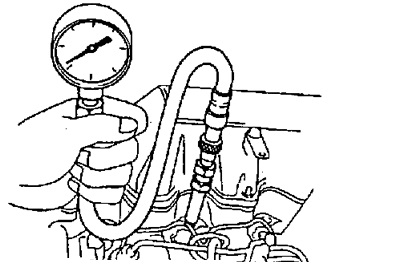
Note: The battery must be fully charged to keep the engine speed at least 250 rpm.
c) Repeat the measurements for each cylinder.
Note: These measurements must be taken as quickly as possible.
- Compression stroke end pressure - not less than 30 bar
- Minimum pressure - not less than 25 bar
- The difference between individual cylinders is no more than 5 bar
d) If low pressure is detected in one or more cylinders, pour a small amount of engine oil into the cylinder through the glow plug hole, then repeat the test for that cylinder again.
- If adding oil increases the end of stroke pressure, the piston rings and/or cylinder are worn or damaged.
- If the pressure remains low, the valve may be stuck or not seating properly, or there may be a gasket leak.
9. Remove the compression gauge.
10. Install the glow plugs.
11. Connect the fuel shut-off valve connector;
12. Connect the cable to the negative terminal of the battery.