
Company Honda Company Ford Company Skoda Company Kia Company Mazda Company Mercedes Company Renault
English Русский
Български
Беларускі
Український
Српски
Hrvatski
Română
Polski
Slovenský
Magyar
Bookmark Articles Sitemap Contacts
ToyotaMan.ru


Camry Corolla Corona Carina Land Cruiser Highlander 4Runner RAV4 Others
Cruiser 100 (1998-2007) Cruiser 60/80 (1980-1997, petrol) Cruiser 70 (1985-1996, diesel)

Checking the compression in the cylinders [Toyota Land Cruiser J60]

  • Main
  • Land Cruiser
  • J60 (1980-1997)
  • Power unit
  • Engine overhaul
  • Checking the compression in the cylinders
0
The results of the compression test in the engine cylinders allow us to judge the condition of the engine parts (pistons, rings, valves and seats, cylinder head gaskets).

To obtain accurate test results, the engine must be warmed up to normal temperature and the battery must be fully charged.

1. Remove the spark plugs.

2. Open the throttle fully.

3. Turn off the ignition by connecting the coil wire to ground. On injection engines, turn off the fuel pump (see subsection 5.1.4).
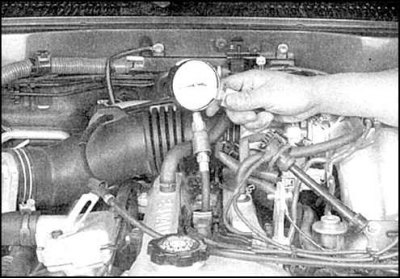


4. Insert the compression gauge into the spark plug hole of cylinder 1.

5. Turn on the starter and watch the pressure gauge. On a working engine, the pressure should build up quickly. Low pressure after the first stroke of the piston and a slow build-up during subsequent compression strokes indicates worn piston rings. If the pressure is low after the first stroke of the piston and does not build up during subsequent compression strokes, the cause is a leak in the valves or a leaky gasket or cylinder head. Record the highest compression reading.

6. Repeat the procedure for the remaining cylinders.

7. Inject some oil (10–15 cm³) into the cylinders. If the compression increases after injecting oil into the cylinder, then we can conclude that the piston rings are worn out. If the compression increases slightly, then the leak is through the valves or the head gasket.


8. If the compression is equally low only in two adjacent cylinders, then the most likely cause is a burnt gasket between these cylinders.

9. If the compression value exceeds the norm, the combustion chamber is covered with carbon deposits. In this case, the cylinder head must be removed and the carbon deposits removed.

10. If there is a significant difference in compression in the cylinders, the car should be taken to a service station to have the cylinder head and block checked for leaks using the pressure testing method.
This article is available at: russian, bulgarian, belarusian, ukrainian, serbian, croatian, romanian, polish, slovak, hungarian
The article material has been checked: Evdokimov Evgeniy
Share information:
◀ Previous
Cruiser 60/80: Engine overhaul
Next ▶

Engine diagnostics using a vacuum gauge
Engine specifications
Engine dismantling and overhaul — general information
Dismantling the power unit
Removal and installation the engine
Alternatives to major repairs
Engine disassembly procedure
Cylinder head — disassembly, inspection and assembly
Similar articles on other Toyota models

➥ Checking the compression in the cylinders Toyota Camry XV20 (1996-2001)
➥ Checking the compression in the cylinders Toyota Corolla Verso 3 (2004-2009)
➥ Checking the compression in the cylinders Toyota Carina T170 (1988-1992)
➥ Checking the compression in the cylinders Toyota Highlander 1 (2000-2007, petrol)
➥ Checking the compression in the engine cylinders Toyota 4Runner N120 (1989-1995)
➥ Checking the compression in the engine cylinders Toyota RAV 4 XA10 (1994-2000)
Link in different formats to this article
Comments and feedback from visitors
No comments yet


Add two numbers 34 + 45


Cruiser 100 (1998-2007) 
  • General information
  • Introduction to the guide
  • Controls and instruments
  • Maintenance
  • Power unit
  • Petrol engines
  • Diesel engines
  • Cooling and heating
  • Power and exhaust systems
  • Engine electrical equipment
  • Engine management systems
  • Transmission
  • Automatic gearbox
  • Transmission line
  • Chassis, running gear
  • Brake system
  • Car suspension
  • Steering
  • Body and interior
  • Exterior (external elements)
  • Interior (internal elements)
  • Doors, locks and windows
  • Electrical equipment
  • Equipment and devices
  • Electrical circuits
Cruiser 60/80 (1980-1997, petrol) 
  • General information
  • User manual
  • Maintenance
  • Power unit
  • Petrol engines 2F and 3F-E
  • Petrol engines 1FZ-FE
  • Engine overhaul
  • Engine electrical equipment
  • Cooling and heating
  • Fuel system (carburetor)
  • Fuel system (injector)
  • Toxicity reduction system
  • Transmission
  • Car gearbox
  • Clutch
  • Transfer case
  • Drive shafts and axles
  • Chassis, running gear
  • Brake system
  • Car suspension
  • Steering
  • Body and interior
  • Exterior and interior
  • Doors, locks and windows
  • Electrical equipment
  • Equipment and devices
  • Electrical circuits
Cruiser 70 (1985-1996, diesel) 
  • General information
  • User manual
  • Maintenance
  • Power unit
  • Engine adjustment
  • Engine repair
  • Fuel system
  • Control system
  • Turbocharging system
  • Cooling and lubrication system
  • Charge and start system
  • Transmission
  • Clutch
  • Mechanical gearbox
  • Automatic gearbox
  • Transfer case
  • Chassis, running gear
  • Car suspension
  • Brake system
  • Steering
  • Body and interior
  • Body elements
  • Heating and air conditioning
  • Electrical equipment
  • Equipment and devices
  • Electrical circuits
ToyotaMan.ru © 2018–2026 • Mobile version • Interesting about Toyota • Administration • Sitemap: EN BG BY UA RS HR RO PL SK HU • Search system • Bookmark
Camry Vista-V40 • Camry XV10 • Camry XV20 • Camry XV30 • Corolla Verso-AR10 • Corolla E80 • Corona T190 • Carina T170 • Carina T190 • Land Cruiser J70 (diesel) • Land Cruiser J60 (petrol) • Land Cruiser J100 • Highlander XU20 (petrol) • 4Runner N120 • RAV4 XA10 • RAV4 XA20 • Duet M100 • Dyna Y50 •
We require cookies to enable some interactive features. Is that ok with you?