
Company Honda Company Ford Company Skoda Company Kia Company Mazda Company Mercedes Company Renault
English Русский
Български
Беларускі
Український
Српски
Hrvatski
Română
Polski
Slovenský
Magyar
Bookmark Articles Sitemap Contacts
ToyotaMan.ru


Camry Corolla Corona Carina Land Cruiser Highlander 4Runner RAV4 Others
Camry XV30 (2001-2006) Camry XV20 (1996-2001) Camry XV10 (1991-1996) Camry Vista V40 (1994-1998)

Checking the compression in the cylinders [Toyota Camry XV20]

  • Main
  • Camry
  • XV20 (1996-2001)
  • Power unit
  • 4-cylinder engine
  • Checking the compression in the cylinders
0

Numbering and sequence of cylinders
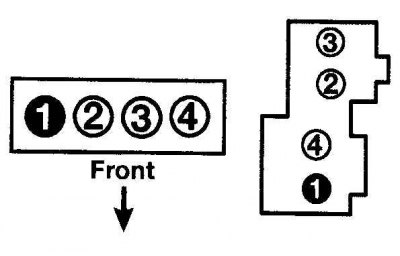


If the engine runs poorly or intermittently, check the ignition system and fuel system. If the reasons for poor engine performance cannot be found, perform a compression test. Regularly performing this test will also allow you to prevent malfunctions in advance.

To perform the check, the engine must be warm, the battery must be charged, and the spark plugs must be unscrewed.

Disable the ignition system by disconnecting the ignition coil high tension wire from the distributor cap. Ground the wire to the cylinder block.

Connect a compression tester to the spark plug hole of cylinder N1.

Open the throttle valve fully and turn the engine crankshaft with the starter. After one or two revolutions, the compression pressure should increase to the maximum mark and then stabilize. Write down the result.

Perform a similar check on the remaining cylinders and record the readings obtained.

The pressure in all cylinders should be the same. A difference of more than 2 bar between any two cylinders indicates a malfunction. In a healthy engine, the pressure should build up quickly. Low first-stroke pressure that gradually increases with subsequent strokes indicates worn piston rings. Low first-stroke pressure that does not build up with subsequent strokes indicates a leak in the valves or a blown head gasket. Deposits on the bottom of the valves can also cause low compression.


If you have any doubts during the inspection, please contact the specialists.

If the pressure in any cylinder is too low, perform the following test to determine the cause. Pour a teaspoon of clean motor oil into the cylinder through the spark plug hole and repeat the pressure test.

If the compression pressure increases after adding oil, it means the piston or cylinder is worn. If the pressure does not increase, it means the valves are worn or burnt, or the cylinder head gasket is broken.

Low pressure in two adjacent cylinders almost always means that the head gasket between them is blown.

If one of the cylinders is about 20% lower in pressure than the others, and the engine is not idling properly, it means that the cause may be a worn camshaft cam.

If the pressure is very high, the combustion chambers are likely coated with carbon deposits.

After completing the check, screw the spark plugs back into place and connect the ignition system.
This article is available at: russian, bulgarian, belarusian, ukrainian, serbian, croatian, romanian, polish, slovak, hungarian
The article material has been checked: Kolokoltsev Grigory
Share information:
◀ Previous
Camry XV20: 4-cylinder engine
Next ▶

Technical characteristics of 4-cylinder engines
Top dead center (TDC) of piston N1
Cylinder Head Cover — Removal and Installation
Intake manifold — removal and installation
Exhaust manifold — removal and installation
Timing belt and sprockets
Similar articles on other Toyota models

➥ Checking the compression in the engine cylinders Toyota 4Runner N120 (1989-1995)
➥ Checking the compression in the engine cylinders Toyota RAV 4 XA10 (1994-2000)
➥ Checking the compression in the cylinders Toyota Highlander 1 (2000-2007, petrol)
➥ Checking the compression in the cylinders Toyota Cruiser 60/80 (1980-1997, petrol)
➥ Checking the compression in the cylinders Toyota Corolla Verso 3 (2004-2009)
➥ Checking the compression in the cylinders Toyota Carina T170 (1988-1992)
Link in different formats to this article
Comments and feedback from visitors
No comments yet


Add two numbers 32 + 33


Camry XV30 (2001-2006) 
  • User manual
  • Vehicle description
  • Keys, locks and alarms
  • Governing bodies
  • Salon equipment
  • Driving and operation
  • Maintenance
  • Power unit
  • 4-cylinder engine
  • Control system (I4)
  • Engine overhaul (I4)
  • 6-cylinder engine
  • Control system (V6)
  • Engine overhaul (V6)
  • Transmission
  • Clutch
  • Mechanical gearbox
  • Automatic gearbox
  • Drive mechanism
  • Chassis, running gear
  • Wheels and tires
  • Car suspension
  • Steering
  • Brake system
  • Body and interior
  • Exterior (external elements)
  • Doors, locks and windows
  • Air conditioning and heater
  • Electrical equipment
  • Equipment and devices
  • Power devices
  • Electrical circuits
Camry XV20 (1996-2001) 
  • General information
  • Controls and instruments
  • Driving and operation
  • Daily care
  • Maintenance
  • Power unit
  • 4-cylinder engine
  • 6-cylinder engine
  • Engine overhaul
  • Engine electrical equipment
  • Cooling system
  • Heating and ventilation
  • Fuel system
  • Exhaust system
  • Transmission
  • Mechanical gearbox
  • Automatic gearbox
  • Clutch
  • Chassis, running gear
  • Suspension and axle shafts
  • Steering
  • Brake system
  • Body and interior
  • Exterior (external elements)
  • Interior (internal elements)
  • Doors, locks and windows
  • Electrical equipment
  • Equipment and devices
  • Electrical circuits
Camry XV10 (1991-1996) 
  • General information
  • User manual
  • Maintenance
  • Power unit
  • 4-cylinder engine
  • 6-cylinder engine
  • Overhaul of engines
  • Cooling and heating
  • Fuel system
  • Engine electrical equipment
  • Control system
  • Transmission
  • Mechanical gearbox
  • Automatic gearbox
  • Clutch and drive shafts
  • Chassis, running gear
  • Brake system
  • Car suspension
  • Steering
  • Body and interior
  • Exterior (external elements)
  • Interior (internal elements)
  • Doors, locks and windows
  • Electrical equipment
  • Equipment and devices
  • Headlights and lighting
  • Electrical circuits
Camry Vista V40 (1994-1998) 
  • General information
  • User manual
  • Maintenance
  • Power unit
  • Petrol engines
  • Diesel engines
  • Engine overhaul
  • Cooling and lubrication system
  • Fuel system (diesel)
  • Fuel injection (petrol)
  • Engine electrical equipment
  • Transmission
  • Clutch and cardan
  • Automatic gearbox
  • Chassis, running gear
  • Front suspension
  • Rear suspension
  • Steering
  • Brake system
  • Body and interior
  • Body elements
  • Air conditioning and heater
  • SRS security system
  • Electrical equipment
  • Equipment and devices
  • Electrical circuits
ToyotaMan.ru © 2018–2026 • Mobile version • Interesting about Toyota • Administration • Sitemap: EN BG BY UA RS HR RO PL SK HU • Search system • Bookmark
Camry Vista-V40 • Camry XV10 • Camry XV20 • Camry XV30 • Corolla Verso-AR10 • Corolla E80 • Corona T190 • Carina T170 • Carina T190 • Land Cruiser J70 (diesel) • Land Cruiser J60 (petrol) • Land Cruiser J100 • Highlander XU20 (petrol) • 4Runner N120 • RAV4 XA10 • Duet M100 • Dyna Y50 •
We require cookies to enable some interactive features. Is that ok with you?