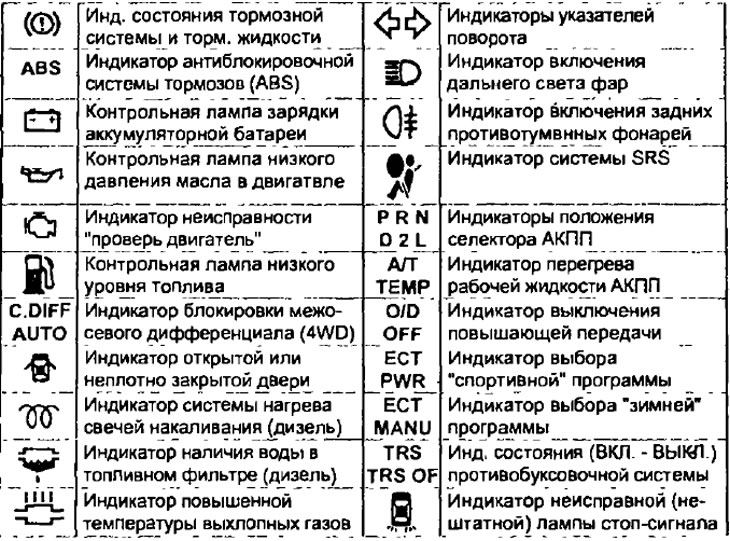
CAUTION: When working in the passenger compartment of a vehicle equipped with an airbag system and seat belt pretensioners (sRS system), special care should be taken to avoid damaging the SRS control unit. To avoid accidental deployment of the airbags or seat belt pretensioners, set the wheels to the straight-ahead position and the ignition switch to the "LOCK" position before starting work, disconnect the cable from the negative terminal of the battery and wait at least 90 seconds (backup power discharge time). Do not attempt to disassemble the air bag assembly or the seat belt pretensioner assembly, as there are no serviceable parts in these assemblies. If the air bags and/or seat belt pretensioners have deployed (were unfolding), then they cannot be repaired or reused.
1. Brake system status indicator.
a) The indicator lights up if
- parking brake on;
- low brake fluid level or brake booster leak;
- the electrical circuit of the indicator is faulty.
b) If the indicator lights up while driving, slow down, pull off the road and stop the car carefully
- Check the parking brake, it may be on. If the parking brake is off or the indicator lights up after it is off, there is a problem with the brake system.
- Check the brake fluid level in the reservoir. If the brake fluid level is low, check the vehicle's braking efficiency in a safe place.
- If you think the brakes are still working well enough, carefully drive the car to the nearest repair facility. If the brakes are not working, the car will need to be towed or removed for repair.
Warning: Driving a vehicle with low brake fluid is dangerous.
- If the brake fluid level is normal, then the brake booster may not be working effectively or the indicator electrical circuit may be faulty.
2. ABS indicator.
After turning on the ignition, the indicator lights up for a few seconds and then goes out. If the indicator lights up while driving, there may be a malfunction in the anti-lock system.
Attention:
- When the center differential is locked, ABS does not work and the ABS indicator lights up constantly.
- Pressing the brake pedal repeatedly may cause the indicator to come on for a few seconds.
3. Battery charging indicator lamp.
- a) The indicator lamp lights up when the battery is discharged.
- b) If the indicator light comes on while driving, the charging system is faulty or the alternator belt is loose. However, the engine will continue to run until the battery is completely discharged. Turn off additional equipment (air conditioner, fan, radio, etc.) and move to the repair site.
4. Low oil pressure indicator lamp.
- a) The indicator lamp lights up if the engine oil pressure is too low.
- b) If the indicator lamp flashes or lights up continuously while driving, pull off the road to a safe place and stop the engine immediately.
The indicator lamp may flash after sudden braking or when the engine is idling. There is no malfunction if the indicator lamp goes out with a slight increase in engine speed
The control lamp may turn on when the engine oil level is too low. However, this control lamp is not intended to inform about low oil level, so periodically check the level with the dipstick.

General view of the instrument panel. 1 - clock; 2 - audio system; 3 - hazard warning switch; 4 - Rear window defroster switch; 5 - Windscreen wiper and washer switch; 6 - instrument cluster; 7 - ignition switch; 8 - headlight and turn signal switch; 9 - Rear fog light switch; 10 - Front fog light switch; 11 - hood opening handle; 12 - steering column angle adjustment lever; 13 - windshield washer button; 13 - Interaxle differential lock switch; 14 - air conditioning and heating control panel; 15 - ashtray; 16 - cigarette lighter; 17 - storage box; 18 - signal flare; 19 - interaxle differential lock button (for some 4WD models).
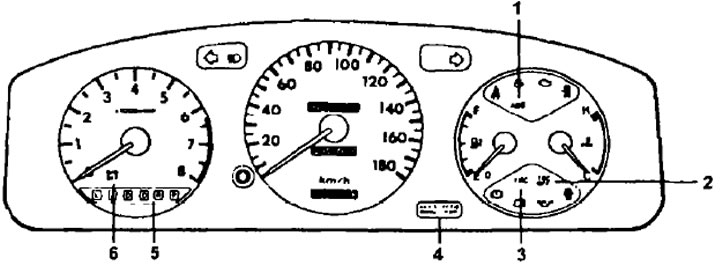
General view of one of the instrument cluster variants. 1 - ABS system indicator; 2 - indicators of the TRC system being on; 3 - TRC system off indicator; 4 - indicator for selecting the "sport" and "winter" automatic transmission programs; S - indicator of automatic transmission operating modes; 6 - Automatic transmission overdrive off indicator
The original can be viewed on the website (www.ToyotaMAN.ru)
5. Check engine light.
The indicator lights up if there are any faults in the engine management system
6 Low Fuel Warning Light
The indicator lamp comes on when the fuel level in the tank approaches zero. Depending on the vehicle's configuration, the fuel may be sufficient for 40-60 km of travel on a good road. On slopes or when turning, the indicator lamp may come on due to fluctuations in the fuel in the tank.
7. Airbag and Belt Tensioner System Indicator (SRS)
The indicator comes on when the ignition switch is in the "ON" or "ACC" position. The indicator goes out after about 6 seconds. If the indicator does not come on or comes on (flashes) while driving, there is a malfunction in the SRS system components.
8. Indicator of the presence of an open or loosely closed door.
The indicator remains on until all doors, including the tailgate, are completely closed.
9. Sound signal to remind you that the light is on.
The horn will sound if the driver's door is opened with the ignition key in the "LOCK" position and the headlights on. Even if the key is removed, the horn will continue to sound until the headlights are turned off.
10. Sound signal to remind about ignition key not being removed
The horn will sound if the driver's door is opened while the ignition key is in the "LOCK" or "ACC" position.
11. Odometer and trip meters.
- a) The odometer shows the total mileage of the vehicle.
- b) The trip meter shows the distance traveled since the last time the meter was set to zero.
- c) The button located to the left of the speedometer is used to reset the odometer readings to zero
12 Headlight and direction indicator switch.
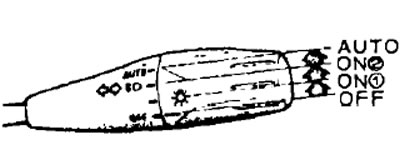
- a) When the knob is turned to the "ON 1" position, the side lights, license plate light and instrument panel light are turned on
- b) When the knob is turned to the "ON 2" position, the low beam headlights are turned on.
Caution: To avoid discharging the battery, do not leave the headlights on for a long period of time when the engine is off.
- c) When turning the handle to the "AUTO" position (on some models) when the illumination decreases (entering a tunnel, twilight, etc.) the low beam headlights are turned on automatically.
- d) To turn on the high beam headlights, push the lever away from you. To turn off the high beam headlights and turn on the low beam headlights, pull the lever towards you.
- d) To briefly turn on the high beam headlights (High beam headlights alarm) pull the lever towards you until it stops, then release the lever.
- e) To turn on the turn signal, move the lever up or down. The lever will automatically return to its original position after completing the turn. However, when changing lanes, you may need to return the lever to the neutral position by hand.
Caution: If the turn signal indicators on the instrument cluster flash more frequently than usual, the front or rear turn signal bulb has burned out.