



Engine cooling system
All vehicles covered by this manual use a sealed engine cooling system with thermostatically controlled coolant circulation (Fig. 1.1). Coolant is circulated through the engine by a centrifugal pump mounted on the front of the cylinder block. The coolant flows past each cylinder and enters the rear of the engine. It then passes through passages in the cylinder head casting and cools the ports of the intake and exhaust valves, the spark plug area and the exhaust valve guides.
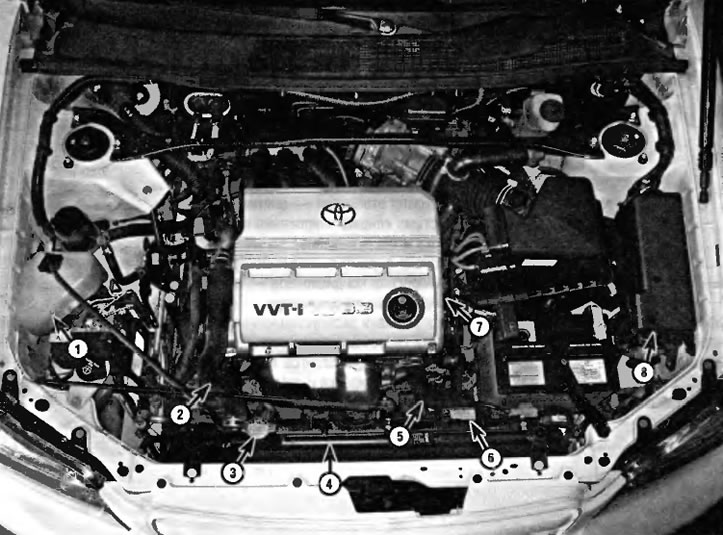
Fig. 1.1. Typical arrangement of cooling system elements (vG engine shown, similar for four-cylinder engine)
1 - Expansion tank
2 - Upper radiator hose
3 - Radiator cap
4 - Radiator
5 - Lower radiator hose
6 - Cooling fans
7 - Thermostat (approximate installation location shown)
8 - Fuse and relay box
The wax-filled thermostat is located in a suitable housing near the front of the engine (Fig. 1.2). During the warm-up phase, the closed thermostat prevents coolant from passing through the radiator. When the engine reaches normal operating temperature, the thermostat opens and hot coolant is allowed to pass through the radiator, where it is cooled before returning to the engine.
(The original publication can be found on the website: toyotaman.ru)
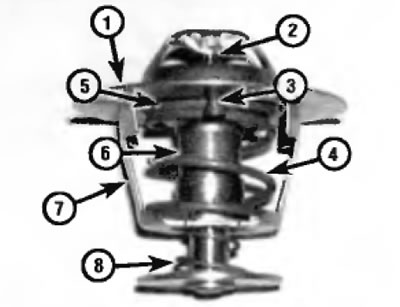
Fig. 1.2 Typical thermostat
1 - Flange
2 - Piston
3 - Overflow valve
4 - Valve spring
5 - Valve seat
6 - Valve
7 - Frame
8 - Secondary spring
The cooling system is sealed with a hermetically sealed radiator cap. This allows the boiling point of the coolant to be raised, and the higher boiling point allows the radiator to provide greater cooling efficiency. If the system pressure exceeds the pressure relief valve in the cap, a spring-loaded valve opens and coolant is allowed to flow through the overflow pipe into the expansion tank. As the system cools, excess coolant is automatically drawn from the tank back into the radiator.
The expansion tank serves as a reservoir from which fresh coolant is added to the cooling system to maintain the correct fluid level, and as a catch basin for overheated coolant.
This type of cooling system is called a "closed system" because the coolant that leaks out of the sealed cap is saved and reused.
Heating system
The heating system consists of a blower fan and a heater core located in the heater housing, inlet and outlet hoses connecting the heater core to the engine cooling system, and a heater/air conditioning control panel on the front panel. Hot coolant circulates through the heater core. When the heating mode is activated, a flap opens, opening a passage from the heater housing to the vehicle interior. The fan switch on the control panel activates an electric fan, which forces air through the heater core, where it is heated.
Air conditioning system
The air conditioning system consists of a condenser mounted in front of the radiator, an evaporator mounted next to the heater core under the dash panel, a compressor mounted on the engine, a receiver-dryer containing a high-pressure relief valve, and lines connecting all of these elements.
The blower fan forces warmer air from inside the car through the evaporator core, transferring heat from the air to the refrigerant. The liquid refrigerant is converted to a low-pressure vapor, removing heat as it leaves the evaporator. The compressor keeps the refrigerant circulating through the system, forcing the heated refrigerant through the condenser, where it is cooled and then returned to the evaporator.
Some models are equipped with an optional (installed at the customer's request) automatic air conditioning. With this system, you select the desired cabin temperature with a button on the control panel, similar to setting the temperature on a home heating/cooling thermostat, and the system automatically adds the correct mixture of cool or warm air to maintain that temperature. The system has sensors that detect both the cabin temperature and the outside temperature.