



Elements of the engine cooling system
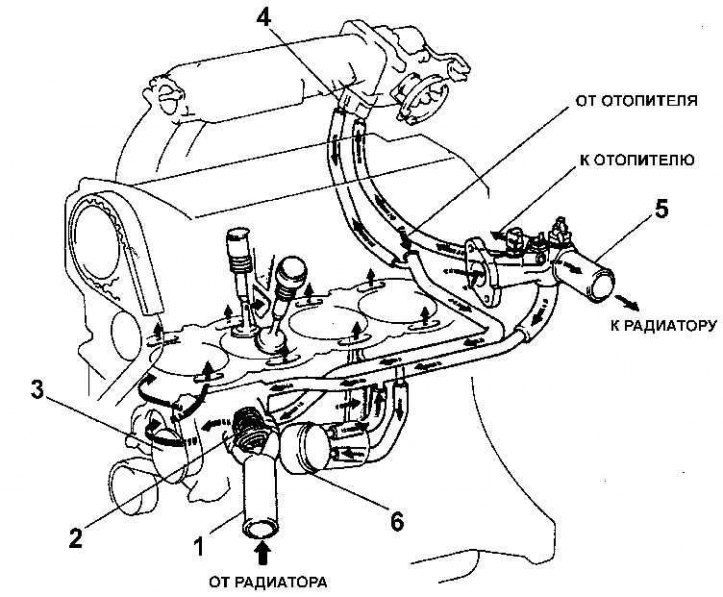
1 – Coolant inlet pipe; 2 – thermostat; 3 – water pump; 4 – IAC valve; 5 – coolant outlet from the engine; 6 – oil radiator
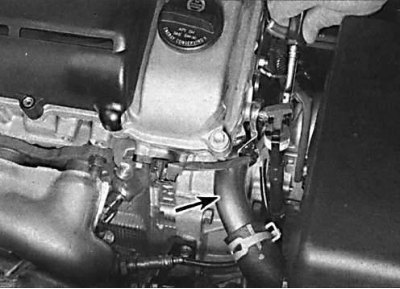
Location of the coolant supply pipe to the engine on the 1MZ-FE V6 engine
Caution! When opening the expansion tank cap on a hot engine, be careful as hot fumes may escape and cause severe burns.
Caution! Avoid contact of coolant with clothing and paintwork. If this happens, rinse the surface with plenty of water.
(The publication is taken from the website toyotaman.ru)
Warning! After turning off a hot engine, the radiator fan may turn on.
The sealed cooling system includes a pump, radiator, expansion tank, electric radiator fan and thermostat. When starting a cold engine, coolant circulates around the cylinder block, cylinder head and exhaust manifold. Warm coolant passes through the heater core and returns to the water pump. As the coolant expands when heated, its level in the expansion tank rises. The coolant flow through the radiator is closed, which ensures a closed thermostat. When the coolant reaches a predetermined temperature, the thermostat opens and the hot coolant passes through a hose to the radiator. As the coolant passes through the radiator, it is cooled by the oncoming air flow. An electric radiator cooling fan, mounted behind the radiator, is controlled by a thermal sensor located in the radiator. In addition to the usual coolant temperature gauge, temperature switches and sensors are installed to ensure the operation of the fuel injection system and the ignition system.