



Automatic transmission
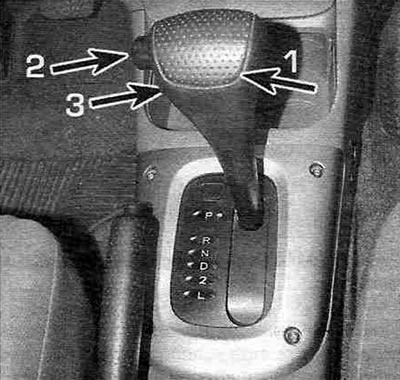
Figure 37.
1 - Selector lever.
2 - Lock button.
3 - Overdrive switch.
Selector lever
The selected mode is displayed on the instrument panel:
- R Parking, starting the engine and removing the key.
- R Reverse.
- N Neutral position.
- D Normal driving mode (with overdrive engaged).
- 2 Improved engine braking.
- L Maximum engine braking.
The automatic transmission has a locking system that prevents incorrect gear shifting. This means that shifting from position "P" can only be done if three conditions are met simultaneously:
- The brake pedal is pressed.
- The ignition key is in the "ON" position.
- The lock button is pressed.
To prevent incorrect shifting:
- With the brake pedal depressed, shift from P to R while holding the release button pressed. The ignition key must be in the "ON" position.
- Shift between D-2*, 2-L, N-R and R-P while holding the lock button down.
- Shift R-N, N-D, L-2, 2-D and D-N in the usual way (no need to press the button).
*Left-hand drive models: Shift by holding down the release button. right-hand drive models: Shift in the normal manner.
Overdrive switch
To disengage overdrive, press the switch. The "O/D OFF" indicator will appear on the instrument panel. To re-engage the overdrive, press the switch again. The "O/D OFF" indicator light should go out.
Driving with the overdrive gear engaged allows you to save fuel and reduce the noise of the power unit.
If the engine is stopped with the overdrive gear disengaged, the overdrive gear will be engaged automatically the next time the engine is started.
Features of operating a car with an automatic transmission
Failure to observe the following precautions will result in damage to the automatic transmission.
- Move the selector lever to the Park position only after the vehicle has come to a complete stop.
- Reverse mode should be engaged only after the vehicle has come to a complete stop, with the engine idling.
- Do not move the selector lever from Reverse, Park, or Neutral to Drive if the engine speed is above idle.
- When changing the driving mode from forward to reverse, or if the vehicle is stationary, press and hold the brake pedal before engaging them.
- Revving the engine while simultaneously pressing the brake pedal to achieve a "rocket launch" can result in a "landing" in the workshop, costly repairs, or replacement of the automatic transmission.
Although manufacturers and many other sources allow for a more relaxed towing mode, we recommend sticking to the old 20x30 rule: with the selector lever in the "Neutral" position, towing the vehicle at a speed of no more than 20 km/h for a distance of no more than 30 kilometers, or at a speed of 30 km/h, but for a distance of no more than 20 kilometers. And only in extreme cases! If the engine can run, it's best to start it so the automatic transmission can cool down (the engine and automatic transmission cooling systems are combined). If you need to transport your car a longer distance, use a tow truck.
Before starting the engine, check the position of the selector lever and press the brake pedal. The engine will only start in positions "P" or "N".
In cold weather, before starting to move, move the selector through all positions, holding in each of them for a few seconds. Then engage one of the driving ranges and hold the car with the brake for a few minutes, while the engine should be idling (warming up the transmission fluid).
Before starting to move, press the brake pedal, move the selector to the desired position without pressing the throttle pedal. After a characteristic slight push (the ease of the push depends on the condition of the automatic transmission) and reduce idle speed, release the brake pedal and start moving by pressing the gas pedal.
For the first few days after starting to drive, avoid dynamic driving until the oil and fluids in all units have warmed up to operating temperature.
If you're just starting out with an automatic transmission, try to break some of the habits you developed with a manual transmission. Resist the temptation to manually shift into the next gear while accelerating or to shift into neutral or a lower gear when braking unless engine braking is required. During the first few days of getting used to it, move your left foot further away from the pedals to avoid pressing the brake instead of the non-existent clutch.
In mountainous and other severe conditions, use range "2" or "L".
The selector lever can be switched while driving, but not to all positions. It is strictly forbidden to move the lever to the "P" and "R" positions while moving forward. The lever may only be moved to these positions when the vehicle is completely stopped. It is not recommended to shift the transmission to the "N" position while driving unless absolutely necessary. If this happens, release the accelerator, wait until the engine speed drops to idle, and only then shift to "Drive." All other positions can be shifted while driving. The only limitation is not to exceed the permissible engine speed.
Moving the selector from position "D" to position "2" will increase the effectiveness of engine braking by forcibly engaging a lower gear. Release the accelerator pedal before moving the lever. As the speed decreases (no higher than 50 km/h) you can also shift the selector to the "L" position. Don't expect the same deceleration as with a manual transmission, as the engine braking effect is greatly reduced by torque converter slippage.
For quick acceleration, such as when overtaking, it's also helpful to shift the gear selector from position "D" to position "2." In this case, keep an eye on the tachometer or speedometer to avoid overrevving the engine. Pressing the accelerator pedal harder will also result in later gear shifts and more efficient acceleration.
To achieve maximum acceleration, quickly press the accelerator pedal all the way down, then briefly release it sharply—the transmission will downshift by one or two gears into "kick-down" mode—and continued pressure on the accelerator will provide the fastest possible acceleration. In this case, reverse upshifting can only occur when the engine reaches maximum speed. If you release the accelerator pedal, the gearbox will return to normal operation. Do not use the kick-down mode unless necessary, so as not to reduce the life of the unit.
Before turning, use kickdown mode to increase front axle load and enter the turn in a lower gear. Another option is to shift the transmission selector to position "2" before entering the turn.
When making short stops, be sure to hold the vehicle by pressing the brake pedal, as the car may start moving even when idling, which may result in torque being transferred completely to the drive wheels. However, this effect can be used for slow maneuvering in tight spaces.
Shift the range selector lever to "N" only during long stops in traffic jams in hot weather to reduce heat generation and prevent the transmission oil from overheating. In other cases, this is not recommended.
To securely park the vehicle on relatively level surfaces, a functioning automatic transmission output shaft locking mechanism (in the "P" position) is sufficient. However, if the vehicle is parked on a slope, engaging the parking brake is mandatory. Moreover, you must first apply the parking brake and only then move the selector lever to the "P" position.
On slippery roads, when forced downshifting, the drive wheels may begin to slip, which can lead to skidding. Nothing terrible happens when an automatic transmission slips. Increased heat generation in the torque converter in this case can only be critical if the cooling system has low efficiency (the automatic transmission cooling radiator is clogged with corrosion products and there is no additional heat exchanger).
If you regularly tow a trailer, consider installing an additional heat exchanger in the automatic transmission cooling system. Using overdrive is not recommended when the vehicle is fully loaded or when towing a trailer. In such cases, start accelerating in range "2" and at a speed of about 40 km/h, move the selector to position "D".
If you are stuck in snow or mud, turn on the downshift mode "2" (turn off the "D" mode). Then, using the brake pedal as a clutch, i.e. gently releasing it, ensure that the wheels rotate slowly. At the point of "hanging", press the brake, switch the selector to reverse, etc.
Do not neglect automatic transmission maintenance.
At the first suspicion of a malfunction, carry out diagnostics. Don't trust automatic transmission repairs to dubious specialists—use the services of a dealership or specialized workshop.