



Attention! Inspection and repair of exhaust system components should be performed only after the system has completely cooled down.
1. The exhaust system consists of the exhaust manifold, catalytic converters, muffler, tail pipe, and the exhaust pipes that connect these components together, as well as the hangers and clamps that support and secure these components. The exhaust system is attached to the body using support brackets and rubber hangers (fig. 16.1, a) If any of these components are damaged or worn, increased noise and vibration will be transmitted to the body. The exhaust system consists of various sections that are bolted together. Some of these sections are made up of several components welded into one assembly. For example, the center section of the exhaust system, which is also the longest section, includes the rear catalytic converter and the pre-muffler (fig. 16.1, b, c). If any of these components are damaged, you will need to replace the entire assembly or cut off the catalytic converter or muffler and weld in a new unit. You will also need to remove the center exhaust pipe to remove the fuel tank.
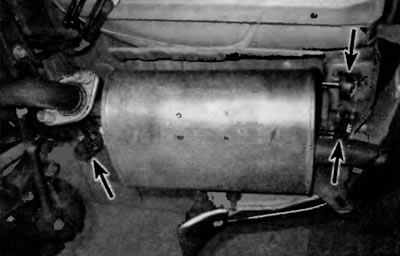
Fig. 16.1, a. Each section of the exhaust system (rear muffler shown) suspension on rubber hanger mounts. Over time, the rubber can become worn and eventually crack or tear. Be sure to inspect the exhaust hanger mounts whenever you perform maintenance work under the vehicle. If they are damaged or worn, replace them immediately.
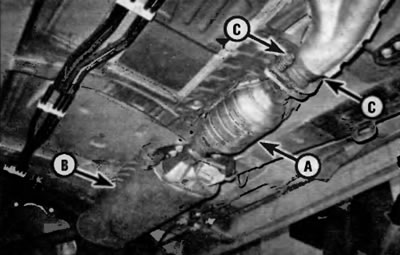
Fig. 16.1, b. The center exhaust pipe assembly is the longest and most bulky part of the exhaust system. It consists of the rear catalytic converter (A) and the front muffler (B). To disconnect the front end of the center exhaust pipe, remove the two bolts (C)
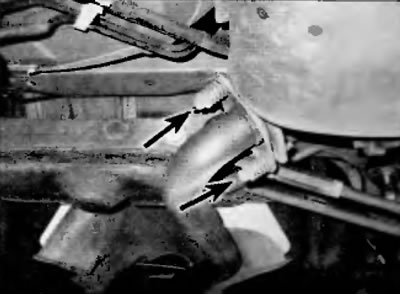
Fig. 16.1, c. To disconnect the rear end of the central exhaust pipe assembly, unscrew the two bolts
2. Regular inspections of the exhaust system allow you to maintain it in working condition, eliminating the generation of increased noise. When performing an inspection, it is necessary to identify damaged or deformed parts, open seams, unintended holes, loose connections, signs of increased corrosion or other damage that can allow processed gases to penetrate into the car. Do not repair damaged elements of the exhaust system. Replace them.
The original can be found on this resource [ToyotaMan.ru]
3. If the system components are heavily corroded, they may need to be cut out of the exhaust system. The most convenient way is to contact a specialized repair shop, where they will cut out the corroded areas with a gas cutter. However, if you want to save money by doing it yourself, but you do not have oxy-acetylene welding equipment with a gas torch, simply cut off the old components with a metalworking saw. If you have access to compressed air, you can also use special pneumatic cutters. If you are going to do this work yourself, prepare eye protection and reliable gloves to protect yourself from metal shavings.
4. There are several simple recommendations for repairing the exhaust system:
- a) When removing exhaust system components, work from the rear end to the front.
- b) To facilitate the removal of the fastening elements of the exhaust system sections, apply penetrating oil to them.
- c) Use new gaskets, brackets and clamps when installing exhaust system components. If the condition of the fasteners is far from ideal, it is recommended to replace them at the same time. Even if you successfully unscrew the rusted fasteners, they will be even more difficult to unscrew the next time you need to do this. In addition, they may break the next time you loosen or tighten them.
- d) When reassembling, apply a suitable lubricant to the threads of all exhaust system fastening elements. Ensure that there is sufficient clearance between the newly installed parts and all elements on the underbody of the vehicle to prevent the underbody from overheating and, as a result, possible damage to the interior floor covering and insulation. Pay particular attention to the catalytic converter and its heat shield.
Caution! The catalytic converter operates at very high temperatures and requires considerable time to cool down. Allow the converter to cool completely before attempting to remove it. Failure to do so may result in serious burns.