
Company Honda Company Ford Company Skoda Company Kia Company Mazda Company Mercedes Company Renault
English Русский
Български
Беларускі
Український
Српски
Hrvatski
Română
Polski
Slovenský
Magyar
Bookmark Articles Sitemap Contacts
ToyotaMan.ru


Camry Corolla Corona Carina Land Cruiser Highlander 4Runner RAV4 Others
RAV 4 XA20 (2000-2005) RAV 4 XA10 (1994-2000)

Checking the fuel pump [Toyota RAV4 XA10]

  • Main
  • RAV4
  • XA10 (1994-2000)
  • Power unit
  • Fuel and exhaust system
  • Checking the fuel pump
0
General check of the fuel pump. If you suspect that the fuel pump is not producing enough fuel or is producing low pressure, follow these steps:
  • check the condition and charge level of the battery and charge it if necessary;
  • check the fuse in the fuel pump power supply circuit for proper operation;
  • check the condition of the fuel lines and hoses for leaks;

Check the fuel pump's operation by ear. The assistant should turn the ignition key to the "ignition on" position, and you should hear a click and noise created by the pump within 2 seconds (the noise from the fuel pump is most easily heard through the fuel tank filler neck). If the fuel pump does not work, check the fuel pump electrical supply circuit. If the fuel pump is working but is not producing the required pressure, the pressure produced by the pump must be checked.

Checking the pressure generated by the fuel pump. To check the pressure in the fuel system, you must have a pressure gauge and an appropriate adapter for connecting to the fuel system, taking into account the following notes:
  • on models produced before 2001, the fuel hoses are connected with hollow bolts and washers to the fuel filter, the fuel filter is mounted on a bracket on the left side in the engine compartment;
  • on models produced since 2001, the fuel hoses are connected with quick-release connectors, the fuel filter is installed on the fuel pump block.

Relieve pressure in the fuel system.

Connect the pressure gauge to measure the pressure as follows:
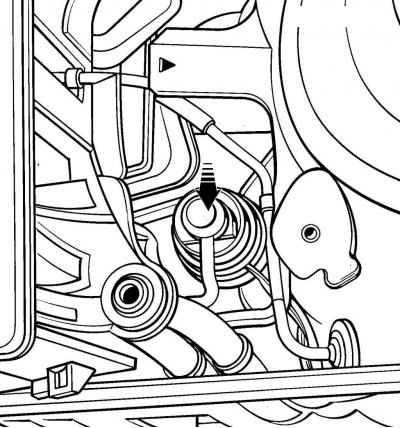


Figure 5.1. Location of the hollow bolt securing the fuel outlet hose from the fuel filter on models produced before 2001


  • on pre-2001 models, remove the relay and fuse box from the bracket and disconnect the fuel outlet hose from the fuel filter and connect a pressure gauge adapter to the fuel filter outlet (figure 5.1);
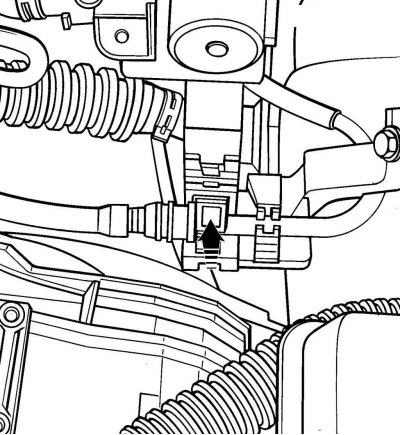


Figure 5.2. Fuel pipe connector location on 2001 and later models

  • on models produced since 2001, disconnect the fuel line connector near the fuel distribution line and connect the pressure gauge adapter to it (figure 5.2).

Turn on the ignition, the fuel pump should run for 2 seconds.

Take readings from the pressure gauge. If the fuel pressure exceeds the nominal value, replace the pressure regulator. If the fuel pressure is below the specified value, the fuel filter and/or fuel lines may be clogged, there are fuel leaks, or the fuel pump and/or pressure regulator may be faulty.

Start the engine and warm it up to operating temperature. Check the fuel pressure. If the fuel pressure is below the nominal value and no obvious reason for this is found, the pressure regulator and/or fuel pump may be defective. In this case, it is recommended to replace the pressure regulator and fuel pump.

Turn off the engine and constantly monitor the pressure in the fuel system, which should be maintained constant. Five minutes after turning off the engine, the fuel system pressure should be 150 kPa. If the pressure drops significantly below this value, the pressure regulator and/or fuel pump are defective, or the fuel rail is leaking.

After checking the fuel pressure, relieve the pressure in the fuel system and disconnect the pressure gauge with the adapter.
This article is available at: russian, bulgarian, belarusian, ukrainian, serbian, croatian, romanian, polish, slovak, hungarian
The article material has been checked: Kolokoltsev Grigory
Share information:
◀ Previous
RAV 4 XA10: Fuel and exhaust system
Next ▶

Relieving pressure in the fuel system
Technical characteristics of the fuel injection system
General information about the fuel and exhaust system
Checking fuel lines, hoses and their connections
Fuel pump — removal and installation
Fuel pressure regulator — removal and installation
Fuel level sensor — removal and installation
Fuel tank — removal and installation
Similar articles on other Toyota models

➥ Checking the performance of the fuel pump Toyota Camry XV10 (1991-1996)
➥ Checking the fuel pump Toyota Corolla E80 (1983-1990)
➥ Checking the high pressure fuel pump (HPFP) Toyota Corona T190 (1992-1997)
➥ Checking the fuel injection pump Toyota Carina T190 (1992-1996)
➥ Fuel Pump and Fuel Pressure — Checking Toyota Cruiser 60/80 (1980-1997, petrol)
➥ Checking the fuel pump Toyota 4Runner N120 (1989-1995)
Link in different formats to this article
Comments and feedback from visitors
No comments yet


Add two numbers 50 + 44


RAV 4 XA20 (2000-2005) 
  • General information
  • Introduction to manual
  • User manual
  • Daily care
  • Maintenance (petrol)
  • Maintenance (diesel)
  • Troubleshooting
  • Power unit
  • Gasoline engines (before 2000)
  • Petrol engines (since 2001)
  • Diesel engines
  • Engine overhaul
  • Cooling and heating
  • Fuel system (petrol)
  • Fuel system (diesel)
  • Engine electrical equipment
  • Control system (petrol)
  • Control system (diesel)
  • Transmission
  • Manual gearbox
  • Automatic gearbox
  • Clutch and drive shafts
  • Chassis, running gear
  • Brake system
  • Front suspension
  • Rear suspension
  • Steering system
  • Body and interior
  • Exterior (external elements)
  • Interior (internal elements)
  • Doors, locks and windows
  • Electrical equipment
  • Equipment and devices
  • Electrical circuits
RAV 4 XA10 (1994-2000) 
  • General information
  • User manual
  • Maintenance
  • Power unit
  • Petrol engine 3S-FE
  • Petrol engine 1AZ-FE
  • Engine overhaul
  • Cooling and air conditioning
  • Fuel and exhaust system
  • Ignition system
  • Toxicity reduction system
  • Transmission
  • Clutch
  • Mechanical gearbox
  • Automatic gearbox
  • Cardan and drive shafts
  • Chassis, running gear
  • Brake system
  • Car suspension
  • Steering
  • Body and interior
  • Exterior (external elements)
  • Interior (internal elements)
  • Doors, locks and windows
  • Electrical equipment
  • Equipment and devices
  • Power devices
  • Electrical circuits
ToyotaMan.ru © 2018–2026 • Mobile version • Interesting about Toyota • Administration • Sitemap: EN BG BY UA RS HR RO PL SK HU • Search system • Bookmark
Camry Vista-V40 • Camry XV10 • Camry XV20 • Camry XV30 • Corolla Verso-AR10 • Corolla E80 • Corona T190 • Carina T170 • Carina T190 • Land Cruiser J70 (diesel) • Land Cruiser J60 (petrol) • Land Cruiser J100 • Highlander XU20 (petrol) • 4Runner N120 • RAV4 XA10 • RAV4 XA20 • Duet M100 • Dyna Y50 •
We require cookies to enable some interactive features. Is that ok with you?