



Note: Do not adjust the gap on iridium spark plugs. Using a gap adjusting tool on them may damage the iridium coating on the electrodes. These spark plugs are gapped directly by the manufacturer.
1. Replacing spark plugs requires the use of a spark plug socket, mounted on a ratchet handle. This socket is lined with a rubber sealing sleeve, which serves to protect the porcelain insulator of the spark plug and to hold the plug when it is unscrewed into the corresponding hole (Fig. 27.1).
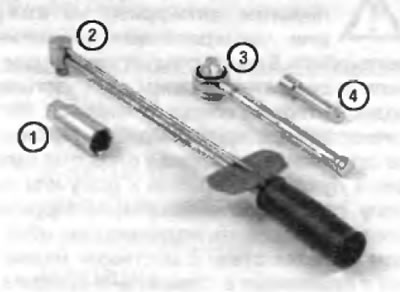
Fig. 27.1. Tools for replacing spark plugs
1 - Spark plug socket - it has a special packing inside to protect the porcelain insulator of the spark plug
2 - Torque Wrench - Although not required, using this tool is the best way to ensure that your spark plugs are tightened correctly
3 - Ratchet wrench - standard tool for working with a spark plug socket
4 - Extension - Depending on the model and accessories, you may need a special extension and universal joint to reach some spark plugs
2. If you are replacing spark plugs, purchase new ones and replace the spark plugs one at a time.
Note: The manufacturer specifies that only spark plugs with iridium-coated tips be used on these models. When purchasing new spark plugs, be sure to purchase the correct spark plugs for your specific vehicle. This information can be found in "Specifications" at the beginning of this chapter, on the hood label containing the emission standard (VECI) information that your particular vehicle meets, or in the owner's manual that came with your vehicle. If these sources specify different spark plugs, purchase the type indicated on the VECI label because this information is specific to your engine.
3. Inspect each new spark plug for defects. If there are any signs of cracks in the porcelain insulator of the spark plug, do not use it.
4. Remove the engine cover and disconnect any hoses or components that may interfere with access and move them to the side. If you are working on a V6 model, remove the upper intake manifold (see chapter 2B).
5. Remove the bolts and disconnect each ignition coil assembly from the spark plugs (Fig. 27.5).
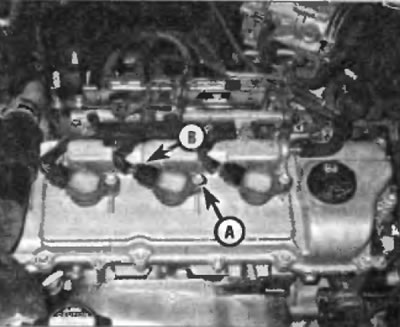
Fig. 27.5. Remove the bolt (A), disconnect the electrical connector (B) and disconnect the individual coils to access the spark plugs
6. If compressed air is available, blow out any dirt or foreign material from the spark plug area before continuing.
Caution! When working with compressed air, always use eye protection!
7. Remove the spark plug (Fig. 27.7).
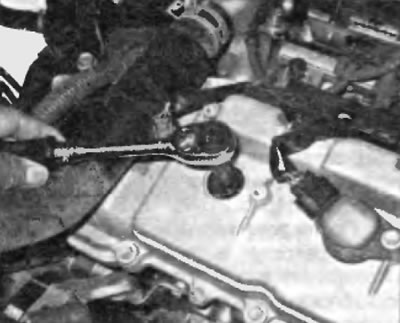
Fig. 27.7 Because the spark plugs are located in a deep recess, a proper spark plug socket and extension will be required when removing or installing them
8. Whether you are replacing the spark plugs this time or reusing the "old" spark plugs, compare each old spark plug to the pictures provided on the inside back cover to determine the general operating condition of the engine.
9. Apply a little grease to the spark plug threads (fig. 27.9, a). It is often difficult to screw spark plugs into their holes without skewing them. To avoid this, place a short piece of rubber hose over the end of the plug (fig. 27.9, b). The flexible hose acts as a universal joint, which helps align the spark plug with its corresponding mounting hole. If the spark plug starts to stick, the hose will slide on it, preventing damage to the threads. Tighten the spark plug to the specified torque specified in "Specifications" at the beginning of this chapter.
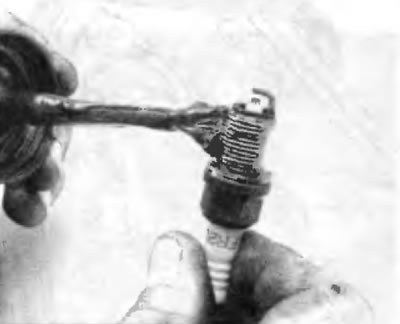
Fig. 27.9, a. A thin layer of grease applied to the spark plug threads will protect the threads in the cylinder head from damage the next time the spark plugs are unscrewed
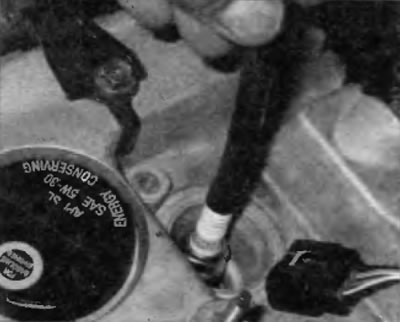
Fig. 27.9, b. A piece of rubber hose can help to properly "tighten" the spark plug when screwing it into the mounting hole
10. Install the ignition coil assembly onto the new spark plug.
The full article is posted on the website (www.ToyotaMan.ru)