



Note: On V6 models, the following procedure requires the use of a special tappet tool. It is not possible to perform this procedure without one.
1. Remove the right front fender apron, engine cover and any other elements that interfere with the removal of the cylinder head cover. Disconnect the cable from the negative battery terminal (see paragraph 1 of chapter 5).
2. Remove the ignition coil.
3. On V6 models, drain the coolant (see paragraph 26), will remove the radiator inlet hose, air cleaner assembly, upper suspension tie rod and all other elements that interfere with the removal of the cylinder head cover.
4. If compressed air is available, blow out the spark plug recesses to remove any dirt that may have entered the cylinders, then remove the spark plugs (see paragraph 27).
Caution! When working with compressed air, always use eye protection!
5. Remove the cylinder head cover (see chapter 2A or 2B).
6. Refer to the chapter 2A or 2B and position piston No.1 in the TDC position on the compression stroke.
7. Measure the clearance in the specified valves using a feeler gauge of the prescribed thickness (fig. 22.7, a, b, c). Record the clearance readings for each valve and note any readings that are outside the tolerance range. This information will be needed later to determine the required shims or tappets.
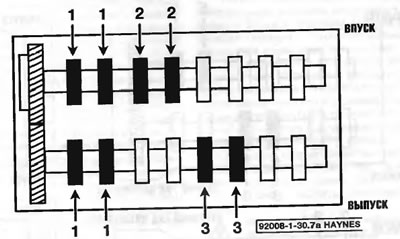
Fig. 22.7, a. On four-cylinder engines, when piston No.1 is in the TDC position on the compression stroke, it is possible to measure the valve teasers in the exhaust valves of cylinders No.1 and 3 in the intake valves of cylinders No.1 and 2
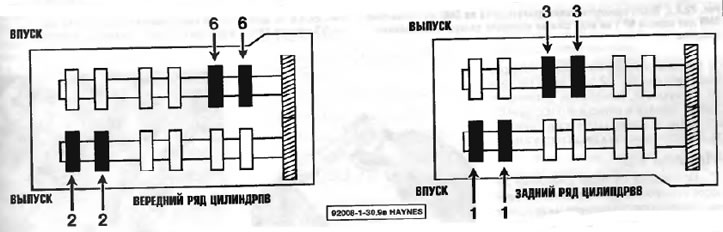
Fig. 22.7, b. On a V6 engine, when piston #1 is at TDC on the compression stroke, the clearances in the valves shown can be measured

Fig. 22.7, c. Measure the clearance in each valve with a feeler gauge of the prescribed thickness. If the clearance is normal, you should feel slight resistance when inserting the feeler gauge
8. On four-cylinder engines, rotate the crankshaft one full revolution and align the timing marks again. Measure the clearances in the remaining valves (Fig. 22.8).
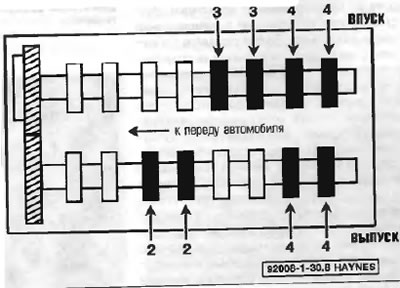
Fig. 22.8. On four-cylinder engines, when piston No.4 is in the TDC position on the compression stroke, it is possible to measure the valve clearances in exhaust valves No.2 and 4 and intake valves No.3 and 4
9. On V6 engines, turn the crankshaft no more than ⅔ of a revolution (240 degrees) clockwise. Measure the valve clearance on the valves shown (fig. 22.9, a). Turn the crankshaft another ⅔ of a revolution and measure the clearance in the remaining valves (fig. 22.9, b).

Fig. 22.9, a. After turning the V6 engine 240° from the TDC position for piston No.1 on the compression stroke, measure the clearances in the valves shown
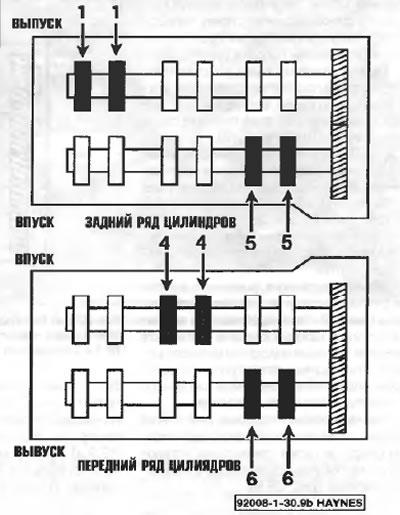
Fig. 22.9, b. On a V6 engine, turn the crankshaft another ⅔ of a revolution (248°) and measure the clearance in the remaining grooves
Four-cylinder models
10. Remove the camshaft corresponding to the valve whose clearances you intend to adjust (see chapter 2A). Remove the tappets one by one and measure the height of each with a micrometer (fig. 22.10). Before working on the next tappet, install the removed tappet back into its mounting hole in the cylinder head. Record the height reading for each tappet.
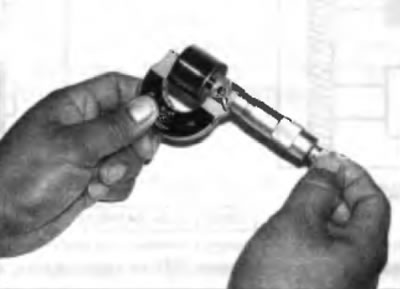
Fig. 22.10. On models with a four-cylinder engine, measure the thickness of the tappet with a micrometer
V6 Models
11. On V6 models, after measuring each valve clearance and recording the results, rotate the crankshaft pulley until the camshaft lobe above the first valve you want to adjust faces up and away from the shim. Align the groove in the tappet toward the spark plug. Then compress the tappet using the special tools (fig. 22.11, a, b). Position the special tool as shown so that the longer arm of the tool grips the bottom edge of the cast boss on the tappet and the shorter arm of the tool grips the top edge of the tappet itself. Compress the tappet by squeezing the handles of the tool, then hold the tappet compressed with the smaller tool and remove the larger tool. Remove the shim with a small screwdriver or tweezers (fig. 22.11,c). Note that the wire hook found on the end of some lifter removal tool handles can be used to squeeze the handles together to hold the lifter in a compressed position while removing the shim.
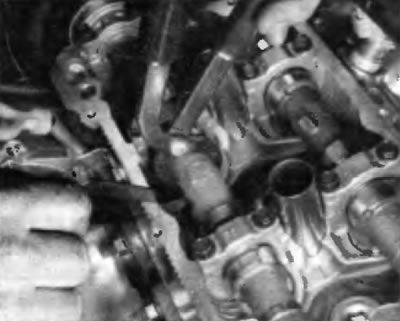
Fig. 22.11, a. On a V6 engine, position the tappet puller as shown and squeeze the handles to compress the tappet, then use a smaller tool to hold the tappet compressed so that the adjusting shim can be removed...
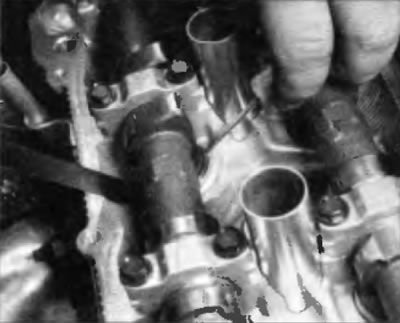
Fig. 22.11, b...while continuing to press on the pusher, remove the adjusting shim using a small screwdriver...
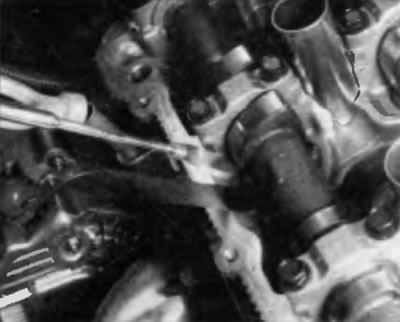
Fig. 22.11,c....tweezers or magnet, as shown here
12. Measure the thickness of the adjusting shim with a micrometer (fig. 22.12)
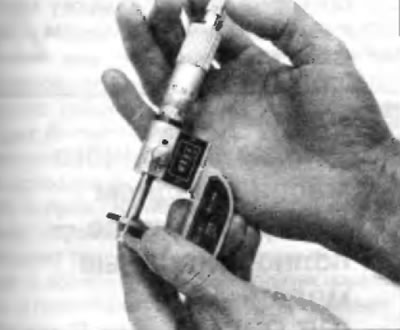
Fig. 22.12. Measure the thickness of the adjusting shim with a micrometer
All models
13. To calculate the correct thickness of the replacement shim or tappet that will bring the valve clearance to the standard, use the following formula:
N = T + (A - V),
where T = thickness of the "old" adjusting shim or pusher;
A = measured valve clearance;
N = thickness of new adjusting shim or tappet;
V= desired valve clearance (see "Specifications").
14. Select the adjustment gasket or tappet with the thickness (s) closest to the design valve clearance. The adjustment pads for V6 models are available in 17 thickness options in 0.050 mm increments ranging from 2,500 mm to 3,300 mm. Pushers for four-cylinder engines are available in 35 thickness variants with a discreteness of 0.020 mm ranging from 5.060 mm to 5.740 mm.
Note: By carefully analyzing the shim or tappet sizes required to bring out-of-spec valve clearances up to spec, it is often possible to simply swap the shim or tappet from one tappet to the location of the other tappet that requires that specific shim or tappet size.
15. On V6 models, install the special tappet tool in the position shown (fig. 22.11,c) so that the longer jaw of the tool grips the bottom edge of the cast boss on the tappet and the upper, shorter jaw of the tool grips the top edge of the tappet itself. Compress the tappet by squeezing the handles of the tool and install the new shim. The wire hook found on the end of some tappet removal tool handles can be used to squeeze the handles together to hold the tappet in a compressed position while installing the shim. Measure the clearance with a feeler gauge to ensure that the calculations are correct.
16. Repeat this procedure on all valves that require valve clearance adjustment.
17. Installation of spark plugs, cylinder head cover, camshaft, accelerator cable bracket, etc. is performed in the reverse order of removal.
18. On four-cylinder models, after installing the camshafts, recheck the valve clearances to ensure they are within specification.