



Contents: Checking the thermostat installed on…↓ Checking with thermostat removal ↓ Replacing the thermostat ↓
Caution: When opening the radiator cap on a hot engine, exercise caution as escaping steam can cause severe burns. Cover the radiator cap with a thick layer of cloth and slowly unscrew the cap until you hear a hissing sound. After the hissing stops, slowly unscrew and remove the radiator cap.
Checking the thermostat installed on the car
Before checking the thermostat, check the coolant level, the tension of the water pump drive belt and the functionality of the temperature sensor.
If after starting a cold engine it takes a very long time to warm up, it is possible that the thermostat is constantly open and the coolant is circulating in a large circle. In this case, replace the thermostat.
If the engine is overheating, check the temperature of the lower radiator hose with your hand. If the hose is cold, the thermostat may be permanently closed and the coolant is constantly circulating in a small circle. In this case, also replace the thermostat.
If the lower radiator hose is hot, this indicates that the thermostat is open and coolant is flowing through the radiator. In this case, you need to contact a service station to find and eliminate the cause of engine overheating.
Checking with thermostat removal
Remove the thermostat.
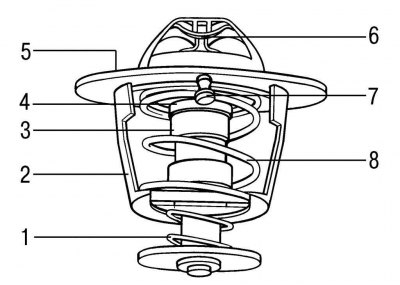
Figure 4.1. Thermostat: 1 – secondary spring; 2 – frame; 3 – valve; 4 – valve seat; 5 – flange; 6 – plunger; 7 – mounting pin; 8 – main spring
The appearance of the thermostat is shown in the figure 4.1.
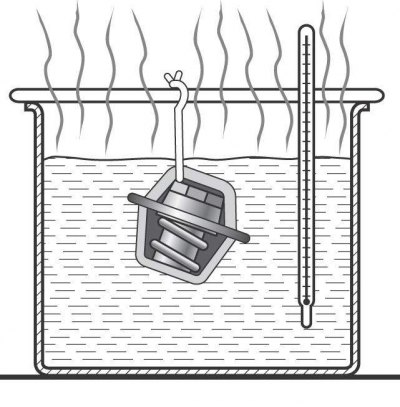
Figure 4.2. Checking the opening of the thermostat valve in a vessel with hot water
You can pre-test the thermostat's functionality by hanging it on a thread in a glass container filled with water and heating the water to boiling point (figure 4.2). When the water boils, the thermostat valve should open. Otherwise, replace it.
The opening temperature of the thermostat valve is written on its body.
The thermostat, the valve of which does not close when the water cools, is also faulty and must be replaced.
Replacing the thermostat
Turn off the ignition and disconnect the ground wire from the battery.
Drain the coolant from the radiator. Disconnect the radiator hose from the thermostat housing.
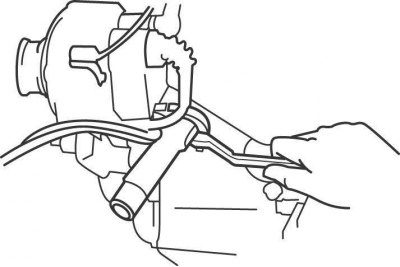
Figure 4.3. Loosening the thermostat housing mounting nuts on vehicles manufactured before 2001
On vehicles manufactured before 2001, remove the thermostat housing from the rear of the water pump housing (figure 4.3). To facilitate access to the lower thermostat housing mounting nut, it is recommended to remove the oil filter.
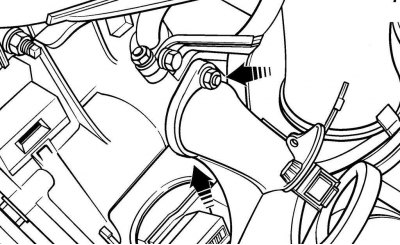
Figure 4.4. Location of thermostat housing mounting nuts on vehicles produced since 2001
On vehicles produced since 2001, remove the alternator and unscrew the thermostat housing mounting nuts (figure 4.4).
Remove the thermostat, remembering the position in which it was installed.
Install a new O-ring onto the thermostat and clean the mating surfaces of the thermostat housing.
On vehicles manufactured before 2001, install the thermostat into the thermostat housing. Then install the housing with the thermostat into the rear of the water pump with the locating pin facing up.
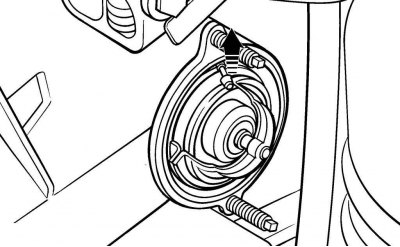
Figure 4.5. When installing the thermostat, the mounting pin should be located on top
On vehicles produced since 2001, install the thermostat into the cylinder block socket with the dowel pin facing up (figure 4.5).
Use nuts to secure the thermostat housing and install the remaining components removed earlier.
Fill with coolant.
Start the engine and check for leaks.