



The engine can be damaged by detonation caused by combustion of the fuel mixture. High compression ratios, which improve engine fuel efficiency and change the quality of the fuel used, increase the engine's tendency to detonation, i.e., explosive combustion of the fuel mixture in the engine cylinders. The knock sensor reacts to high-frequency vibrations of the cylinder block and transforms them into electrical signals, the magnitude of which increases as detonation increases. Based on these signals, the engine control unit delays the ignition timing for a certain number of cycles, after which it gradually returns it to its original position. The knock sensor is located on the rear of the cylinder block, directly below the cylinder head.
Replace the knock sensors as follows:
- turn off the ignition and disconnect the ground wire from the battery;
- drain the coolant from the cooling system;
- on pre-2001 and all-wheel drive models, remove the intake manifold;
- on front-wheel drive models prior to 2001, raise the front of the vehicle and support it with jack stands;
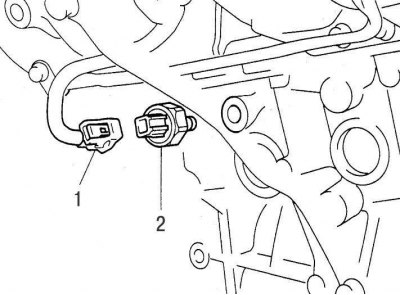
Figure 7.19. Knock sensor on models before 2001: 1 – electrical connector; 2 – knock sensor
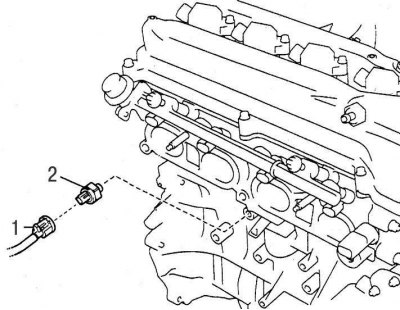
Figure 7.20. Knock sensor on models since 2001: 1 – electrical connector; 2 – knock sensor
- disconnect the electrical connector, unscrew and remove the knock sensor (figure 7.19, 7.20).
When installing the knock sensor, apply a layer of sealant to its threads.
Screw in the sensor and tighten it to 44 Nm.
Note: The threads of the new sensor are already coated with sealant.
Further installation is carried out in the reverse order of removal. After installing the sensor, fill the cooling system with coolant.