
Company Honda Company Ford Company Skoda Company Kia Company Mazda Company Mercedes Company Renault
English Русский
Български
Беларускі
Український
Српски
Hrvatski
Română
Polski
Slovenský
Magyar
Bookmark Articles Sitemap Contacts
ToyotaMan.ru


Camry Corolla Corona Carina Land Cruiser Highlander 4Runner RAV4 Others
RAV 4 XA20 (2000-2005) RAV 4 XA10 (1994-2000)

Evaporative emission control system (EVAP) [Toyota RAV4 XA10]

  • Main
  • RAV4
  • XA10 (1994-2000)
  • Power unit
  • Toxicity reduction system
  • Evaporative emission control system (EVAP)
0
The EVAP (fuel vapor recovery) system collects fuel vapors in a special container with activated carbon - an absorber, and when the engine is running, mixes them with fresh air and delivers them to the engine cylinders, where they are burned.


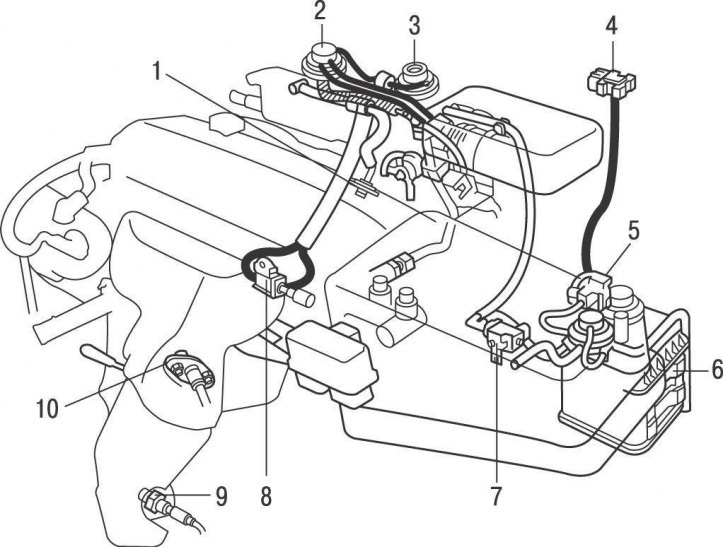
Figure 7.28. Location of Fuel Vapor Capture system (EVAP) elements on models before 2001: 1 – crankcase ventilation valve; 2 – vacuum modulator of the exhaust gas reburning system; 3 – exhaust gas re-burning system valve; 4 – fuel vapor pressure sensor; 5 – fuel vapor pressure sensor vacuum valve; 6 – container with activated carbon; 7 – fuel vapor recovery system vacuum valve; 8 – oxygen sensor (block 1 sensor 2); 9 – vacuum valve of the exhaust gas reburning system; 10 – oxygen sensor (block 1 sensor 1)
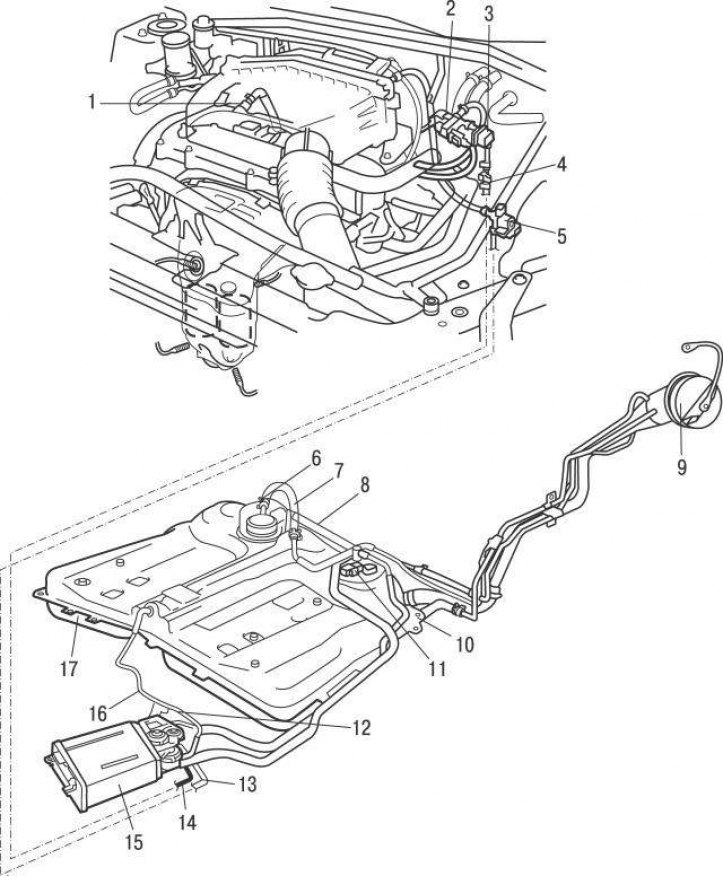


Figure 7.29. Location of Fuel vapor capture system (EVAP) elements on models from 2001: 1 – crankcase ventilation valve; 2 – fuel vapor recovery system vacuum valve; 3 – equalizing tank; 4 – Fuel vapor recovery system service connector; 5 – vacuum valve of the activated carbon canister closing valve (CCV); 6 – fuel valve; 7 – pressure control tube; 8 – ventilation tube; 9 – fuel tank filler cap; 10 – return hose; 11 – fuel vapor pressure sensor; 12 – vacuum valve controlling the pressure valve; 13 – air supply hole; 14 – cleaning hose; 15 – canister with activated carbon; 16 – fuel vapor emission control system hose; 17 – fuel tank


On models produced since 2001, the activated carbon container is installed in the engine compartment, and on models produced before 2001, it is located under the car, behind the fuel tank (figure 7.28, 7.29).

When the engine is not running, fuel vapors are transferred from the fuel tank, throttle body and intake manifold to the activated carbon container, where they are collected. After the engine is started, fuel vapors are removed from the tank through the purge control valve and fed into the engine cylinders for combustion. The cleaning control valve is controlled by the engine control unit.

The fuel filler cap has a double-acting check valve. If the fuel vapor recovery system malfunctions and the pressure in the fuel tank increases, the valve releases fuel vapor into the atmosphere.
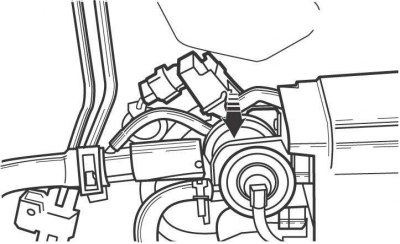


Figure 7.30. Location of the fuel vapor pressure sensor on models produced before 2001


The fuel vapor recovery system includes a pressure sensor (figure 7.30), which reacts to changes in fuel vapor pressure. On models prior to 2001, the sensor is mounted on the engine compartment bulkhead, and on models from 2001 onwards, it is located on the top of the fuel tank on the fuel pump/sensor assembly.


The material is reprinted from an online resource: www.toyotaman.ru

After the engine is started and warmed up to a preset temperature, the vacuum valve (VSV) opens, opening the purge valve, causing a vacuum to be created in the intake manifold, drawing fuel vapors out of the activated carbon canister. The fuel vapors are then mixed with the air entering the engine and burned together with the fuel mixture in the engine cylinders.

The fuel vapor pressure sensor, located in the fuel tank, monitors the vapor pressure in the fuel tank and when the pressure exceeds a preset threshold, a vacuum valve opens and the fuel vapor is released from the tank and collected in a canister containing activated carbon.

Replace the activated carbon container as follows:
  • turn off the ignition and disconnect the ground wire from the battery;
  • on 2001 and later models, raise the rear of the vehicle and support it with stands;
  • label and disconnect all electrical connectors and hoses from the activated carbon container;
  • unscrew the bolts and remove the container from the engine compartment or from under the car.

Installation is carried out in the reverse order of removal.
This article is available at: russian, bulgarian, belarusian, ukrainian, serbian, croatian, romanian, polish, slovak, hungarian
The article material has been checked: Kolokoltsev Grigory
Share information:
◀ Previous
RAV 4 XA10: Toxicity reduction system
Next ▶

Exhaust gas recirculation (EGR) system on 2001 and later models
Positive Crankcase Ventilation (PCV) system
Replacing the Idle Air Control (IAC) Valve
Replacing the vehicle speed sensor (VSS)
Replacing knock sensors
Catalytic converter replacement
Similar articles on other Toyota models

➥ Checking the evaporative emission control system components Toyota Cruiser 100 (1998-2007)
➥ Checking the fuel vapor emission control system Toyota Camry XV20 (1996-2001)
➥ Emission Control System (1CD-FTV) Toyota Corolla Verso 3 (2004-2009)
➥ Emission Control and Engine Management System Specifications Toyota Highlander 1 (2000-2007, petrol)
➥ Technical data of the exhaust emission control system Toyota 4Runner N120 (1989-1995)
➥ Electrical part of the control system (4WD) Toyota Corona T190 (1992-1997)
Link in different formats to this article
Comments and feedback from visitors
No comments yet


Add two numbers 37 + 29


RAV 4 XA20 (2000-2005) 
  • General information
  • Introduction to manual
  • User manual
  • Daily care
  • Maintenance (petrol)
  • Maintenance (diesel)
  • Troubleshooting
  • Power unit
  • Gasoline engines (before 2000)
  • Petrol engines (since 2001)
  • Diesel engines
  • Engine overhaul
  • Cooling and heating
  • Fuel system (petrol)
  • Fuel system (diesel)
  • Engine electrical equipment
  • Control system (petrol)
  • Control system (diesel)
  • Transmission
  • Manual gearbox
  • Automatic gearbox
  • Clutch and drive shafts
  • Chassis, running gear
  • Brake system
  • Front suspension
  • Rear suspension
  • Steering system
  • Body and interior
  • Exterior (external elements)
  • Interior (internal elements)
  • Doors, locks and windows
  • Electrical equipment
  • Equipment and devices
  • Electrical circuits
RAV 4 XA10 (1994-2000) 
  • General information
  • User manual
  • Maintenance
  • Power unit
  • Petrol engine 3S-FE
  • Petrol engine 1AZ-FE
  • Engine overhaul
  • Cooling and air conditioning
  • Fuel and exhaust system
  • Ignition system
  • Toxicity reduction system
  • Transmission
  • Clutch
  • Mechanical gearbox
  • Automatic gearbox
  • Cardan and drive shafts
  • Chassis, running gear
  • Brake system
  • Car suspension
  • Steering
  • Body and interior
  • Exterior (external elements)
  • Interior (internal elements)
  • Doors, locks and windows
  • Electrical equipment
  • Equipment and devices
  • Power devices
  • Electrical circuits
ToyotaMan.ru © 2018–2026 • Mobile version • Interesting about Toyota • Administration • Sitemap: EN BG BY UA RS HR RO PL SK HU • Search system • Bookmark
Camry Vista-V40 • Camry XV10 • Camry XV20 • Camry XV30 • Corolla Verso-AR10 • Corolla E80 • Corona T190 • Carina T170 • Carina T190 • Land Cruiser J70 (diesel) • Land Cruiser J60 (petrol) • Land Cruiser J100 • Highlander XU20 (petrol) • 4Runner N120 • RAV4 XA10 • RAV4 XA20 • Duet M100 • Dyna Y50 •
We require cookies to enable some interactive features. Is that ok with you?