



Contents: Governing bodies and their purpose ↓ Air heating ↓ Air cooling ↓ Ventilation ↓ Windshield heating and defroster ↓ Air flow direction regulator…↓
System controls
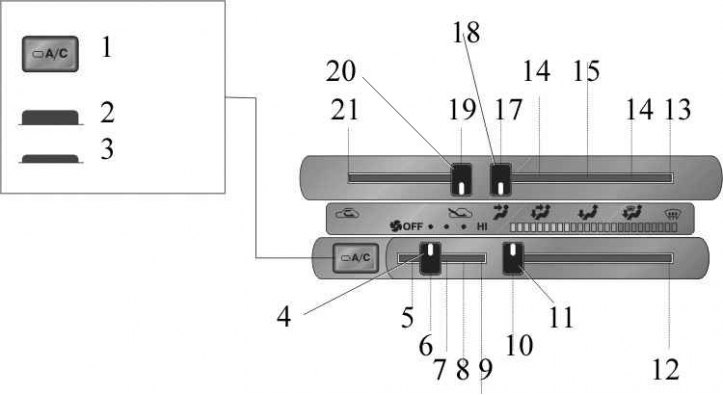
1. Air conditioner on/off button; 2. Turn off; 3. Turn on; 4. Air flow direction regulator; 5. Air intake adjustment lever; 6. Air recirculation; 7. Outside air; 8. In the face; 9. Flow to the legs and face; 10. On the floor; 11. On the floor or windshield; 12. On the windshield; 13. Fan speed control lever; 14. Off; 15. Low speed; 16. Moderate speed; 17. Increased speed; 18. High rotation speed; 19. Low temperature; 20. Thermostat lever; 21. High temperature
Governing bodies and their purpose
The temperature regulator sets the temperature of the air entering the passenger compartment.
In the extreme left position of the handle the temperature is the lowest, in the extreme right position it is the highest.
The air intake control handle can be used to set the mode to full or partial recirculation with outside air intake.
When the lever is in the OUTSIDE AIR position, air from outside the vehicle is supplied to the air conditioning system. For recirculation, move the lever to the RECIRCULATED AIR position.
The air flow direction control lever sets the channel through which air enters the passenger compartment.
Air flow direction regulator positions
 | In the face |
 | In the legs and in the face |
 | On the floor |
 | On the floor and windshield |
 | On the windshield |
Switching on, switching off and rotation speed is set by the fan control lever. To switch off the fan, move the lever to the OFF position. A special button is designed to switch the air conditioner on and off. To switch on, press the button, to switch off, press the button again.
If the button backlight is flashing, contact your car service as soon as possible.
The cause may be belt slippage or compressor failure. In this case, the air conditioner automatically switches off to prevent belt damage.
Air heating
1. Move the thermostat lever to any position except the leftmost position. If you need air with a low moisture content, move the lever to a position between the middle and rightmost positions. If you need warm air blowing at face level, move the lever to a position close to the middle position.
2. Move the air intake control lever to the OUTSIDE AIR position.
3. If you need to quickly heat the air in the cabin, move the lever to the RECIRCULATED AIR position.
4. It is recommended that the air intake control lever be kept in the OUTSIDE AIR position at all times. Otherwise, the windows will fog up quickly.
5. Move the flow direction control lever to the FLOOR position. If you want warm air to be blown at face level, move the lever to the BI LEVEL two-level blowing position.
6. If the windows fog up quickly, move the lever to the FLOOR/WINDSHIELD position (floor and windshield).
7. Move the fan control lever to any position except the leftmost position.
8. The air conditioner button should be pressed. If you need dry warm air, press the button.
Air cooling
1. Move the thermostat lever to a position between the middle and the far left.
2. If you need heated air at floor level with a two-level airflow mode, move the thermostat lever to a position close to the middle.
3. Move the air intake control lever to the OUTSIDE AIR position. If rapid circulation of cool air is required, move the lever to the RECIRCULATED AIR position.
4. It is recommended that the air intake control lever be kept in the OUTSIDE AIR position at all times. Otherwise, the windows will fog up quickly.
5. Move the flow direction control lever to the FLOOR position. If you want warm air to be blown at face level, move the lever to the BI LEVEL two-level blowing position.
6. If the windows fog up quickly, move the lever to the FLOOR/WINDSHIELD position (floor and windshield).
7. Move the fan control lever to any position except the leftmost position.
8. The air conditioner button should be pressed. If you need dry warm air, press the button.
Ventilation
1. Move the thermostat lever to the extreme left position.
2. Move the air intake control lever to the OUTSIDE AIR position.
3. Move the flow direction control lever to the FACE position.
4. Move the fan control lever to any position except the leftmost position.
5. The air conditioner power button must be pressed.
Windshield heating and defroster
To clear up fogged up windshields
1. Move the thermostat lever to any position.
2. Move the air intake control lever to the OUTSIDE AIR position.
3. Move the flow direction control lever to the WINDSHIELD position (windshield).
4. Move the fan control lever to the leftmost position.
5. Press the air conditioner power button.
To clear icy or foggy windshields from the outside
6. Move the thermostat lever to the extreme right position.
7. Move the air intake control lever to the OUTSIDE AIR position.
8. Move the flow direction control lever to the WINDSHIELD position (windshield).
9. Move the fan control lever to the HI position.
10. The air conditioner power button must be pressed.
Air flow direction regulator positions
FACE position – flow direction at face level.
BI LEVEL position – the flow is directed to the face and feet level simultaneously. The air at the feet level is slightly warmer than at the face level (except for ventilation mode).
FLOOR position – the airflow is directed almost entirely to the face and feet. In some cars, the air at foot level is slightly warmer than at face level.
FLOOR/WINDSHIELD position – the flow is directed to the windshield, front door windows, face and feet. A less heated flow is directed to the face.
WINDSHIELD position – the flow is directed to the windshield, front door windows and face. On some cars, in this position of the control lever, a less heated flow is directed to the face.
Do not use the WINDSHIELD position when cooling the air in very humid conditions. Otherwise, due to the difference in temperature between the outside air and the windshield, the outer surface of the glass will fog up.