



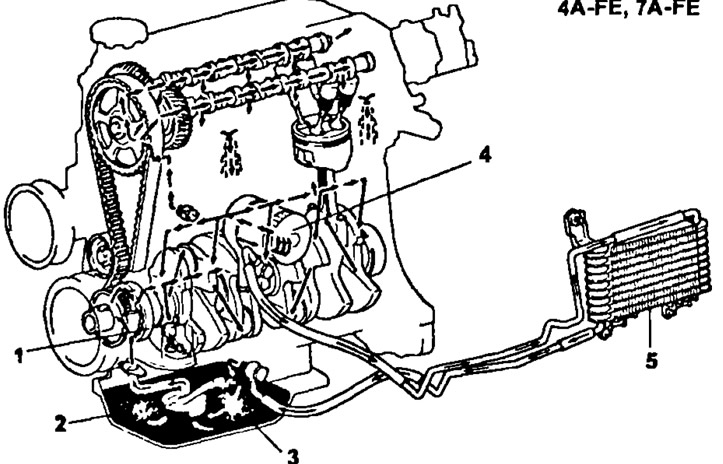
Layout diagram of the lubrication system elements for 3S-GE, 4A-FE, 7A-FE engines: 1 - oil pump, 2 - oil intake, 3 - pressure reducing valve, 4 - oil filter, 5 - oil radiator, 5 - oil cooler.
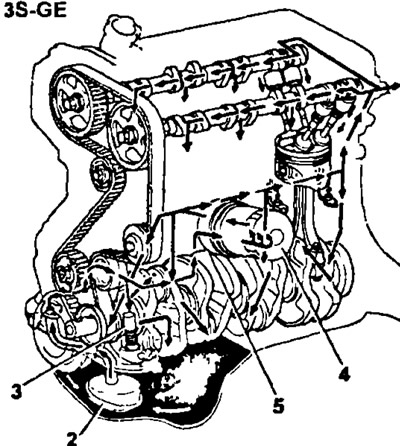
These engines use a lubrication system with full-flow oil cleaning and oil supply under pressure to the main moving parts and units of the engine. The lubrication system includes: an oil pan, an oil pump, an oil filter and various elements that provide oil supply to various moving parts of the engine. Oil from the pan through the oil intake is pumped into the oil filter by the oil pump. Some of the oil is sent to the oil radiator immediately after the oil pump.
After passing the oil filter, some of the oil is fed to the main bearings of the crankshaft through various channels in the cylinder block and through holes. Through the holes in the crankshaft, the oil is fed to the connecting rod bearings of the crankshaft. Lubrication of the cylinder walls and the lower part of the piston crown is carried out mainly by splashing. A special hole is provided in the piston head of the connecting rod and in the piston pin bushing for lubricating the piston pin.
Some of the oil, after passing through the oil filter through the holes in the cylinder block, is directed to the cylinder head for lubrication:
(The material was taken from a resource: ToyotaMan)
- driven gear of the intake camshaft;
- camshaft bearing journals:
- fists;
- valve tappets and valve stems;
- exhaust camshaft drive gear;
After performing its functions, the oil returns to the sump under the force of gravity (by gravity).
To control the oil level in the crankcase, a dipstick is installed on one side of the oil pump housing.
Oil pump
The oil pump takes oil from the engine sump through the oil receiver and delivers it under pressure to various friction units. The oil receiver with a mesh filter is located in front of the inlet pipe of the oil pump. The oil pump itself is a trochlear-type pump. Inside it are the leading and driven rotors with internal engagement, which rotate in the same direction. Since the axes of the leading and driven rotors are offset relative to each other, the space between both rotors changes as they rotate. Oil is sucked into the pump when the space between the rotors expands, and is swept when the space between the rotors narrows.
Oil pressure regulator (pressure reducing valve)
At high rotation speeds, the amount of oil supplied by the oil pump is excessive compared to the amount required to lubricate the friction pairs. Oil pressure regulator (pressure reducing valve) prevents excess oil supply. At low rotation speeds, the regulator valve closes the bypass channel under the action of the spring. But at high rotation speeds, the oil pressure increases sharply, the force of the oil pressure overcomes the force of the spring, and the regulator valve opens. Excess oil returns to the sump through the valve.
Oil filter
Oil filter - full-flow type with replaceable paper filter element. Metal particles (wear products), airborne dirt particles, carbon particles and other types of contaminants can enter the oil during use, causing increased engine wear or clogging (narrowing of channels) oil lines, preventing the circulation of oil. An oil filter installed in the oil line allows these particles to be retained as oil passes through it. The filter is installed on the outside of the engine, which makes it relatively easy to replace the filter element. A bypass valve is installed in front of the filter element, which opens when the pressure in front of the filter increases, which occurs when the filter element is clogged with contaminants. The bypass valve opens when the oil pressure force exceeds the force of the valve spring. In this case, the oil passes through a bypass channel, bypassing the oil filter, and is directed directly to the main oil line of the engine.