



Contents: Description of the design ↓ Replacement of elements ↓ Air intake control valve actuators ↓
Description of the design
Application: ACIS is only available on V6 models. It is not available on four-cylinder engines.
1. When the intake valve is closed, incoming air flowing through the intake port hits the closed valve, is compressed by its own inertia, and "bounces" back into the intake port and the plenum, then "bounces" back into the intake port where it hits the closed intake valve, and so on. At some load and engine speed combinations, the phases of this uncontrolled compression wave coincide with the opening of the intake valve, causing an increase in air intake volume and an improvement in torque. But at most load and speed combinations, this does not happen because the length of the intake manifold is fixed. The Variable Geometry Intake System (ACIS) takes advantage of this phenomenon by changing the effective length of the intake manifold to control the pulsation of this compression wave. The result is improved torque and power throughout the V6 engine's operating range, especially torque under high loads at lower engine speeds. By improving torque and power at low engine speeds, ACIS improves overall vehicle handling and fuel economy.
Models 1999-2003.
2. On 1999-2003 models, the ACIS system consists of a dual-cylinder throttle body and a pair of air intake control valves. One air intake control valve is mounted inside the throttle body and the other is mounted inside the air intake plenum. A vacuum-operated actuator actuates each air intake control valve, and a PCM-controlled vacuum selector valve (VSV) operates each actuator. This setup allows for three different intake manifold lengths.
3. Under heavy engine loads in the low rpm range, the intake pulses are very long. The PCM turns on both VSV valves, which allows the vacuum in the intake system to operate two actuators that close both air intake control valves. When both valves are closed, the intake air duct, throttle body and the entire intake manifold (accumulation chamber and inlet channels) operate as one big long intake manifold to take advantage of those long intake pulses.
4. Under heavy engine loads in the mid-speed range, the intake pulses are relatively long, the PCM turns on the VSV, which controls the air intake control valve in the intake manifold, and turns off the VSV, which controls the air intake control valve in the throttle body. Now the intake manifold and the air intake accumulation chamber work as an intake manifold.
5. At idle, light loads and low RPM operation without load, the intake pulses are short. The PCM turns off both VSV valves, which allows both air intake control valves to open, reducing the effective length of the intake manifold to just the length of the intake ports themselves.
Models 2004 and later
6. On 2004 and later V6 models, the ACIS system is simplified. There is only one air intake control valve, which is located in the air intake plenum. Like earlier units, it is activated by a vacuum-operated actuator, which in turn is actuated by a PCM-controlled VSV. On these models, there are only two effective intake manifold lengths.
7. Under heavy engine loads at low engine speeds, the PCM energizes the VSV, which closes the air intake control valve, providing an effective intake manifold length that includes the intake air duct, throttle body and the entire intake manifold (including the accumulation chamber and inlet channels).
8. At idle, light load and high speed operation without load, the intake pulses are short, the PCM turns off the VSV, which opens the air intake control valve, reducing the effective length of the intake manifold to only the length of the intake ports themselves.
9. These models do not have the effective intake manifold length adjustment for heavy engine loads in the mid-range. Not all of these models are equipped with the Electronic Throttle Control System-i (ETCS-i), which provides slightly more precise control of the throttle body than conventional intake systems that use an accelerator cable.
10. Lexus models are also equipped with a special air intake control system that changes the effective volume of the air filter housing (see next paragraph).
Replacement of elements
Vacuum Switching Valves (VSV)
Note: This procedure applies to all VSVZ valves. The accompanying illustrations in this paragraph show valves used on 1999-2003 models. 2004 and later models use a single VSV valve, but it is located on a similar support bracket in the same location as the two VSV valves shown here.
11. Remove the engine cover (see paragraph "Intake manifold - removal and installation" in Chapter 2B).
12. The vacuum switching valves are located on the support bracket located on the front side of the intake manifold (fig. 15.12).
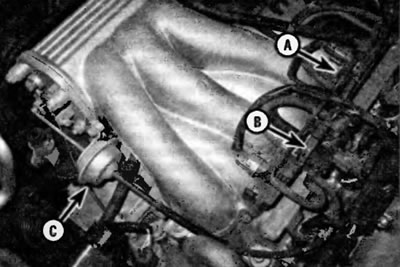
Fig. 15.12 On 1999-2003 models with the VG engine, the vacuum switching valves (VSV) for the variable geometry air intake system (ACISI) are located on this support bracket on the front side of the intake manifold
A - VSV valve for actuator on throttle body
B — VSV valve for actuator on intake manifold
C — Intake manifold actuator (the throttle body actuator, which is located on the bottom of the throttle body, is not visible in this photo)
13. Disconnect the VSV valve electrical connector (fig. 15.13).
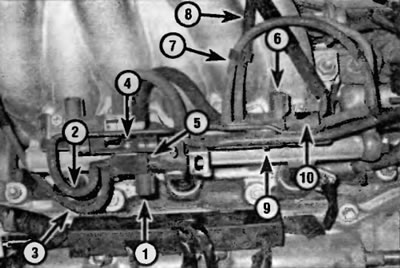
Fig. 15.13. Details of removal and installation of the vacuum switching valve (VSV):
1 - Disconnect the VSV valve electrical connector for the intake manifold actuator
2 - Disconnect the vacuum supply hose (from the intake manifold)
3 - Disconnect the vacuum signal hose (to the intake manifold actuator)
4 - Remove the VSV valve mounting screw
5 - Remove the VSV valve from the support bracket
6 - Disconnect the VSV electrical connector for the throttle body actuator
7 - Disconnect the vacuum supply hose (from the intake manifold)
8 - Disconnect the vacuum signal hose (to the actuator of the throttle body)
9 - Remove the VSV mounting screw
10 - Remove the VSV valve from the support bracket
14. Clearly label the vacuum hoses and then disconnect them from the VSV valve.
15. Remove the VSV valve mounting screw and remove the valve.
16. Installation is performed in the reverse order of removal.
Air intake control valve actuators
Intake manifold actuator
Note: The intake manifold actuator is located on the right end of the intake manifold. The device shown is for 1999-2003 models. Models from 2004 onwards use a similar device.
17. Remove the engine cover (see paragraph "Intake manifold - removal and installation" in Chapter 2B).
18. Disconnect the vacuum hose from the actuator (Fig. 15.18).
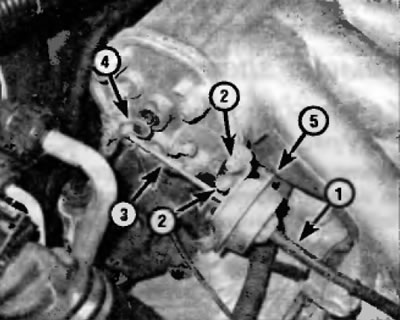
Fig. 15.18. Removing and installing the intake manifold actuator
1 - Vacuum supply hose (from VSV)
2 - Mounting bolts
3 — Actuator rod
4 — Actuator lever
5 — Executive device
19. Release the E-clip (fig. 15.19), which secures the actuator rod to the actuator lever, and then disconnect the rod from the lever.
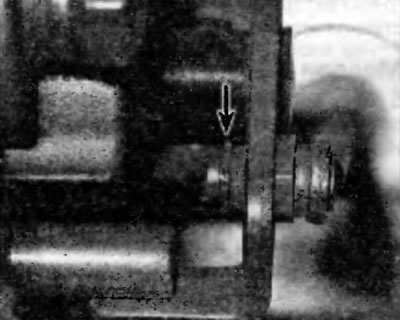
Fig. 15.19. To disconnect the intake manifold actuator rod from the actuator lever, remove the E-clamp using a small screwdriver
20. Unscrew the corresponding bolts and remove the actuator.
21. Installation is performed in the reverse order of removal.
Throttle body actuating device
Application. The actuating device of the throttle body is located on the lower side of the throttle body. This actuator is only used on the 1999-2003 models. This actuating device is not used on models from 2004 and later with an electronic throttle.
22. Remove the throttle body (see chapter 4).
23. Remove the actuator mounting screws (fig. 15.23) and remove the actuator from the throttle body.
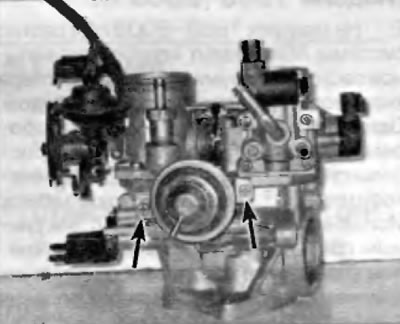
Fig. 15.23. To disconnect the air intake control valve actuator from the throttle body, remove the two bolts
24. Installation is performed in the reverse order of removal.