



- Check the condition of the battery terminal contacts.
- Check the condition of the battery wiring (see paragraph 4). Replace defective wires with new ones.
- Check the battery status (see paragraph 3). Replace the defective battery with a new one.
- Check the starter solenoid wiring. Electrical diagrams are given in chapter 12.
- Check the starter mounting bolts.
- Check the fuses (if any) in the engine compartment fuse/relay box (see chapter 12). If there are any burnt-out ones, determine the cause and restore the circuit.
- Check the ignition switch circuit.
- Check the circuit of the contact sensor of the automatic transmission selector lever position (on the corresponding models) or clutch pedal position sensor (models with manual transmission). Make sure the clutch pedal was depressed or the automatic transmission selector lever was in the Park or Neutral position when the starter was engaged. The procedure for adjusting the selector lever sensor is described in chapter 7B. Electrical diagrams are provided at the end chapter 12. For the starter to engage, voltage must be supplied to the solenoid relay.
- Check the serviceability of the starter power relay. This relay is located in the underhood fuse and relay box. The relay testing procedure is described in chapter 12.
2. If the starter does not work when the ignition key is turned to the START position, make sure that voltage is still supplied to the starter solenoid relay. Connect a test lamp or voltmeter to the S terminal of the solenoid relay coil power supply (smaller diameter wire) and have an assistant turn the ignition key to the START position. If there is no voltage, check the power supply circuit of the solenoid coil using the diagrams provided in chapter 12, and also check all the fuses and relays of the starting system one by one. If there is voltage, but the starter does not turn the crankshaft, remove the starter (see paragraph 15) and check it on the workbench (see point 5).
[The original is published on the website: www.toyotaman.ru]
3. If the starter turns the crankshaft sluggishly, check the starter cranking voltage and current. To do this, do not remove the starter from the engine. Crank the engine with the starter for no more than 10 seconds and monitor the battery voltage.
On models with a manual transmission, the voltage should not drop below 8.0 volts; on models with an automatic transmission, it should not drop below 8.5 volts. Measure the starter motor current with an ammeter (see Figure 14.3).
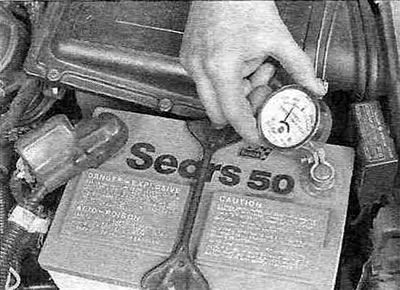
Figure 14.3. To measure current with an inductive ammeter, place it near any terminal of the battery (where it is more convenient).
The starter current consumption during cold cranking should not exceed 400 amperes (and should not be less than 250 amperes).
Warning. At this current, the starter power wire may become noticeably hot; it must cool down completely before continuing the test.
4. If the starter cranking current does not fall within the specified tolerances, the starter must be replaced. Check the battery condition carefully (it may no longer be able to provide starting currents) — terminal contacts must be free from corrosion and securely fastened. At very low temperatures, such checks should only be carried out if the engine block and starter are warm.
5. If the starter solenoid makes a loud click when you turn the ignition key, but the starter does not turn at all, remove and inspect the unit on a work bench. In most cases, the solenoid relay is to blame for the malfunction. In the rarest cases, the cause may be a seized engine - to confirm these suspicions, try to turn the engine crankshaft (see chapter 2A, 2B or 2B). Clamp the starter in a vice, connect the negative battery terminal to its housing, connecting them with a "cigarette lighter" wire. Using a second wire, connect the positive battery terminal to the B+ terminal of the starter. Connect (no more than 10 seconds) jumper terminals B+ and S on the pull-in relay. The relay should click, retract the plunger, push the overrunning clutch ("bendix") out of the starter housing, and the starter shaft should begin to rotate quickly. If the clutch pops out of the starter, but the shaft remains motionless, either the power contacts of the solenoid relay or the starter motor itself are faulty. If the relay does not make any clicks, its winding has burned out.