
Company Honda Company Ford Company Skoda Company Kia Company Mazda Company Mercedes Company Renault
English Русский
Български
Беларускі
Український
Српски
Hrvatski
Română
Polski
Slovenský
Magyar
Bookmark Articles Sitemap Contacts
ToyotaMan.ru


Camry Corolla Corona Carina Land Cruiser Highlander 4Runner RAV4 Others
Duet (1998-2004) Dyna Y50/Y60 (1984-1995)

Safety precautions when working with refrigerant [Toyota Duet M100]

  • Main
  • Toyota
  • Duet (1998-2004)
  • Body and interior
  • Heating and air conditioning
  • Safety precautions when working with refrigerant
0
Observe safety precautions when working with refrigerant.

1. Do not work with refrigerant in a closed room or near an open flame.

2. Always wear safety glasses.

3. Avoid contact with refrigerant in the eyes or on the skin.

In case of defeat:
  • a) Do not rub the burnt area.
  • b) Wash the burned area with plenty of cold water and lubricate the skin with Vaseline.
  • c) Do not try to treat yourself, seek medical attention immediately.

4. Before removing or checking electrical components, turn the ignition switch to the "LOCK" position and disconnect the negative battery cable.

5. Do not heat or burn refrigerant cylinders.

6. Do not drop cylinders or subject them to impacts.

7. Do not operate the compressor without sufficient refrigerant. Insufficient refrigerant will result in insufficient lubrication of the compressor, which may result in compressor failure.

8. Do not open the high pressure valve on the gauge block while the compressor is running. Opening the high pressure valve will change the direction of the refrigerant flow, which will cause the cylinder to break.

9. Do not overcharge the system. Excess refrigerant leads to insufficient cooling, excessive fuel consumption and engine overheating.

10. Use only R134a refrigerant. The large differences in the properties of R12 and R134a refrigerants require different air conditioning systems for each type of refrigerant.

Never mix R12 and R134a refrigerants, even in small quantities, as this will cause serious damage to the air conditioning system.

11. Use compressor oil that is suitable for the refrigerant used.


Caution: Mixing oils intended for different air conditioning systems will result in compressor failure.


Toyota recommends ND-OIL 8 for systems using R134a refrigerant.

12. Use seals and rings only for the type of refrigerant used.

13. Be careful when tightening connections.

a) Apply a small amount of compressor oil to the rubber seals of the fittings to facilitate tightening and prevent refrigerant leaks.

[See the source on the internet resource: ToyotaMan.ru]

b) When tightening the nuts, use two wrenches to prevent the pipe from twisting.

c) Tighten only to the specified torque.
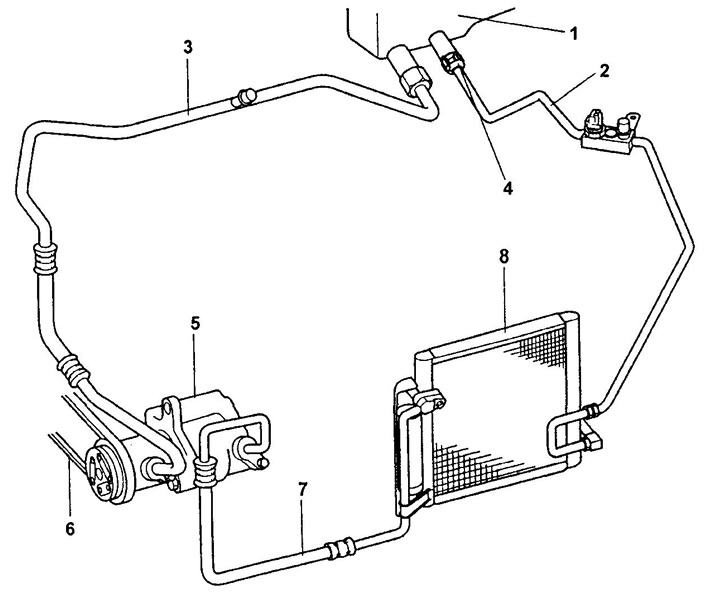


Location of air conditioning, heating and ventilation system components.
1 - air conditioning unit,
2 - high pressure tube,
3 - low pressure hose,
4 - retainer,
5 - compressor,
6 - drive belt,
7 - high pressure hose,
8 - capacitor.


14. Immediately install plugs on open ends of hoses and fittings to prevent ingress of moisture and dust.

15. Remove plugs immediately before connecting parts.
This article is available at: russian, bulgarian, belarusian, ukrainian, serbian, croatian, romanian, polish, slovak, hungarian
The article material has been checked: Kolokoltsev Grigory
Share information:
◀ Previous
Duet: Heating and air conditioning
Next ▶

 
Vacuuming, charging and checking the system
Charging the system
Cooling lines
Removal the clamp from the tube
Air conditioning and heating control panel
Similar articles on other Toyota models

➥ Safety precautions when working with refrigerant Toyota Carina T190 (1992-1996)
➥ Safety precautions when working with automatic transmissions Toyota Camry XV30 (2001-2006)
➥ Safety precautions when working with the ignition system Toyota Corolla E80 (1983-1990)
➥ Precautions when working with the air supply system Toyota Corona T190 (1992-1997)
➥ Precautions when working with oils Toyota Cruiser 70 (1985-1996, diesel)
➥ Methods and safety precautions for engine dismantling Toyota 4Runner N120 (1989-1995)
Link in different formats to this article
Comments and feedback from visitors
No comments yet


Add two numbers 46 + 20


Duet (1998-2004) 
  • General information
  • User manual
  • Maintenance
  • Power unit
  • Petrol engines 1.0 l
  • Petrol engines 1.3 l
  • Engine overhaul
  • Cooling system
  • Lubrication system
  • Fuel injection system
  • Starting and charging system
  • Transmission
  • Clutch
  • Mechanical gearbox
  • Automatic gearbox
  • Drive shafts and cardan
  • Chassis, running gear
  • Car suspension
  • Steering
  • Brake system
  • Body and interior
  • Body elements
  • Heating and air conditioning
  • SRS security system
  • Electrical equipment
  • Equipment and devices
  • Electrical circuits
Dyna Y50/Y60 (1984-1995) 
  • Petrol engines «Y»
  • Checks and adjustments
  • Overhaul engine
  • Cooling and lubrication system
  • Fuel system
  • Starting and charging system
  • Ignition system
  • Diesel engines «L»
  • Engine repair
  • Cooling and lubrication system
  • Fuel system
  • Starting and charging system
  • Transmission
  • Clutch
  • Manual gearbox
  • Cardan shaft
  • Chassis, running gear
  • Car suspension
  • Brake system
  • Steering
  • Electrical equipment and body
  • Body elements
  • Equipment and devices
  • Electrical diagrams
ToyotaMan.ru © 2018–2026 • Mobile version • Interesting about Toyota • Administration • Sitemap: EN BG BY UA RS HR RO PL SK HU • Search system • Bookmark
Camry Vista-V40 • Camry XV10 • Camry XV20 • Camry XV30 • Corolla Verso-AR10 • Corolla E80 • Corona T190 • Carina T170 • Carina T190 • Land Cruiser J70 (diesel) • Land Cruiser J60 (petrol) • Land Cruiser J100 • Highlander XU20 (petrol) • 4Runner N120 • RAV4 XA10 • RAV4 XA20 • Duet M100 • Dyna Y50 •
We require cookies to enable some interactive features. Is that ok with you?