
Company Honda Company Ford Company Skoda Company Kia Company Mazda Company Mercedes Company Renault
English Русский
Български
Беларускі
Український
Српски
Hrvatski
Română
Polski
Slovenský
Magyar
Bookmark Articles Sitemap Contacts
ToyotaMan.ru


Camry Corolla Corona Carina Land Cruiser Highlander 4Runner RAV4 Others
Camry XV30 (2001-2006) Camry XV20 (1996-2001) Camry XV10 (1991-1996) Camry Vista V40 (1994-1998)

Battery Charging System — Description and Testing [Toyota Camry XV20]

  • Main
  • Camry
  • XV20 (1996-2001)
  • Power unit
  • Engine electrical equipment
  • Battery Charging System — Description and Testing
0
The charging system consists of an alternator, a voltage regulator built into the generator, a charge control circuit, a battery, a fuse link and connecting wires. When these devices operate together, power is supplied to such consumers as the ignition system, lighting and signaling devices, a radio receiver, etc. The generator is driven by a belt in the front part of the engine.

The voltage regulator is designed to maintain the generator voltage at a given level. When the voltage at the generator output increases sharply, the regulator prevents current surges and overloads in the power supply circuit.

Periodic maintenance of the charging system is generally not required. However, the alternator drive belt, battery and connecting cables should be inspected periodically.

The charge indicator lamp on the instrument panel lights up when the ignition is turned on and goes out after the engine starts. If the lamp does not go out after the engine starts, then the charging circuit is faulty. Some cars are equipped with a voltmeter. If the voltmeter shows very high or very low voltage, then the charging circuit needs to be checked.

Caution: Always observe the correct polarity when connecting the battery to the generator.


Attention! Before repairing any part of the car with electric welding, disconnect the wires from the generator and battery.


Warning! Do not start the engine when the charger is connected.


Warning! The generator is connected directly to the battery, so if the generator terminals are shorted or if it is overloaded, an arc may form and cause a fire.


Examination


If the battery charging circuit is faulty, perform the following checks before concluding that the generator is faulty.

1. Check the battery condition, the condition and reliability of the wires and connectors.

2. Check the condition and tension of the alternator belt. If signs of wear are detected, replace the belt.

3. Check the generator bolts for tightness.

4. Start the engine and check the sound made by the generator.

5. Check the fuse links, if you find burnt fuse links, find out the cause and fix it.

6. Check the battery voltage with the engine off, it should be around 12.5V.
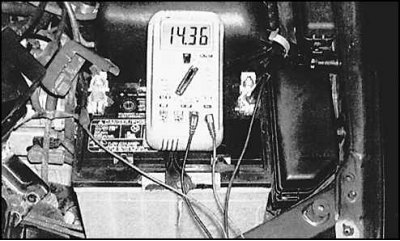


7. Connect the ammeter and voltmeter, start the engine and check the voltage, which should be from 13.5 to 15 V at a current of no more than 10 A.

8. Turn on the high beam headlights, air conditioning and heater. When the charging system is operating normally, the voltage should be at least 13.5 V at a current of about 30 A.

9. If the voltage is higher than 15 V, replace the voltage regulator.
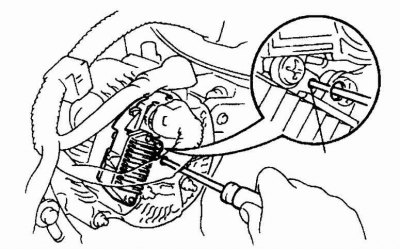


10. If the voltage is below normal, connect terminal F to ground and start the engine.

11. If the voltage is normal, replace the voltage regulator. If the voltage is still low, the alternator is faulty.
This article is available at: russian, bulgarian, belarusian, ukrainian, serbian, croatian, romanian, polish, slovak, hungarian
The article material has been checked: Kolokoltsev Grigory
Share information:
◀ Previous
Camry XV20: Engine electrical equipment
Next ▶

Electronic ignition unit — check
Checking the ignition timing
Ignition coils — replacement
Ignition system — description and testing
Power Cables — Checking and Replacing
Generator — removal and installation
Voltage Regulator and Brushes — Replacement
Engine starting system — design description
Starter motor — removal and installation
Starter Solenoid Relay — Removal and Installation
Similar articles on other Toyota models

➥ Battery Charging System — Design Description Toyota Cruiser 60/80 (1980-1997, petrol)
➥ Battery Charging System — Design Description Toyota 4Runner N120 (1989-1995)
➥ Charging system — design description Toyota Corolla Verso 3 (2004-2009)
➥ Operating principle and precautions of the charging system Toyota Corona T190 (1992-1997)
➥ Precautions when working with the charging system Toyota Carina T190 (1992-1996)
➥ Battery charging (every 8000 km or 6 months) Toyota Highlander 1 (2000-2007, petrol)
Link in different formats to this article
Comments and feedback from visitors
No comments yet


Add two numbers 10 + 45


Camry XV30 (2001-2006) 
  • User manual
  • Vehicle description
  • Keys, locks and alarms
  • Governing bodies
  • Salon equipment
  • Driving and operation
  • Maintenance
  • Power unit
  • 4-cylinder engine
  • Control system (I4)
  • Engine overhaul (I4)
  • 6-cylinder engine
  • Control system (V6)
  • Engine overhaul (V6)
  • Transmission
  • Clutch
  • Mechanical gearbox
  • Automatic gearbox
  • Drive mechanism
  • Chassis, running gear
  • Wheels and tires
  • Car suspension
  • Steering
  • Brake system
  • Body and interior
  • Exterior (external elements)
  • Doors, locks and windows
  • Air conditioning and heater
  • Electrical equipment
  • Equipment and devices
  • Power devices
  • Electrical circuits
Camry XV20 (1996-2001) 
  • General information
  • Controls and instruments
  • Driving and operation
  • Daily care
  • Maintenance
  • Power unit
  • 4-cylinder engine
  • 6-cylinder engine
  • Engine overhaul
  • Engine electrical equipment
  • Cooling system
  • Heating and ventilation
  • Fuel system
  • Exhaust system
  • Transmission
  • Mechanical gearbox
  • Automatic gearbox
  • Clutch
  • Chassis, running gear
  • Suspension and axle shafts
  • Steering
  • Brake system
  • Body and interior
  • Exterior (external elements)
  • Interior (internal elements)
  • Doors, locks and windows
  • Electrical equipment
  • Equipment and devices
  • Electrical circuits
Camry XV10 (1991-1996) 
  • General information
  • User manual
  • Maintenance
  • Power unit
  • 4-cylinder engine
  • 6-cylinder engine
  • Overhaul of engines
  • Cooling and heating
  • Fuel system
  • Engine electrical equipment
  • Control system
  • Transmission
  • Mechanical gearbox
  • Automatic gearbox
  • Clutch and drive shafts
  • Chassis, running gear
  • Brake system
  • Car suspension
  • Steering
  • Body and interior
  • Exterior (external elements)
  • Interior (internal elements)
  • Doors, locks and windows
  • Electrical equipment
  • Equipment and devices
  • Headlights and lighting
  • Electrical circuits
Camry Vista V40 (1994-1998) 
  • General information
  • User manual
  • Maintenance
  • Power unit
  • Petrol engines
  • Diesel engines
  • Engine overhaul
  • Cooling and lubrication system
  • Fuel system (diesel)
  • Fuel injection (petrol)
  • Engine electrical equipment
  • Transmission
  • Clutch and cardan
  • Automatic gearbox
  • Chassis, running gear
  • Front suspension
  • Rear suspension
  • Steering
  • Brake system
  • Body and interior
  • Body elements
  • Air conditioning and heater
  • SRS security system
  • Electrical equipment
  • Equipment and devices
  • Electrical circuits
ToyotaMan.ru © 2018–2026 • Mobile version • Interesting about Toyota • Administration • Sitemap: EN BG BY UA RS HR RO PL SK HU • Search system • Bookmark
Camry Vista-V40 • Camry XV10 • Camry XV20 • Camry XV30 • Corolla Verso-AR10 • Corolla E80 • Corona T190 • Carina T170 • Carina T190 • Land Cruiser J70 (diesel) • Land Cruiser J60 (petrol) • Land Cruiser J100 • Highlander XU20 (petrol) • 4Runner N120 • RAV4 XA10 • RAV4 XA20 • Duet M100 • Dyna Y50 •
We require cookies to enable some interactive features. Is that ok with you?