Company Honda Company Ford Company Skoda Company Kia Company Mazda Company Mercedes Company Renault
English Русский
Български
Беларускі
Український
Српски
Hrvatski
Română
Polski
Slovenský
Magyar
Bookmark Articles Sitemap Contacts
ToyotaMan.ru


Camry Corolla Corona Carina Land Cruiser Highlander 4Runner RAV4 Others
Corona T190 (1992-1997)

Turbocharging system — general description [Toyota Corona T190]

  • Main
  • Corona
  • T190 (1992-1997)
  • Power unit
  • Turbo diesel
  • Turbocharging system — general description
0
Contents: Turbocharger operation ↓ Gas bypass valve past the turbine ↓ Warnings ↓
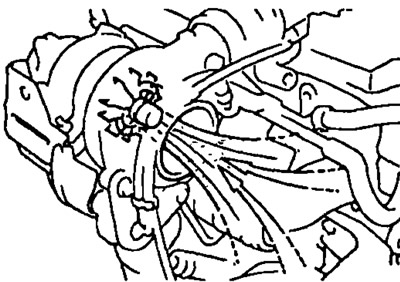
In order to boost the engine to increase the amount of air entering the engine, and therefore fuel, one or another type of supercharging is used. On 2C-T engines, a turbocharger is installed that uses the energy of the exhaust gases to force air into the cylinders.

Turbocharger operation


The exhaust gases, which are still quite hot, are fed to the turbine wheel, causing the wheel to rotate. When the turbine rotates, the gases expand and transmit excess power to the unit shaft, which is spent on compressing the air in the compressor, located on a common shaft with the turbine. The rotation frequency of the turbocharger shaft varies in the range of 20,000-115,000 rpm, which is accompanied by a characteristic "whistle" of the turbine.

Gas bypass valve past the turbine


If the pressure of the air supplied by the compressor exceeds the permissible value (lo engine reliability conditions), the exhaust gases are bypassed by the turbine by a special valve with an independent drive. The drive is a diaphragm driven by the pressure of the supercharged air. In this way, the boost pressure is regulated with feedback.

Warnings


1. Do not turn off the engine immediately after the end of the trip. Let the engine idle for 20-120 seconds to cool the turbine. This will significantly extend the service life of the turbocharger. (If possible, install a turbo timer).

2. Avoid prolonged engine operation at high speeds and sudden acceleration when the engine is not warmed up.


3. If the turbocharger fails prematurely, check:
  • Engine oil level and quality.
  • Turbocharger operating conditions.
  • Turbocharger oil supply lines

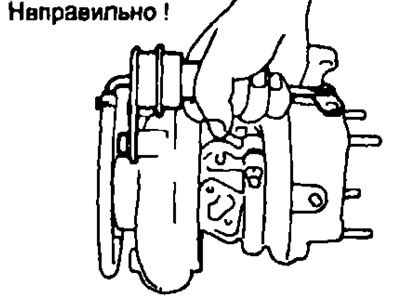
4. Take care when removing and installing the turbocharger. Do not carry the unit by the bypass valve drive rod.


5. After removing the turbocharger, close the inlet and outlet pipes and oil holes with plastic plugs.

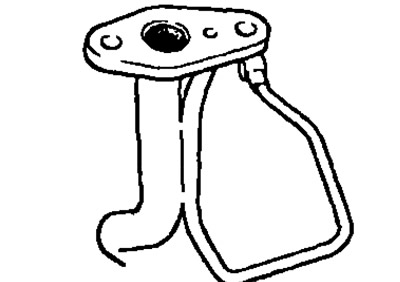
6. Before installing the turbocharger, flush the oil supply pipe

7. Before installation, clean the mating surfaces of the turbocharger and oil pipes.


8. When replacing fasteners, install only original products.

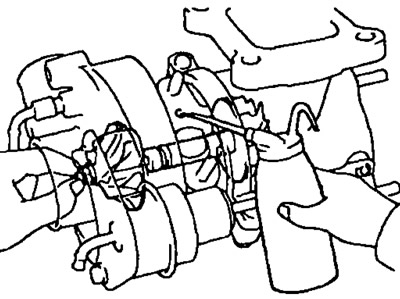
9. After installing the compressor, pour 20 cm³ of engine oil into the bearing housing and turn the compressor shaft by hand.


[The article is taken from a web resource: www.ToyotaMAN.ru]


10. After replacing the compressor, crank the engine with the starter for 20-30 seconds (without starting the engine) to fill the lubrication system or run the engine at idle speed for at least one minute.

11. Do not operate the engine with the air filter removed. Otherwise, the compressor wheel will fail very quickly.
This article is available at: russian, bulgarian, belarusian, ukrainian, serbian, croatian, romanian, polish, slovak, hungarian
The article material has been checked: Kondratyeva Ulyana
Share information:
◀ Previous
Corona T190: Turbo diesel
Next ▶

 
Checking the turbocharger on a car
Removal the turbocharger
Checking the turbocharger
Checking the turbocharger actuator
Installing a turbocharger
Similar articles on other Toyota models

➥ Cooling system — general information Toyota Camry XV30 (2001-2006)
➥ General description of the ignition system Toyota Corolla E80 (1983-1990)
➥ Fuel injection system — general information Toyota Carina T190 (1992-1996)
➥ General information about the toxicity reduction system Toyota Cruiser 60/80 (1980-1997, petrol)
➥ General information about the cooling and heating system Toyota Highlander 1 (2000-2007, petrol)
➥ General information about the ignition system Toyota 4Runner N120 (1989-1995)
Link in different formats to this article
Comments and feedback from visitors
No comments yet


Add two numbers 40 + 24


Corona T190 (1992-1997) 
  • General information
  • User manual
  • Maintenance
  • Power unit
  • Engines 3S-FE/GE and 4S-FE
  • Engines 4A-FE and 7A-FE
  • Engines 5E-FE
  • Diesel engines 2C and 2C-T
  • Engine overhaul
  • Cooling system
  • Lubrication system
  • Fuel injection (petrol)
  • Control system (petrol)
  • Fuel system (diesel)
  • Turbo diesel
  • Ignition system
  • Engine electrical equipment
  • Transmission
  • Clutch
  • Mechanical gearbox
  • Automatic gearbox
  • Drive shafts and cardan
  • Chassis, running gear
  • Front suspension
  • Rear suspension
  • Steering
  • Brake system
  • Body and interior
  • Body and interior elements
  • Doors, windows and locks
  • Heating and air conditioning
  • Electrical equipment
  • Equipment and devices
  • Lighting and signaling
  • Electrical circuits
ToyotaMan.ru © 2018–2026 • Mobile version • Interesting about Toyota • Administration • Sitemap: EN BG BY UA RS HR RO PL SK HU • Search system • Bookmark
Camry Vista-V40 • Camry XV10 • Camry XV20 • Camry XV30 • Corolla Verso-AR10 • Corolla E80 • Corona T190 • Carina T170 • Carina T190 • Land Cruiser J70 (diesel) • Land Cruiser J60 (petrol) • Land Cruiser J100 • Highlander XU20 (petrol) • 4Runner N120 • RAV4 XA10 • RAV4 XA20 • Duet M100 • Dyna Y50 •
We require cookies to enable some interactive features. Is that ok with you?