
Company Honda Company Ford Company Skoda Company Kia Company Mazda Company Mercedes Company Renault
English Русский
Български
Беларускі
Український
Српски
Hrvatski
Română
Polski
Slovenský
Magyar
Bookmark Articles Sitemap Contacts
ToyotaMan.ru


Camry Corolla Corona Carina Land Cruiser Highlander 4Runner RAV4 Others
Highlander 1 (2000-2007, petrol)

Wheel alignment angles — general information [Toyota Highlander XU20]

  • Main
  • Highlander
  • XU20 (2000-2007)
  • Chassis, running gear
  • Steering
  • Wheel alignment angles — general information
0
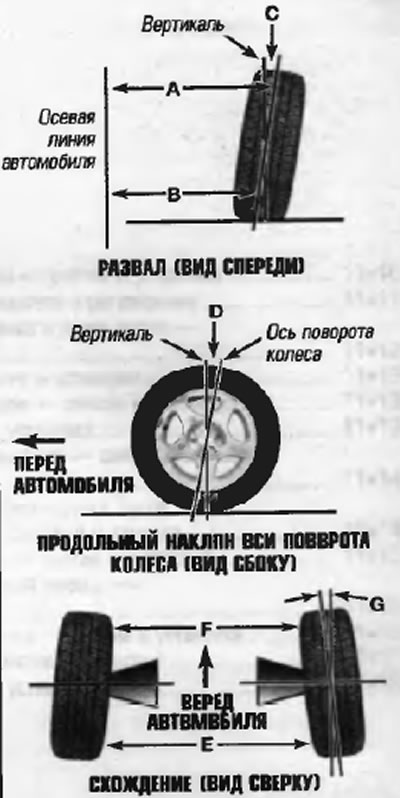
Wheel alignment angles determine the geometry of the wheels relative to the vehicle suspension and the road surface. Improper adjustment leads to reduced vehicle control and accelerated tire wear. Wheel alignment angles subject to control include camber, longitudinal tilt angle of the wheel steering axis, and toe-in (Fig. 25.1).


Fig. 25.1. Angles of camber, longitudinal tilt of the wheel turning axis and toe-in
A minus B = C (camber in degrees)
D = longitudinal inclination of the axis of rotation of the ear (expressed in degrees)
E minus F = toe-in (measured in millimeters)
G = toe-in (expressed in degrees)


Wheel alignment is a very precise procedure, which requires special, rather bulky and expensive equipment to perform properly. Therefore, it is recommended to entrust this work to mechanics at properly equipped service stations. Below, for general understanding, are definitions of each of the car's wheel alignment angles, knowledge of which will facilitate communication between the car owner and the service station personnel.

Toe-in is the amount of convergence of the front edges of the wheels. The purpose of toe-in is to ensure that the wheels swing correctly. At zero toe-in, the distance between the front edges of the wheels is equal to the distance between their rear edges. In fact, toe-in is only a few millimeters. Adjusting the toe-in of the front wheels is done by adjusting the effective length of the steering rods (by changing the position of the tips on the steering rods). Rear wheel alignment is adjusted either using threaded adjusters on the rear wishbones or using cams on the inner ends of the wishbones (depending on the modal year). Improper alignment will result in accelerated wear or improper wear of the tire treads due to them slipping on the road surface.


Camber is the angle of the plane of the wheels relative to the vertical, when viewed from the front or rear of the car. If the upper edges of the wheels are tilted outward, the camber is called positive, if inward - negative. The camber angle is measured in degrees. Correct camber adjustment determines the size and position of the contact patch of the treads with the road surface and allows you to compensate for changes in the geometry of the suspension when cornering and when the car is moving on an uneven road surface.

The caster angle of the steering axis is the angle of the steering axis from the vertical. If the steering axis is tilted backwards, the caster angle is called positive. If forwards, it is called negative. Too little caster angle of the steering axis causes directional instability of the front of the car, while too much caster angle of the steering axis can cause increased effort on the steering wheel.
This article is available at: russian, bulgarian, belarusian, ukrainian, serbian, croatian, romanian, polish, slovak, hungarian
The article material has been checked: Kondratyeva Ulyana
Share information:
◀ Previous
Highlander 1: Steering
Next ▶

Wheels and tires — general information
Subframe — removal and installation
Power Steering System — Air Bleed
Power Steering Pump — Removal and Installation
Steering gear — removal and installation
 
Similar articles on other Toyota models

➥ Wheel alignment angles Toyota Camry XV20 (1996-2001)
➥ Adjusting the front wheel alignment angles Toyota Corolla Verso 3 (2004-2009)
➥ Adjusting the front wheel alignment angles Toyota Corona T190 (1992-1997)
➥ Adjusting the front wheel alignment angles Toyota Carina T170 (1988-1992)
➥ Front wheel alignment angles Toyota Cruiser 60/80 (1980-1997, petrol)
➥ Front wheel alignment angles Toyota 4Runner N120 (1989-1995)
Link in different formats to this article
Comments and feedback from visitors
No comments yet


Add two numbers 14 + 15


Highlander 1 (2000-2007, petrol) 
  • General information
  • Introduction to the guide
  • Troubleshooting
  • Maintenance
  • Power unit
  • 4-cylinder engine
  • 6-cylinder engine
  • Overhaul of engines
  • Cooling and heating
  • Supply and exhaust system
  • Engine electrical equipment
  • Control system
  • Transmission
  • Automatic gearbox
  • Drive shafts and cardan
  • Chassis, running gear
  • Brake system
  • Car suspension
  • Steering
  • Body and interior
  • Exterior (external elements)
  • Interior (internal elements)
  • Doors, locks and windows
  • Electrical equipment
  • Equipment and devices
  • Electrical circuits
ToyotaMan.ru © 2018–2026 • Mobile version • Interesting about Toyota • Administration • Sitemap: EN BG BY UA RS HR RO PL SK HU • Search system • Bookmark
Camry Vista-V40 • Camry XV10 • Camry XV20 • Camry XV30 • Corolla Verso-AR10 • Corolla E80 • Corona T190 • Carina T170 • Carina T190 • Land Cruiser J70 (diesel) • Land Cruiser J60 (petrol) • Land Cruiser J100 • Highlander XU20 (petrol) • 4Runner N120 • RAV4 XA10 • RAV4 XA20 • Duet M100 • Dyna Y50 •
We require cookies to enable some interactive features. Is that ok with you?