



Removal
Proceed with removal in the following order:
- remove the oil pan;
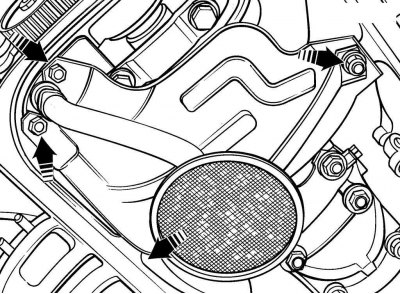
Figure 3.39. Location of bolts and nuts for fastening the oil receiver with a reflector plate and mesh filter
- unscrew 2 nuts and 2 bolts (figure 3.39) and remove the oil receiver with the reflector plate and mesh filter;
- support the engine from above and remove the idler pulley, the poly V-belt pulley from the crankshaft, the timing belt and the timing belt pulley;
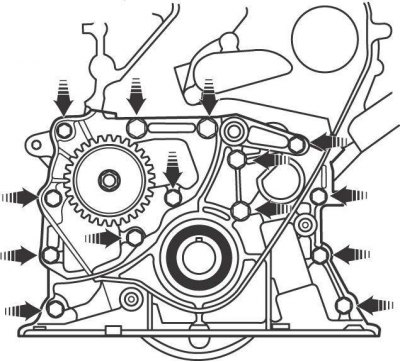
Figure 3.40. Location of bolts securing the front cover to the oil pump housing
- remove 12 bolts (figure 3.40) and remove the front cover with the oil pump housing from the cylinder block;
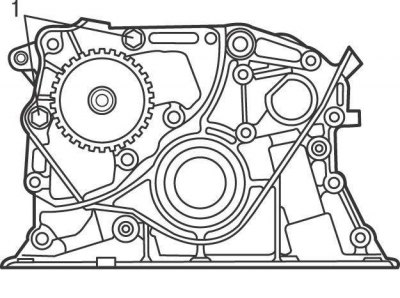
Figure 3.41. Location of bolts (1) securing the cover to the oil pump housing
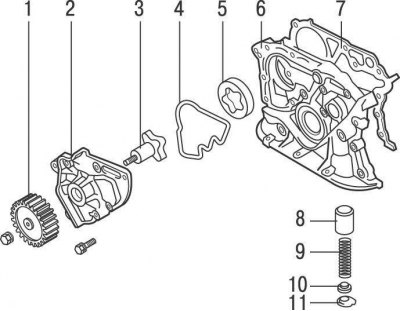
Figure 3.42. Oil pump: 1 – pulley; 2 – lid; 3 – drive gear; 4 – circular sealing gasket; 5 – driven gear; 6 – front cover with oil pump housing; 7 – gasket; 8 – piston of the pressure-reducing valve; 9 – spring; 10 – spring seat; 11 – retaining ring
- unscrew two bolts 1 (figure 3.41) and remove the cover from the oil pump housing. Remove driven gear 5 (figure 3.42) oil pump and sealing gasket 4 round section;
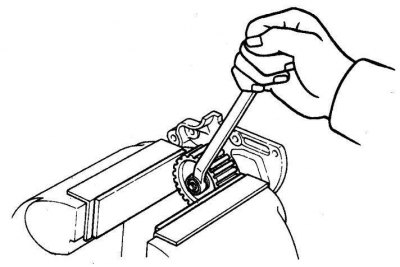
Figure 3.43. Loosening the oil pump pulley mounting nut
- secure the oil pump pulley in a vice with soft jaws and remove the pulley mounting nut (figure 3.43). Remove the oil pump shaft from the drive gear;
- use a hard plastic or wooden scraper to clean off any remaining old gasket and sealant from the mating surfaces of the oil pump housing and cover;
- remove the pressure relief valve retaining ring, spring seat, spring and piston of the pressure relief valve.
Examination
Clean all oil pump parts and inspect them for damage.
Inspect the pressure relief valve piston for wear and tear. Otherwise, replace the pressure relief valve piston and spring as a set.
Using a feeler gauge, check the clearance between the driven gear of the pump and the housing. The nominal clearance value is 0.10–0.16 mm; the maximum permissible value is 0.20 mm. If the clearance exceeds the maximum permissible value, replace the driven and driving gears of the oil pump as a set and the oil pump housing.
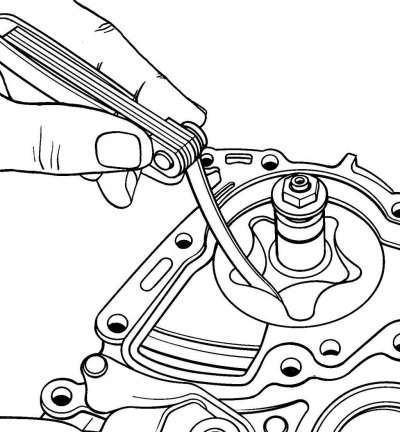
Figure 3.44. Measuring the clearance between the driven and driving gear of the oil pump
Use a feeler gauge to check the clearance between the driven and driving gears of the pump (figure 3.44). The nominal clearance value is 0.04–0.16 mm; the maximum permissible value is 0.20 mm. If the clearance exceeds the maximum permissible value, replace the driven and driving gears of the oil pump as a set.
Installation
Perform installation in the following order:
- use a screwdriver blade to remove the old sealing ring and install a new one in the oil pump cover. Lubricate the sealing lip of the sealing ring with fresh engine oil;
- replace the sealing ring in the oil pump housing in the same manner. Lubricate the sealing lip of the sealing ring with fresh engine oil;
- install a new O-ring seal into the oil pump housing;
- lubricate the driven gear of the oil pump with fresh engine oil and install it in the housing so that the mark on the gear is located on the side of the oil pump cover;
- lubricate the bearing and pinion shaft with fresh engine oil and install the shaft into the housing. Install the pulley on the shaft and secure it with a nut, tightening it to a torque of 24 N·m;
- install the oil pump cover and secure it with two 16 mm long bolts, tightening them to a torque of 9 N·m;
- lubricate the relief valve piston with fresh engine oil and install all valve parts into the oil pump housing;
- check that the guide bushings are installed in the cylinder block.
- install the gasket on the guide bushings;
- install the oil pump housing and secure with bolts, tightening them in several passes to a torque of 9 N·m;
- install the oil receiver with the reflector plate and mesh filter with a new gasket or sealing ring and secure with bolts and nuts, tightening them to a torque of 5.5 N·m (see Figure 3.39).
Further installation is carried out in the reverse order of removal, taking into account the following.
Fill the engine with motor oil.
Start the engine and check the oil pressure and for leaks.
Check the engine oil level.