



Typical types of wear of V-belts
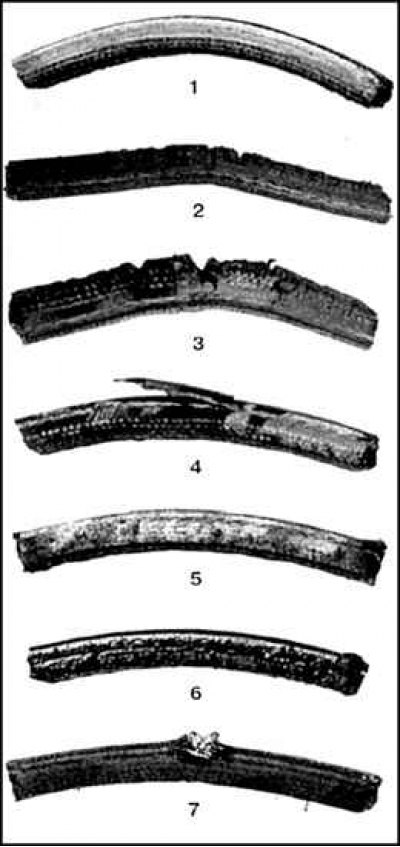 | 1. Strip wear of the side surface
2. Charring 3. Cracks 4. Stratification 5. Glossiness 6. Oiling 7. Tear |
Typical types of wear of belts with a corrugated profile
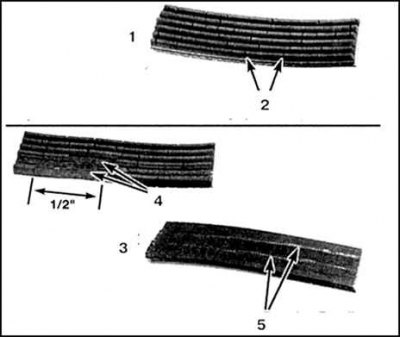 | 1. Acceptable
2. Cracks 3. Unacceptable 4. Loss of 2 or more ribs 5. Parallel cracks |
Examination
1. The number of drive belts depends on the vehicle configuration. The belts have a V-shaped cross-section and are used to drive the generator, power steering, coolant pump and air conditioner. One belt is usually used to drive several units.
2. Open the hood and check the condition of the belts with your fingers on both sides, twisting the belts (see fig. Typical types of wear of V-belts).
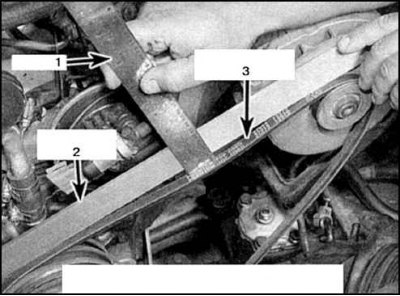
3. Check the belt tension by the deflection in the middle between the pulleys. If the distance between the pulley centers is 180–300 mm, the deflection should be 6.5 mm, and if the distance between the centers is 300–400 mm, the deflection should be 13 mm (1 – ruler, 2 – block, 3 – deflection) for V-belts and 6.5 mm for belts with a corrugated profile (see fig. Typical types of wear of belts with a corrugated profile).
Adjustment
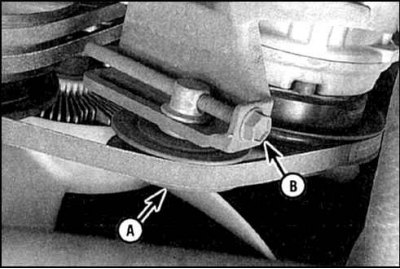
1. The belt is adjusted with two bolts - adjusting (B) and axial (A), which must be loosened and the roller or pulley of the moving part must be moved. After adjustment, check the belt tension, if necessary, loosen the bolts again and adjust the tension. After completing the adjustment, tighten the bolts without applying much force.
2. On early production cars, the adjusting bolt is missing and the roller (or pulley) is moved by an auxiliary lever (with a crowbar).
Replacement
1. To replace the belt, follow the same preliminary procedures as for adjustment, then remove the belt. It is recommended to replace all belts at the same time.
2. Before removal, mark each belt and corresponding pulley.
3. When purchasing, compare the new belt with the one being replaced.
4. Adjust the belt tension.