



Examination
Inspect the drive belts along their entire length on both sides for cracks or signs of wear.
V-belt wear
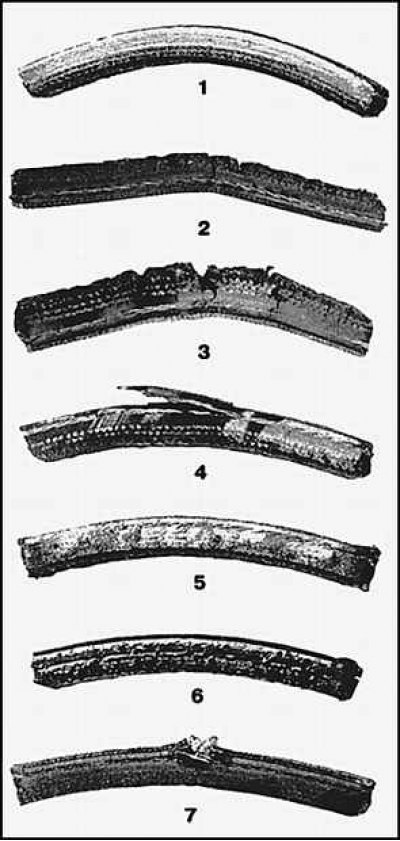
1. Wear of the side surface; 2. Severe surface abrasion; 3. Cracks; 4. Stratification; 5. Polished surface; 6. Oil contamination; 7. Break
Ribbed belt wear
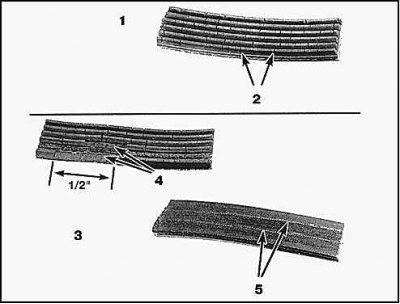
1. Permissible wear; 2. Transverse cracks on the belt ribs; 3. Unacceptable wear; 4. There are no adjacent sections of belt ribs longer than 1 cm; 5. Cracks parallel to the belt ribs
Measure the belt tension using special measuring instruments and compare the obtained data with the technical specifications. If you do not have a special instrument, check the tension by pressing on the belt in the middle between two pulleys and measuring the belt deflection. The belt should deflect by 6 mm if the distance between the pulley centers is 18-28 cm. The belt should deflect by 12 mm if the distance between the pulley centers is 30-40 cm.
Measuring Belt Deflection with a Ruler
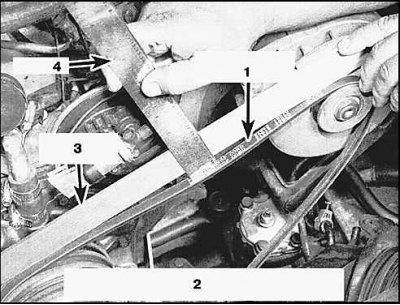
1. Belt deflection; 2. Check that the ruler is perpendicular to the rail; 3. Rail; 4. Ruler
Tension adjustment
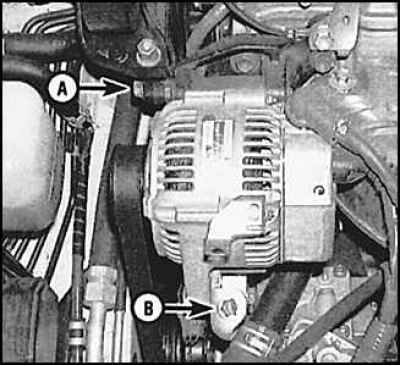
1. To adjust the tension of the drive alternator and compressor, loosen the alternator pivot bolt (A) at the left front corner of the cylinder block. Loosen the lock bolt and turn the adjusting bolt (B) clockwise to tighten the belt or counterclockwise to loosen it. Measure the belt tension. Readjust if necessary.
2. To adjust the tension of the power steering pump drive belt, loosen the adjusting bolt and turn the pump toward the engine or vice versa to loosen or tighten the belt tension, respectively.
Replacement
Loosen the drive belt tension and remove it from the pulleys. If one belt requires replacement, it is recommended that the other belts be replaced as well.